AI Actors in Commercials: Rights, Rules and What Is Allowed
A synthetic presenter can demonstrate a product, explain it and appear in a commercial, provided the ad is disclosed as AI-generated where required. In 2026 that requirement comes from four places: India’s amended IT Rules since 20 February, Meta since March, Google Ads since 9 July, and EU AI Act Article 50 since 2 August. What a synthetic presenter cannot do is claim to be a real customer describing a real experience, or resemble a real identifiable person without that person’s permission. Likeness is the one where disclosure does not save you.
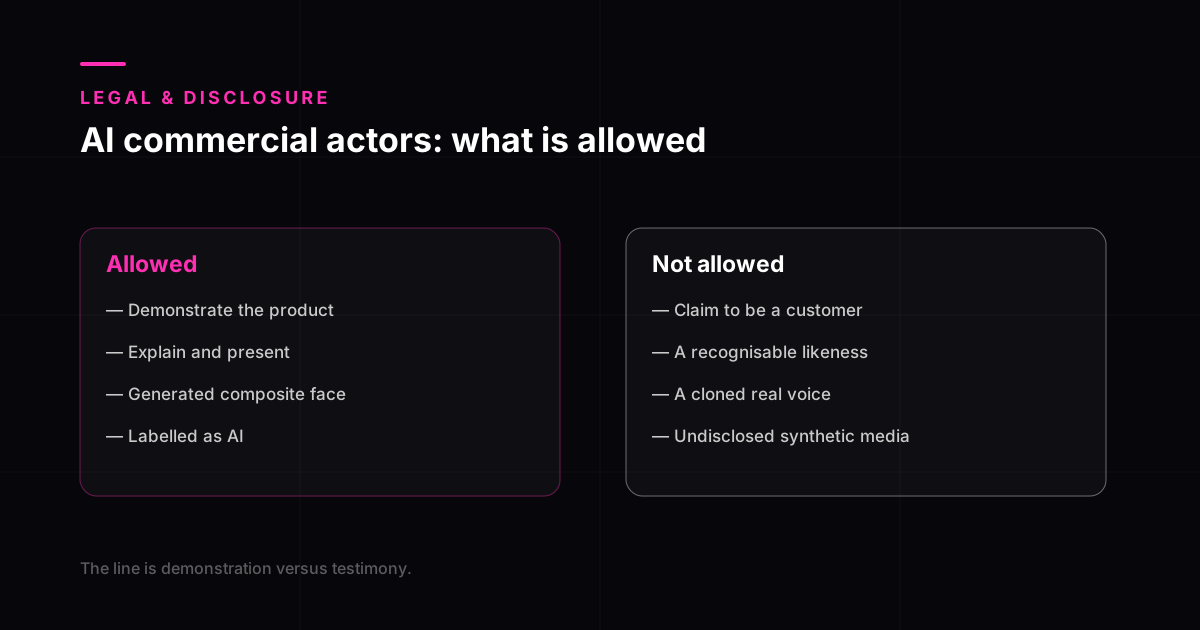
AI commercial actors: the three questions that actually matter
- Is the ad disclosed? Four separate regimes now ask for this, and they arrived within six months of each other. See Meta's own AI content labelling policy for where the label lands.
- Is it claiming something false? The FTC's rule on fake reviews and testimonials prohibits a testimonial from a person who does not exist, whoever or whatever produced it.
- Does it resemble a real person? Generating a likeness of an identifiable individual without permission is a separate and more serious problem.
Get those three right and the rest is straightforward. Get the third wrong and no amount of disclosure helps.
What changed in 2026
This post previously described a landscape of platform policy. That is no longer the whole picture. Between February and August 2026 the obligation moved from being something Meta asked of you to something the law asks of you, in two large markets at once.
| Regime | Applies from | Relevance to a synthetic presenter |
|---|---|---|
| India, amended IT Rules | 20 February 2026 | You declare synthetic content at upload; the platform labels it |
| Meta advertiser disclosure | March 2026 | Generating a person triggers it. A strike follows a rejection |
| Google Ads disclosure | 9 July 2026 | Manual labelling required for third-party generated assets |
| EU AI Act, Article 50 | 2 August 2026 | Deepfake disclosure, with a specific three-part definition |
The EU deepfake test, which is the one that concerns faces
Article 50 of the AI Act became applicable on 2 August 2026, and the Commission adopted its final guidelines on 20 July 2026. For anyone casting a synthetic presenter, the definition is the part to understand, because it decides whether your ad is caught at all.
Content is a deepfake only where three criteria are met together. It resembles a real subject. That subject exists, or could plausibly exist. And the result appears authentic, in the sense that it could mislead someone into thinking it is real.
Where it applies, disclosure must be clear, distinguishable, and given at the latest on first exposure. Bird & Bird’s reading of the final guidelines is a useful summary of what the Commission settled on. Two practical points matter for planning. Content generated and published before 2 August 2026 does not have to be retroactively labelled, so your existing library is not suddenly non-compliant. And the obligation reaches deployers outside the EU where the output is used inside it, so an Indian brand running a deliberate European campaign is in scope.
The penalty ceiling is high enough that the regime is worth taking seriously even where the risk of enforcement against a single ad is low. The disclosure rules in full carries the figures.
The Indian position, in one paragraph
India brought AI-generated audio and video inside the IT Rules on 20 February 2026 as a category called synthetically generated information. As RNA’s analysis of the amendment sets out, platforms must apply prominent visible labels, preserve them rather than strip them, and embed provenance metadata where technically feasible, while users must declare synthetic content before it is published. For a brand running a commercial, the operative duty is that declaration. The visible label is the platform’s job, not yours.
On Google Ads there is one more step. Since 9 July 2026 its AI disclosure policy labels assets made with Google’s own generative tools automatically, and requires you to label anything made elsewhere by hand. A commercial produced in an external pipeline is exactly the case that needs the manual step.
What a synthetic presenter can do
| Allowed | Not allowed |
|---|---|
| Demonstrate how a product works | Claim "I bought this and it changed my life" |
| Explain features and benefits | Present as a verified customer review |
| Appear as a brand spokesperson | Resemble a real person without permission |
| Read a scripted brand message | Imply medical or professional credentials it lacks |
| Show a product in a scenario | Depict a result the product cannot produce |
The line is between demonstration and testimony. A presenter showing you something is fine. A fabricated person swearing it worked for them is not.
The likeness question
Ask your producer directly: was this face generated, or was it derived from a real person? Generated composite faces are the standard and are not anyone in particular. Deliberately producing a recognisable public figure, or a real customer, without written permission exposes you rather than the producer.
This applies to voice as well. Cloning a specific real voice needs that person’s consent, and the jurisdictions that were tightening rules here have now largely finished doing so. ASCI’s guidelines, finalised in September 2026, treat a recreated likeness or voice as label-triggering even where the person consented, which is a stricter position than most brands expect: consent settles the rights question, and the disclosure question remains open.
Practical disclosure
- Declare the content as synthetically generated when the platform asks at upload. Under the Indian rules this is your obligation and the visible label is theirs.
- Use the platform’s own AI-content toggle. Do not rely on a caption alone.
- On Google Ads, apply the disclosure manually for anything generated outside Google’s own tools. Nothing does it for you.
- If the campaign targets an EU audience, run the three-part deepfake test before launch and disclose at first exposure if it is met.
- Keep documentation per deliverable of what was generated and how it was disclosed.
- Where a claim is made on screen, make sure the claim is substantiable independently of who is saying it.
- Re-check the policy pages every six months. These rules are changing faster than almost anything else in advertising.
What a synthetic presenter still cannot do technically
Separate from what is permitted, there is what currently works. Two limitations shape what you should brief for, and both are consistent across the leading models in 2026.
- Holding one character consistent across many shots remains genuinely difficult. A campaign built around a recurring spokesperson appearing in twelve films is harder than twelve films with a presenter each.
- Close physical contact between people degrades quickly. Handshakes, embraces and crowd scenes are where coherence breaks first, so scenes should be built to avoid needing them.
Neither is a reason to avoid a synthetic presenter. Both are reasons to decide the shot list with the constraint in mind rather than writing a script that requires the two things the method is worst at.
Why this favours a produced approach
A tool renders whatever prompt it receives, including one that quietly creates a compliance problem. The judgement about what a presenter should and should not say is not a feature any generator offers, and it is the part that lands on your ad account rather than on the software. That judgement is what our AI commercial production is for, and whether AI UGC ads are legal covers the disclosure rules in full.
What a synthetic presenter costs, and what it saves
The commercial case is narrower than the marketing suggests. A synthetic presenter removes casting, scheduling, travel and usage-rights renewals; it does not remove direction, script or edit, and it adds a selection burden that a real performance does not have.
- Script and direction
- 30 to 40%
- Generation and take selection
- 25 to 35%
- Edit, grade, sound
- 25 to 35%
- Disclosure and documentation
- 5 to 10%
Our own split. The last row is small but non-optional, and it is the one most often missing from a cheap quote.
The renewal cost nobody quotes
The saving that compounds is not the shoot, it is the second year. A filmed presenter is typically licensed for a term and a set of channels, so continuing to run the ad means renegotiating or pulling it. A generated presenter has no such clock, which is why campaigns built to run for years favour the synthetic route even when the first-year cost is similar. What does carry an obligation is disclosure: Meta publishes its AI content labelling policy, and the label belongs on every deliverable rather than on the campaign as a whole. whether AI UGC ads are legal covers the rules, and what makes an AI commercial look premium covers the craft side.
Briefing around what a synthetic presenter does badly
The technical limits are stable enough to design around rather than discover late. Two shape almost every brief.
- Character consistency across many shots. A campaign built on one recurring spokesperson in twelve films is materially harder than twelve films with a presenter each.
- Long unbroken delivery to camera. Short beats cut together hold up; a continuous forty-second monologue is where the artefacts appear.
- Hands in close contact with the product, which is where generation still fails most visibly.
- Legible packaging text, which should be composited from real photography rather than generated.
None of those is a reason to avoid a synthetic presenter. They are reasons to decide the shot list with the constraint in mind, the same way a director works around any limitation. Where they do bite, a hybrid usually solves it: generated environment, real hands, real product photography. The disclosure obligation is unaffected either way: Meta publishes its AI content labelling policy and it applies per deliverable. What makes an AI commercial look premium covers the craft decisions that matter more than the model.
Where Indian advertisers should look
If you advertise in India, the relevant body is not the FTC. The Advertising Standards Council of India has issued guidelines for labelling AI-generated advertising content, and treats a synthetic spokesperson as something to be disclosed rather than something to be hidden. Finalised on 17 September 2026 and taking effect in December 2026, its prohibited category covers exactly the two things this article warns about: fabricated endorsements, and a real person's likeness used without consent. Read alongside the platform rules and the IT Rules amendment above, the obligations converge on the same two instructions. Label the ad, and keep the presenter demonstrating rather than testifying.
Frequently asked questions
Are AI actors legal in commercials?
Yes, with disclosure, and provided the presenter does not claim a real consumer experience or resemble an identifiable real person without permission. Four regimes now require the disclosure: India’s amended IT Rules since 20 February 2026, Meta since March 2026, Google Ads since 9 July 2026, and EU AI Act Article 50 since 2 August 2026. A synthetic presenter can demonstrate a product, explain features and act as a brand spokesperson. What it cannot do is testify. The disclosure rules for AI UGC cover the same ground in more depth.
Do I need permission to generate a face that looks like someone?
If the face is recognisable as a specific real person, yes, and this is the one area where disclosure does not rescue you. Standard generated composite faces are not anyone in particular and do not raise the issue. Deliberately producing a likeness of a public figure or of a real customer without written permission creates exposure that sits with the advertiser.
Can an AI presenter give a testimonial?
No. A testimonial is a statement about a real personal experience, and a synthetic presenter has not had one. It can say here is what this product does and here is how it works. It cannot say I used this and it worked for me. The visual grammar of UGC makes this easy to blur accidentally, which is why it is worth checking scripts specifically for first-person experience claims.
What about AI voice clones of real people?
Cloning an identifiable person’s voice requires their consent. ASCI’s final guidelines go further and treat a recreated likeness or voice as label-triggering even where the person consented, so consent settles the rights question while the disclosure question stays open. A synthetic voice that is simply a voice, not an imitation of anyone in particular and licensed for commercial use, raises none of this and is what most production uses.
Does using AI actors need to be disclosed in every market?
In practice yes, and since 2026 it is law rather than policy in the two markets that matter most here. India brought synthetic audio and video inside the IT Rules on 20 February 2026, and EU AI Act Article 50 has applied since 2 August 2026. Meta and Google requirements apply globally on top of that, and sector rules for health and finance sit above all of it. Re-check the policy pages every six months.
What counts as a deepfake under the EU AI Act?
Three criteria have to be met together: the content resembles a real subject, that subject exists or could plausibly exist, and the result appears authentic enough to mislead. A photoreal invented presenter can satisfy all three, because "could plausibly exist" is broader than most people assume. Obvious stylisation is what moves content outside the definition, not the fact that the character is fictional.
Do I have to relabel commercials I already published?
Not for the EU. Content that was both generated and published before 2 August 2026 does not have to be retroactively marked under Article 50, so an existing library does not become non-compliant overnight. Anything generated or published after that date is in scope, and platform-level requirements from Meta and Google apply to what you are running now regardless.