Are AI UGC Ads Legal? What Brands Need to Know (2026)
Yes, AI UGC ads are legal, with disclosure, and in 2026 that disclosure comes from four separate places. India’s amended IT Rules, in force since 20 February 2026, require you to declare synthetically generated content when you publish it, after which the platform applies the visible label. Meta has required advertisers to disclose AI-generated creative since March 2026, Google Ads since 9 July 2026, and EU AI Act Article 50 since 2 August 2026 if your spend reaches Europe. Underneath all of it sits the older and stricter rule: an AI presenter can demonstrate and explain a product, but it cannot claim to be a real customer who used it.
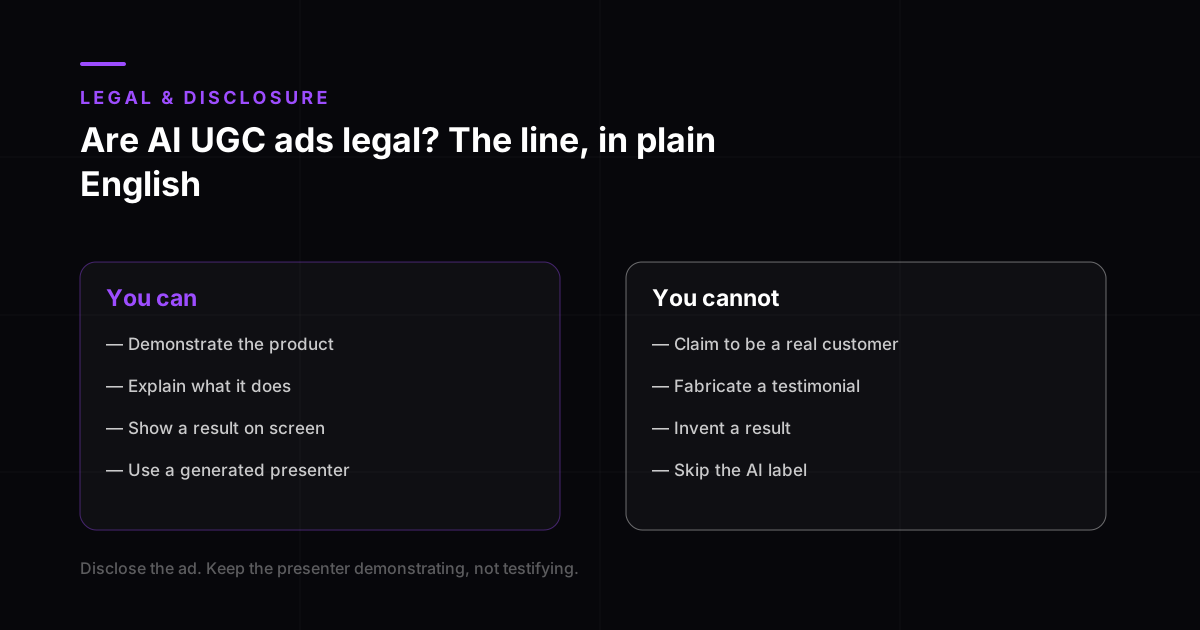
Are AI UGC ads legal? The short answer
Yes, with disclosure. What changed in 2026 is not the answer but the number of places the obligation now comes from. India regulates it, the EU regulates it, and Meta and Google both enforce it at ad review. In plain terms: an AI presenter can demonstrate, explain and present. It cannot pretend to be a real customer who bought your product and loved it.
The four rules that apply to an Indian advertiser in 2026
These stack rather than replace each other. You can satisfy Meta and still breach the Indian rules, or satisfy both and still run a misleading ad. Work through all four.
| Rule | Since | What it asks of you |
|---|---|---|
| India, amended IT Rules | 20 Feb 2026 | Declare synthetic content when you upload. The platform applies the label |
| Meta advertiser disclosure | March 2026 | Tick the AI disclosure box. Meta then labels the served ad |
| Google Ads AI disclosure | 9 July 2026 | Automatic for Google’s own AI tools, manual for third-party ones |
| EU AI Act, Article 50 | 2 Aug 2026 | Disclose deepfake content if your ad reaches an EU audience |
India: the rule most Indian brands have not read
The Information Technology Amendment Rules 2026 were notified on 10 February 2026 and took effect on 20 February 2026. They introduce a defined category, synthetically generated information, covering AI-produced audio, visual and audio-visual content. AI-generated text sits outside the labelling requirement.
The detail that matters commercially is where the duty falls. As Grant Thornton Bharat’s analysis of the amended rules sets out, the obligation to apply a prominent, visible label rests on the intermediary, meaning the platform. What rests on you, the person publishing, is the declaration that the content is synthetically generated in the first place.
Platforms are also required to preserve those labels rather than strip them, to embed provenance metadata where technically feasible, and significant social media intermediaries now face a three-hour window to act on unlawful synthetic content, down from thirty-six. The practical effect for an advertiser is that removal happens faster than any appeal you might file.
The EU rule, if any of your spend reaches Europe
Article 50 of the EU AI Act has applied since 2 August 2026. It is worth knowing about even from India, because it reaches deployers established outside the EU where the output of the system is used inside the EU. Incidental or unforeseeable spillover is not enough to trigger it, but a deliberately targeted EU campaign is.
It bites on deepfakes, which the Commission defines through three cumulative tests: the content resembles a real subject, that subject exists or could plausibly exist, and the result appears authentic. A generic synthetic presenter who is not anyone in particular generally sits outside that. A presenter built to resemble someone real sits squarely inside it. Penalties run to 15 million euro or 3 percent of worldwide turnover.
The line, in plain English
| You can | You cannot |
|---|---|
| Use an AI presenter to demonstrate a product | Have an AI presenter claim to be a real customer |
| Generate a scene the product plausibly appears in | Fabricate a testimonial or a result |
| Use an AI voice you have rights to | Clone a real person’s voice without consent |
| Show the product doing what it actually does | Show the product doing something it cannot do |
| Label the ad as AI-generated and run it | Run synthetic media without disclosure where it is required |
What the platforms require
Meta has required advertisers to disclose AI-generated or AI-modified ad creative since March 2026. You tick a disclosure box and Meta applies the label to the served ad. Colour correction, cropping and headline optimisation do not trigger it. Generating the actual visual subject does: a person, a product render, a scene. Creative that Meta’s own Advantage+ system generates is handled internally and does not need declaring by hand.
Google followed on 9 July 2026. Its advertising policy on AI disclosure covers Search, YouTube and Discover, and surfaces the information to viewers through a "How this ad was made" panel. The split is the part worth planning around: assets made with Google’s own generative tools are labelled automatically, and anything produced in a third-party tool has to be labelled by you, manually, inside Google Ads.
TikTok requires creators and advertisers to label realistic AI-generated content. All three platforms enforce at review, and all three can reject the ad or apply account-level penalties for repeat issues.
Meta sets out where the label actually appears in its own help documentation on how AI-generated content in ads is identified and labelled. Two details there matter for planning. AI information normally sits in the three-dot menu at the top right of the ad, which is unobtrusive. But where the ad contains a photorealistic AI-generated human, the label appears next to the Sponsored tag at the top of the ad, in the part everybody sees. If your concept depends on a generated presenter, assume the label is visible.
The practical upshot is boring and important: labelling is not a legal footnote you add at the end. It is part of the deliverable, and it should be decided at the brief stage, because it occasionally changes the creative.
Where enforcement stands in 2026
This stopped being theoretical. As of 2026 the rules are active and enforced, not advisory.
- India brought synthetic audio and video inside the IT Rules on 20 February 2026, with a three-hour takedown window for unlawful synthetic content at the largest platforms.
- Meta made AI-content disclosure mandatory for advertisers in March 2026 and enforces it at review. Undisclosed AI creative is one of the fastest-growing rejection categories, and a rejection carries a policy strike. Three strikes inside 90 days can restrict or suspend the ad account.
- Where an ad features a photorealistic AI-generated human, Meta requires the disclosure to appear as a visible label, not only a setting in Ads Manager.
- Google Ads began requiring AI disclosure on 9 July 2026 across Search, YouTube and Discover, automatic for its own tools and manual for everyone else’s.
- EU AI Act Article 50 transparency obligations became applicable on 2 August 2026, with penalties up to 15 million euro or 3 percent of worldwide turnover.
- TikTok requires an AI disclosure on ads containing synthetic faces, cloned voices or AI-generated scenes, uses embedded content credentials to detect some of it automatically, and escalates repeat violations toward account-level penalties.
- The FTC’s Consumer Reviews and Testimonials Rule took effect on 21 October 2024. It carries civil penalties per knowing violation, adjusted annually for inflation and standing at $51,744 at the time of writing, so a fabricated endorsement is a regulatory exposure, not only a platform one.
What the FTC says about synthetic endorsers
The FTC’s position on endorsements is that an endorsement must reflect the honest opinions of a real endorser. A synthetic presenter has no opinions and no experience, so it cannot deliver a testimonial. It can deliver information. The distinction matters more than most brands realise, because the format of a UGC ad is designed to feel like a testimonial even when the words are not making a claim.
This stopped being a matter of interpretation in 2024. The FTC announced a final rule banning fake reviews and testimonials on 14 August 2024, and it came into force on 21 October 2024. The rule explicitly covers reviews and testimonials generated by artificial intelligence, and it prohibits misrepresenting the identity, the experience or the existence of the person giving them. The Commission also publishes a plain-language questions and answers guide to the rule, which is the single most useful page to read before signing off a script.
What changed with the rule is the consequence rather than the principle. Fabricated endorsements were already deceptive under Section 5 of the FTC Act. The rule gives courts the power to impose civil penalties for knowing violations, which turns an abstract compliance concern into a quantifiable one.
This is where most AI UGC gets into trouble. Not through a deliberate lie, but by borrowing the visual grammar of a customer review while the script quietly implies experience the presenter never had.
The three phrasings that cause the problem
- Anything in the past tense about using the product. I tried this, I have been using this for a month, this worked for me. There is no I to have done any of it.
- Any claim about a personal result. My skin cleared, I lost weight, my hair stopped falling out. This is the highest-risk category because it is also a health claim.
- Any implied purchase. I ordered this last week, it arrived yesterday. A statement of consumer experience by something that is not a consumer.
The fix is almost always a tense and person change rather than a new concept. Here is what happens when you use this for a month keeps the demonstration and drops the false claim. The ad is barely different and the exposure disappears.
What happens if you get it wrong
- The ad gets rejected at review, and your launch slips.
- Repeated violations attract account-level penalties, which is a much more expensive problem than one rejected creative.
- Fabricated testimonials carry regulatory risk, not just platform risk.
- And the quiet one: an audience that spots a fake testimonial does not just skip the ad. It stops trusting the brand.
A pre-launch checklist
Run this before anything goes live. It takes a few minutes and it catches nearly everything that gets ads rejected.
- Read the script for first-person experience claims. Every one of them needs rewriting into the second person or removing.
- Declare the content as synthetically generated when the platform asks at upload. Under the Indian rules this declaration is your obligation, and the label is theirs.
- Confirm the ad is labelled as AI-generated in the platform interface, and check where that label will appear given what is in the creative.
- On Google Ads, check whether the asset came from a third-party tool. If it did, apply the disclosure manually, because nothing applies it for you.
- If any of the spend targets an EU audience, check whether the creative meets the deepfake definition, and disclose at first exposure if it does.
- Check that anything demonstrated on screen is something the product genuinely does. Generated footage showing a capability the product lacks is a misrepresentation regardless of disclosure.
- Confirm you hold rights to any voice used, and that it is not a clone of an identifiable person without consent.
- If the ad touches health, finance or anything else with sector rules, treat those rules as the binding constraint. AI disclosure sits on top of them, it does not replace them.
- Keep a record of what was disclosed and when. If a platform or regulator ever asks, the record is the answer.
How we handle it
Every deliverable comes labelled correctly, with the disclosure documented so you have a record. Where a concept crosses the line, you hear it at the brief stage rather than from a platform review after your spend is live. If a script needs an experience claim to work, that is a signal the angle is wrong, and we find a better one. That is the standard our AI UGC video ads service works to.
Writing inside the line without losing the ad
The rules above sound restrictive and mostly are not, because the strongest UGC angles were never testimonials. What they remove is the laziest version of the format: a stranger asserting that a product changed their life. Everything else remains available.
- Demonstrate rather than testify. Showing the thing working is more persuasive than someone claiming it worked.
- Put the claim on the product, not in a person's mouth. "It holds eight hours" is a product claim you can substantiate; "it lasted me all day" is an experience claim a generated presenter cannot make.
- Use the second person. "If your bag does this, here is why" addresses a real viewer rather than inventing a fake one.
- Frame scepticism as the angle. A presenter examining a product critically reads as more honest than one endorsing it, and raises no endorsement question at all.
- Keep real testimonials real. If you have genuine customer quotes, use them as text on screen with attribution rather than having a synthetic person perform them.
The structural versions of these are set out in seven AI UGC ad script examples, and how to make a UGC ad with AI covers the production side. Whether the format actually converts is the harder question, answered with the evidence that exists rather than the numbers people quote. If you are still deciding between this and a creator, AI UGC versus influencer marketing sets out where each one is actually stronger. Note that a real creator can make experience claims precisely because the experience is real.
What ASCI’s guidelines say, and when they apply
The Advertising Standards Council of India issued its final Guidelines for Responsible Labelling of Synthetically Generated Content in Advertising on 17 September 2026, after a draft in May and a public consultation that closed on 13 June. They take effect three months after publication, in December 2026, and are aligned with the amended IT Rules. The ASCI Code they rest on already applies to every ad, so build to them now rather than waiting for the date.
The framework is risk-based. It does not restrict AI in advertising. It asks for a label wherever synthetic content could materially influence a buying decision. That test is more useful than a list, because it tells you what the regulator is actually worried about.
| Label required | No label needed |
|---|---|
| A synthetic influencer or brand ambassador | Routine editing, colour correction and light adjustment |
| A real person’s likeness or voice recreated, even with consent | Decorative backgrounds, ambient music and jingles |
| A fabricated event, setting or situation that affects how the product’s performance is understood | Obviously fantastical effects nobody takes as real |
| A product that does not exist yet, such as an unbuilt development | AI-assisted ad copy |
| Sound effects central to a core product feature, such as audio quality in a headphone ad | Subtitles, captions and translations for accessibility |
| A sponsored AI product recommendation, labelled "Sponsored by [Brand]" |
The suggested wording is plain: "Audio/Video created using AI" or "Audio/Video enhanced using AI". A label supplied by the ad platform is also acceptable, as is any alternative that accurately informs the viewer. Labels must follow the ASCI Code’s existing rules on disclaimers, so a label buried in fine print does not do the job.
Frequently asked questions
Are AI UGC ads legal in India?
Yes, with disclosure. The Information Technology Amendment Rules 2026 took effect on 20 February 2026 and bring AI-generated audio and video inside the IT Rules as synthetically generated information. The labelling duty falls on the platform, while your duty is to declare truthfully that the content is synthetic when you publish it. On top of that sit the existing ASCI code and consumer protection rules on misleading advertisements, which apply to the claim regardless of how the video was made.
Who has to apply the AI label under India’s 2026 IT Rules, me or the platform?
The platform. The amended rules place the obligation to apply a prominent, visible label on the intermediary, and require it to preserve rather than strip that label and to embed provenance metadata where technically feasible. Your obligation is the declaration at the point of publishing. That is where an advertiser’s exposure sits, because a false declaration is entirely your own act.
Do I have to label AI ads on Google Ads?
Since 9 July 2026, yes, across Search, YouTube and Discover. Assets generated with Google’s own AI tools are labelled automatically. Anything made in a third-party tool has to be labelled manually by you inside Google Ads. Viewers see the result through the "How this ad was made" panel. The manual case is the one most advertisers miss.
Are ASCI’s AI labelling guidelines binding yet?
They take effect in December 2026. ASCI finalised them on 17 September 2026, to apply three months after publication. ASCI is a self-regulatory body, but its code is applied across Indian advertising, and the IT Rules amendment the guidelines align with has been in force since 20 February 2026. Build to them now.
Does the EU AI Act apply to an Indian brand?
It can. Article 50 has applied since 2 August 2026 and reaches deployers established outside the EU where the output of the system is used inside the EU. Incidental spillover is not enough on its own, but a campaign deliberately targeting an EU audience is. It bites on deepfakes, defined through three cumulative tests: the content resembles a real subject, that subject exists or could plausibly exist, and it appears authentic.
Does the AI label hurt ad performance?
Less than most brands assume, because the label sits in the platform interface rather than inside the creative, and viewers are increasingly used to seeing it. The variable that actually moves performance is whether the ad is any good. It is worth knowing that where an ad contains a photorealistic AI-generated human, Meta places the label prominently next to the Sponsored tag rather than in the menu, so plan for it being seen.
Can I use an AI voice that sounds like a real person?
Not if it is a clone of an identifiable person used without their consent. That raises publicity, likeness and in some jurisdictions specific voice-cloning issues, quite separately from advertising rules. A synthetic voice that is simply a voice, not an imitation of anyone in particular and licensed for commercial use, is fine.
What if a real customer gives permission for an AI version of their testimonial?
This can work, and it needs care. If a genuine customer had a genuine experience, gave you their real words, and consented to those words being delivered by a synthetic presenter, the underlying endorsement is real. What must not happen is any drift between what they actually said and what the generated version says, and the AI generation still needs disclosing. Keep documented consent and the original statement on file.
Who is liable if the ad breaks the rules, the agency or the brand?
In practice the advertiser carries the primary exposure, because the ad account, the media spend and the claims about the product are theirs. That does not leave a producer clear, and it is a reason to agree at the brief stage who signs off compliance. What it definitely means is that a brand cannot treat this as fully outsourced: if a script contains a fabricated testimonial, the advertiser is the one with the problem.