What Are AI UGC Ads? A Plain Definition
UGC stands for user-generated content. An AI UGC ad is a short video built to look like a real customer filmed it on their phone, except the presenter, the setting and the footage are generated with AI instead of shot by a hired creator. The format is the same as traditional UGC. Only the production method changes, which is also why the advertising rules that governed the format before still govern it now.
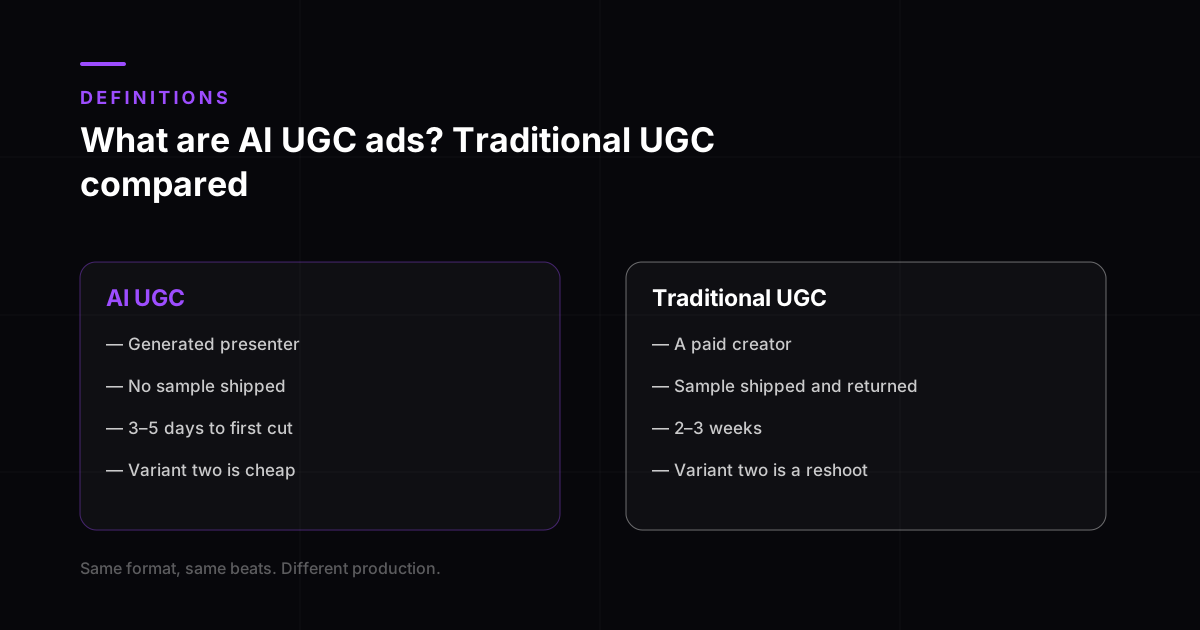
What does UGC stand for?
User-generated content. In advertising it means content that looks like it came from a customer rather than from a brand. Handheld, unpolished, someone talking to a camera about a product they use.
The term is used loosely. Strictly, UGC is content an actual customer made. In practice, almost all "UGC ads" running on Meta and TikTok were made by paid creators briefed by the brand. The word describes a style, not an origin.
So what makes it an AI UGC ad?
The production method. A traditional UGC ad needs a creator sourced, briefed, shipped a product sample, and paid for usage. An AI UGC ad is generated: the presenter, the room, the product in hand, the delivery. The output is designed to be indistinguishable in feel from the handheld original.
Everything else about the ad is unchanged. Same hook in the first two seconds, same demonstration in the middle, same call to action at the end, same vertical 9:16 frame.
| Traditional UGC | AI UGC | |
|---|---|---|
| Who appears | A paid creator | A generated presenter |
| Product sample | Shipped and returned | Not shipped |
| Time to first cut | 2 to 3 weeks | 3 to 5 days |
| A second variant | A second shoot | A re-render |
| Usage rights | Time-limited, per creator | No likeness to license |
| Changing one line | A reshoot | A re-render |
| Disclosure needed | No | Yes, by platform policy and by law |
| Can make experience claims | Yes, the experience is real | No, there is nobody to have had one |
Why brands run them
- Ad creative fatigues in weeks. UGC fatigues fastest of all, because the whole format depends on feeling fresh and unscripted.
- Delivery is increasingly automated, so the advertiser's job has shifted from picking the winner to supplying enough candidates for the system to pick from.
- Sourcing a creator sets the floor on how often you can change your mind. A generated set removes that floor.
- The cost per variant collapses once the script and setup already exist.
Where the disclosure rules now come from
This is the one part of the definition that changed in 2026. Labelling used to be platform policy. It is now also law, in India since February and across the EU under Article 50 of the AI Act since August, with Google Ads and Meta enforcing their own versions at ad review. The obligations differ by market and by who generated the asset, so the full disclosure position is the place to work through yours.
None of this restricts the format. It restricts pretending.
How to tell an AI UGC ad from a real one
Worth knowing in both directions: it tells you what to check before signing off your own, and it tells you what your audience is already noticing. The tells in 2026 are rarely the face. They are the edges.
| Where to look | What gives it away |
|---|---|
| Hands on the product | Grip that does not quite match the object’s weight or shape |
| Small text | Packaging copy and screens that blur or shift between frames |
| The product itself | Silhouette or logo drifting slightly shot to shot |
| Long single takes | Micro-expression settling into a loop after a few seconds |
| Background detail | Objects that change between cuts in the same room |
| The room’s audio | Clean voice with no matching room tone behind it |
None of these are reasons to avoid the format. They are reasons to brief around it, which is largely a matter of shot choice: where AI video still fails covers the same limits from the production side.
The number that explains the whole format
Motion's 2026 benchmark study, covering 578,750 Meta creatives across 6,015 advertiser accounts and $1.29 billion in ad spend, puts the hit rate at roughly 5 percent, defining a winner as a creative that spends at least ten times its account median. That is the share of ads that turn out to be genuine winners. Everything else is either mediocre or gets switched off.
Take that seriously for a moment and the economics of the format follow directly. If roughly one in fifteen creatives wins, then producing one carefully considered ad is not a strategy, it is a bet at long odds. You need somewhere between four and six real attempts to expect one winner, and that is the arithmetic that traditional UGC cannot serve at three weeks per ad.
It also reframes what a failed ad is. At a hit rate like that, most of your ads failing is not evidence that something is wrong. It is the expected outcome, and the only real error is not producing enough attempts to find the winner inside a campaign window.
How fast it fatigues
Reported fatigue windows vary with spend. For most accounts the working range is two to four weeks before a creative measurably declines, and high-spend accounts see it faster because they exhaust an audience sooner. Some practitioner analyses put it considerably faster still, though those figures come from self-reported account data rather than published research, so treat the short end as a warning rather than a benchmark.
The signal to watch is a click-through rate falling roughly 20 to 40 percent from that ad’s own peak. Hook rate and thumb-stop move earlier than click-through, so if your reporting includes them, they buy you a few days of warning.
What AI UGC ads are not
- They are not fake testimonials. A generated presenter can demonstrate and explain a product. It cannot claim to be a customer who bought it.
- They are not unregulated. Meta and TikTok both require AI-content labelling on ads using synthetic media, and the FTC requires that synthetic endorsers do not misrepresent a real consumer experience. The full breakdown is in the full legal position.
- They are not a prompt. The generation is a few hours of the job. The hook, the script, the pacing and the edit are the rest of it, and they are what decides whether the ad works.
How to tell a good one from a bad one
Most AI UGC looks fake for one reason: it is too polished. Real UGC is slightly imperfect. The light is wrong, the framing drifts, the person says "um". Generated footage defaults to clean, evenly lit and evenly paced, which is exactly what a customer video never looks like.
- Watch the first two seconds. If it opens with a logo or a title card, it was made by someone who does not run paid social.
- Watch how the product enters the frame. In good UGC it arrives mid-sentence, not on a turntable.
- Watch the pacing. Uniform shot lengths are the strongest tell that nobody directed it.
- Watch it on mute. If it does not work with captions alone, it will not work in a feed.
That is a directing problem, not a technology problem. The model generates what it is told. The judgement about what to tell it is the entire job.
How AI UGC compares to the alternatives
The format only makes sense next to what it replaces. Three options exist for the same slot, and they differ in what you are actually buying rather than in how the finished ad looks.
- AI UGC ad
- 3 to 5 days
- Creator brief to delivery
- 2 to 3 weeks
- Studio shoot
- 3 to 6 weeks
Elapsed time from brief to first cut. The gap is scheduling and shipping rather than editing, which takes about as long in all three.
Speed matters here for a specific reason rather than as a general virtue. Motion's analysis of 578,750 Meta creatives puts the winner rate near 5 percent, so the deciding variable is how many distinct arguments you can afford to test. A three-week cycle allows four attempts a quarter; a three-day cycle allows twenty. AI UGC versus influencer marketing covers what each buys beyond speed. Notably, a real creator can make experience claims a generated presenter cannot.
When a real creator is still the right call
Two cases, and they are not edge cases. When the ad depends on a genuine testimonial, someone who actually bought it saying so, a creator is not merely better, it is the only lawful option. And when you do not yet know what the message should be, a loosely briefed creator will tell you in their own words, which is information you cannot generate. Use those first, then produce the volume against what they taught you. what the platforms and the FTC require covers the line in full, and seven UGC ad script examples covers the structures worth testing once you have it.
What the format is not allowed to do
The definition has a boundary attached to it, and it is regulatory rather than stylistic. A generated presenter can demonstrate and explain; it cannot claim to have bought and used the product, because that is a fabricated endorsement. Indian advertisers have their own instrument for this now: the Advertising Standards Council of India has issued guidelines for labelling AI-generated advertising content, finalised in September 2026, which prohibit fabricated endorsements and unauthorised likeness outright. the compliance side in detail covers the full position.
Frequently asked questions
What does UGC stand for?
User-generated content. In advertising it describes content that looks like it came from a customer rather than from a brand: handheld, unpolished, someone talking to a camera about a product they use. Strictly the term means content an actual customer made, but in practice it describes a style, and most UGC ads running on Meta and TikTok were produced by briefed paid creators.
What are AI UGC ads?
Short videos built to look like a real customer filmed them on a phone, where the presenter, the setting and the footage are generated with AI instead of shot by a hired creator. The format is identical to traditional UGC, including the hook, the demonstration and the vertical frame. Only the production method changes.
Are AI UGC ads the same as deepfakes?
No. A deepfake reproduces a specific real person’s likeness, usually without their consent, which is precisely what legitimate AI UGC avoids. Generated presenters in advertising are composite faces that are not anyone in particular, and the ads are labelled as AI-generated. The distinction is consent and identity, not the underlying technology.
How much do AI UGC ads cost compared to hiring a creator?
The first one is often comparable, and the difference appears at volume, because the concept and setup are already paid for by the second variant. Traditional UGC costs roughly the same for each additional ad, since every one needs a creator sourced, briefed and shipped a sample. What AI video ads cost in India has the ranges.
Do AI UGC ads actually perform as well as real UGC?
A genuinely good creator with a real relationship to your product will usually outperform generated footage, because real enthusiasm is hard to fake and audiences detect the difference. What AI changes is supply. Most brands are not choosing between one great creator ad and one generated ad; they are choosing between three creator ads a quarter and thirty generated variants, and paid social rewards the second.