AI UGC Ads vs Influencer Marketing: What to Use When
Influencer marketing buys reach and a trusted real face. AI UGC ads buy speed and volume of testable creative. Most brands need both: influencers for top-of-funnel trust, AI UGC to scale the hooks that work into paid. They are not substitutes, and treating them as an either-or is how budgets get wasted.
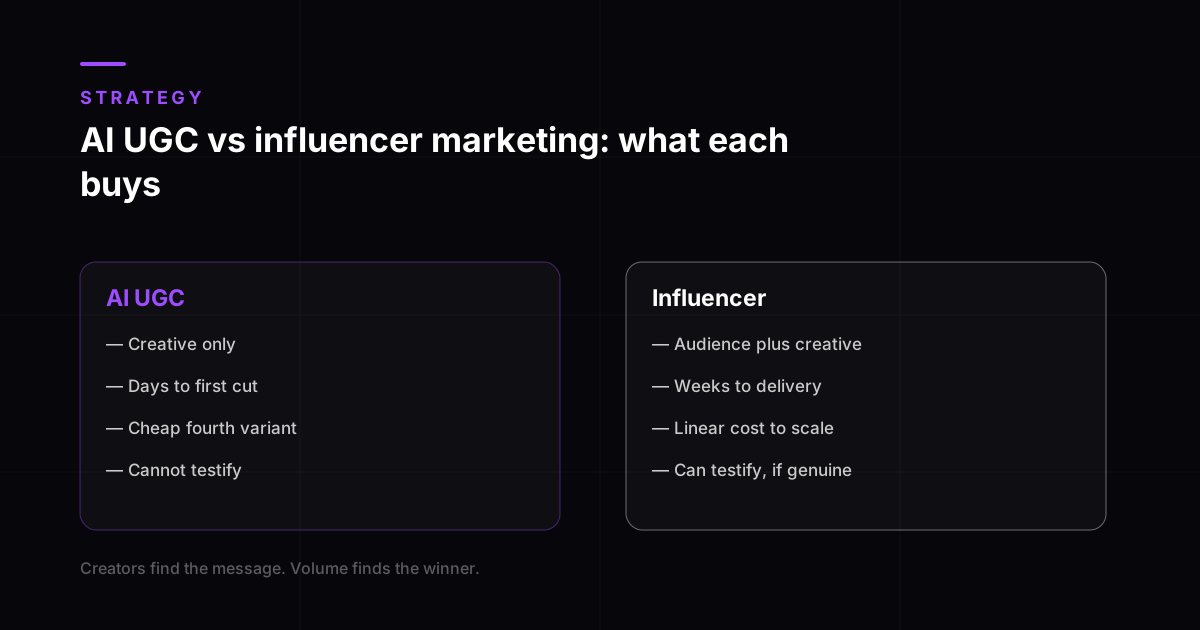
They look similar in the feed, but they solve different problems. Picking the wrong one is how budgets get wasted.
AI UGC vs influencer marketing: where each one wins
- Influencers win on trust and reach: a real person with a real audience vouching for you.
- AI UGC wins on speed and testing: five hooks in the time it takes to brief one creator.
- Influencers are slow and per-post. AI UGC is fast and per-variant.
- Use influencers to build trust. Use AI UGC to scale what already converts.
The difference nobody states plainly
Influencer marketing is a distribution channel that happens to come with creative attached. AI UGC is creative production that comes with no distribution at all. That single distinction explains most of the confusion about which to use.
When you pay a creator, a large part of what you are buying is access to the audience that already follows them, plus the implied endorsement of appearing on their feed. When you commission AI UGC, you are buying the asset only. It reaches nobody until you put media spend behind it. Comparing their costs without accounting for that is comparing a plane ticket to a car.
| Influencer | AI UGC | |
|---|---|---|
| What you are buying | Audience access plus creative | Creative only |
| Distribution included | Yes, their followers | No, you buy the media |
| Can claim personal experience | Yes, if genuine and disclosed | No, never |
| Time to first asset | Two to three weeks typically | Days |
| Cost of a second variant | Close to the cost of the first | A fraction of the first |
| Creative control | Partial, and pushing too hard kills authenticity | Complete |
| Usage rights | Time-limited, negotiated per creator | No likeness to license |
| Best at | Trust, credibility, reaching a new audience | Volume, iteration, scaling a proven message |
The endorsement line
This is the part with legal weight rather than just strategic weight, and it is worth being precise about. A real creator who genuinely uses your product can say it worked for them, because it is a true statement about a real experience, provided the commercial relationship is disclosed.
A generated presenter cannot make that statement under any circumstances, because there is no person who had the experience. They can demonstrate the product, explain what it does, and show a result. They cannot testify. That is not a stylistic preference, it is the boundary between an advertisement and a fabricated testimonial, and are AI UGC ads legal goes through it properly. The FTC's final rule banning fake reviews and testimonials is the instrument, and Meta's AI content labelling policy governs the disclosure side.
What each one actually costs in India
Published Indian rate cards for 2026 put creator fees roughly as follows. Useful as a planning band rather than a quote, because engagement rate and niche move the number by two to three times inside any single tier.
- Nano, 1K to 10K followers
- ₹2,000 to ₹8,000
- Micro, fitness and food at ~50K
- ₹15,000 to ₹35,000
- Micro, beauty and fashion at ~50K
- ₹25,000 to ₹60,000
- Micro overall, 10K to 100K
- ₹8,000 to ₹80,000
- Mid-tier, 100K to 500K
- Up to ₹1,50,000
Celebrity integrations sit off this scale entirely, at ₹25 lakh and up. The two micro rows are the point: identical follower counts, very different rates, because commercial intent in the niche prices the deliverable more than audience size does.
Two things in that table are worth pausing on. A beauty creator and a fitness creator with identical follower counts are priced very differently, because commercial intent in the niche matters more than audience size. And a meaningful ongoing campaign mixing nano and micro creators generally starts around ₹50,000 to ₹1,50,000 a month, which is the real entry price rather than the per-post figure.
The cost line most brands miss: usage rights
The quoted fee is for the content. It is frequently not for the right to advertise with it. Standard organic use for six to twelve months is often included, but paid media usage, longer terms and cross-platform distribution are commonly charged on top.
Published guidance puts that uplift at anywhere from 50 percent to over 150 percent of the base rate depending on duration. In practice a video quoted at a base rate can land at roughly twice that once twelve months of paid media usage and perpetual organic rights are added. If you intend to run creator content as an ad rather than as a post, that is the number to budget against, and it is the one most often discovered late.
How the money behaves differently
Influencer costs scale close to linearly. Ten posts from ten creators cost roughly ten times one post, because each one involves separate negotiation, briefing, product shipping and payment. Bundling several videos with one creator typically saves 10 to 25 percent, which is real but modest against the structural gap.
AI UGC front-loads. The first variant carries the concept, the script development and the setup, so it is the expensive one. The fourth variant reuses all of that and changes one element, so its marginal cost is small. This is why the format only makes economic sense at volume, and why using it to make a single ad is usually the wrong call.
The sequence that works
The strongest play is not choosing between them, it is ordering them. Influencers are unusually good at something AI UGC cannot do at all: telling you which message resonates with a real audience that has no obligation to be polite about it.
- Run a small number of influencer posts, briefed loosely enough that creators say it in their own words.
- Watch which framing gets engagement and, more importantly, which phrases appear in the comments.
- Take the winning message and produce it as AI UGC in several variants with different hooks.
- Put media spend behind those variants and let the paid data narrow it further.
- Return to creators for the next message, not for volume.
That way each format does the thing it is actually good at. The creators supply credibility and language you could not have written. The generated variants supply the volume that paid social consumes. On the production side of that second step, how to make a UGC ad with AI covers the craft, and UGC ad script formats has the structures worth testing.
Why volume is the deciding factor
The cost comparison above is the argument most brands have. The one that actually decides it is how many attempts each method buys, because paid social is a numbers game before it is a craft one.
Motion's analysis of 578,750 Meta creatives across 6,015 advertiser accounts puts the winner rate near 5 percent. At that hit rate, a budget buying three creator posts buys roughly a one-in-seven chance of a winner. The same budget spent on generated variants buys enough attempts that finding one stops being luck. That is the whole case, and it has nothing to do with which looks better.
It also explains why the sequence above works rather than either method alone: creators tell you which message is worth testing, and volume tells you which version of it wins. Producing that volume is what our AI UGC ad production is built for, and how to A/B test video ads covers reading the result.
The disclosure asymmetry
The two routes carry different disclosure burdens, and both carry one. A creator has to disclose the commercial relationship; a generated presenter has to be disclosed as generated. In India both fall under the Advertising Standards Council of India, whose guidelines on labelling AI-generated advertising content, finalised in September 2026, sit alongside its existing influencer disclosure rules. The practical difference stays the one this article is about: the creator may say it worked for them, and the generated presenter may not.
Frequently asked questions
Is AI UGC cheaper than hiring influencers?
Per asset usually yes, and the honest comparison is more complicated than it looks. Influencer fees include distribution to their audience while AI UGC does not, so you have to add media spend to compare fairly. Pulling the other way, creator fees frequently exclude the right to advertise with the content, and paid-media usage rights commonly add 50 to over 150 percent on top. The real saving appears at volume, where the fourth variant costs a fraction of the first and a fourth creator post costs about what the first did.
How much do influencers charge in India?
Published 2026 rate cards put nano creators between 1,000 and 10,000 followers at roughly ₹2,000 to ₹8,000 per deliverable, and micro creators between 10,000 and 100,000 followers at ₹8,000 to ₹80,000. Niche matters more than follower count: a beauty creator at 50,000 followers commonly commands ₹25,000 to ₹60,000 while a fitness creator at the same size sits nearer ₹15,000 to ₹35,000. Budget usage rights on top.
Can AI UGC replace influencer marketing entirely?
Not for what influencers are genuinely best at. You cannot generate credibility with an audience that already trusts someone, and you cannot generate a real personal endorsement at all. What AI UGC can replace is the use of paid creators purely as a production service to churn out volume, which is a common and expensive arrangement that was never really influencer marketing to begin with.
Do influencer posts and AI UGC ads need different disclosures?
Yes, and they stack rather than substitute. An influencer post needs the commercial relationship disclosed as a paid partnership. An AI UGC ad needs the synthetic media labelled under platform AI-content rules. A post that is both, a creator appearing in an ad with generated elements, needs both disclosures.
Which should a brand start with if the budget only covers one?
If nobody has heard of you, start with creators, because borrowed trust is hard to manufacture and you need to learn what language your market responds to. If you already know your message works and the constraint is producing enough creative to keep paid social fed, start with AI UGC. The question is which problem you have, not which format is better.