How to A/B Test Video Ads: Run 10 Creatives, Find the Winner
Test one variable at a time across 5 to 10 variants, give each enough budget to reach roughly 1,000 impressions per day, and run for at least 7 days so the ad set can approach the ~50 optimisation events Meta needs to leave its learning phase. Judge on cost per acquisition, not views or click-through rate. Kill losers early, then rebuild the next round from the winning element.
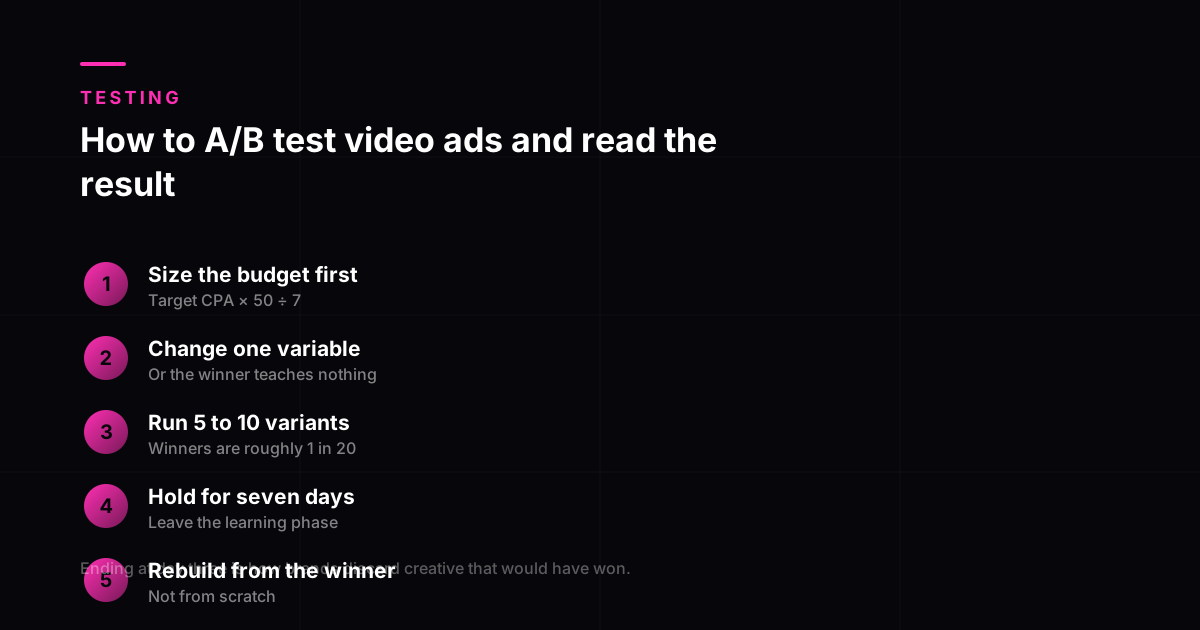
How to A/B test video ads: work out your minimum budget first
Most tests fail for a budget reason rather than a creative reason, and it is arithmetic you can do in advance. Meta documents that an ad set needs roughly 50 optimisation events inside a rolling seven-day window to leave the learning phase. Below that it sits in Learning Limited, where delivery is unstable and the numbers you are reading are not yet a result.
Four things about the learning phase worth knowing
- It is measured at ad set level, not per ad. Splitting one budget across ten ad sets makes the threshold ten times harder to reach.
- Only your chosen optimisation event counts. If you optimise for Purchase, add-to-carts contribute nothing toward the 50.
- The window is rolling, not cumulative. Drop below 50 in any seven-day period after exiting and the ad set can re-enter learning.
- Significant edits reset it. Meta counts a change to the optimisation event, the audience or the creative as a significant edit, and each one restarts the clock, which is why mid-test tinkering is so destructive.
That last point is the one that quietly ruins tests. Adjusting budgets on day three because one variant looks ahead resets learning on the ad sets you touched, so you end up comparing ad sets at different stages of stabilisation and reading the difference as a creative result.
Why one ad is a guess
Launching a single creative and judging the campaign on it tells you almost nothing. If it works you do not know which part worked. If it fails you do not know which part failed, so the next attempt is another guess.
Testing turns advertising from an opinion into a measurement. That has always been true. What changed is that producing ten variants used to cost ten shoots. Once a winner exists, the next move is scaling it across customer segments, and watching what competitors are running against you.
The one-variable rule
Change one thing between variants. If two ads differ in hook, presenter and music, and one wins, you have learned nothing you can reuse.
| Variable | What to change | Test priority |
|---|---|---|
| Hook | The first 2 seconds. Question, claim, problem, visual. | 1. Highest impact |
| Angle | Which benefit leads. Speed vs price vs status vs fear. | 2. High |
| Presenter | Age, gender, energy, setting. | 3. Medium |
| Format | Talking head vs demo vs before-after vs listicle. | 4. Medium |
| Call to action | Wording and placement. | 5. Low |
| Music and pacing | Track, cut rhythm, caption style. | 6. Low |
Start at the top of that table. Hook and angle account for most of the variance between a winning ad and a losing one. Testing button wording before you have found your angle is optimising the wrong end. For hook structures to test, see 7 UGC ad script formats.
How many variants you actually need
Five is a real test. Ten is a good test. Two is a coin flip with extra steps.
A practical structure for a first round: pick one product, one audience, one offer. Write 10 hooks against that. Produce 10 variants that are identical apart from those first 2 seconds. Everything else stays locked.
Budget and duration
- Give each variant enough daily budget to collect meaningful data. A common working target is around 1,000 impressions per variant per day, enough to read a creative signal.
- Run at least 7 days. Meta documents that an ad set needs roughly 50 optimisation events (the action you optimise for, such as purchases) per week to exit its learning phase. Impressions do not clear it; conversions do. Results before that are volatile.
- Do not judge on day one. Early leaders reverse constantly.
- Do not edit ads mid-test. A significant edit, meaning changing the optimisation event, the audience or the creative, or moving budget sharply, resets Meta’s learning phase and invalidates the comparison.
Which metric decides it
| Metric | Use it for | Do not use it for |
|---|---|---|
| 3-second view rate | Judging the hook only | Judging the ad |
| Hold rate / avg watch time | Judging the middle of the ad | Judging the offer |
| Click-through rate | Judging the promise | Declaring a winner |
| Cost per acquisition | Declaring a winner | Judging the hook alone |
| Views, likes, shares | Almost nothing commercially | Any spending decision |
Read them in sequence. A low 3-second view rate is a hook problem. Good views but a low hold rate is a middle problem. Good watch time but a low click-through rate is a promise problem. Good clicks but a bad cost per acquisition is a landing page or offer problem, not a creative problem at all.
What to do with the result
- Kill the bottom half once the data is genuinely conclusive, not on day two.
- Take the winning element and build the next round around it. Winning hook, now test angle against it.
- Keep a written record of every hook tested and its cost per acquisition. After three rounds this file is worth more than any single ad.
- Expect the winner to fatigue. Refresh before performance drops, not after.
Testing is a loop, not an event. The brands that win at paid social are not the ones with the best single ad. They are the ones on their fifteenth round of learning while a competitor is still defending their first.
Frequently asked questions
How many video ad variants should I test at once?
Five to ten is the practical range for most budgets, and there is a reason that number is not smaller. Motion's analysis of 578,750 Meta creatives puts the share that become genuine winners at roughly 5 percent, which implies four to six real attempts per winner. Below five variants you are not testing, you are placing one bet at long odds. Above ten, each variant gets too little budget to produce a readable result.
How often does video ad creative fatigue?
Two to four weeks is the working range for most accounts, and faster at high spend because the audience is exhausted sooner. The signal is that ad’s click-through rate falling roughly 20 to 40 percent from its own peak, not from some benchmark. Hook rate and thumb-stop rate turn down earlier than click-through, so watching those buys a few days of warning before delivery weakens.
How long should an A/B test run?
At least seven days, and longer if spend is thin. Meta ad sets need roughly 50 optimisation events in a rolling seven-day window to exit the learning phase, and below that threshold delivery is unstable and the numbers are not yet a result. Ending a test at day three because one variant looks ahead is the most common way brands discard creative that would have won.
What budget does a video ad test need?
Work it out rather than guessing: target cost per acquisition × 50 ÷ 7 gives the minimum daily budget an ad set needs to clear the learning phase within a week. At a ₹500 target CPA that is around ₹3,600 a day per ad set. If your available spend is far below that, run fewer variants with adequate budget rather than more variants that will each stay in Learning Limited and tell you nothing.
What should I actually be measuring?
Cost per acquisition, or cost per whatever your real conversion event is. Views tell you the algorithm delivered the ad. Click-through rate tells you the thumbnail and hook worked, which is useful diagnostically but not the goal. An ad can win on both and lose money, and that is a common pattern rather than an edge case.
What variable should I test first?
The hook, because it has the largest effect and the fastest read. Hold everything else constant and vary only the opening two seconds. Once you know which hook holds attention, test the angle against it, then the offer. Testing in that order means each round builds on the last rather than restarting.
What if all my variants perform badly?
That is a useful result, and it usually points upstream. If every variant fails at similar cost per acquisition despite decent click-through, the problem is likely the landing page or the offer rather than the creative. Producing another ten variants of an ad driving traffic to a page that does not convert repeats the same failure more expensively.