How to Scale Video Ads Across Different Customer Groups
Scaling video ads means adding creative, not budget. As of 2026 the targeting system does most of the segmenting for you, and Nielsen attributes about half of advertising-driven sales effect to the creative itself, so the work is producing psychologically distinct message angles rather than refining audience definitions. Variants that hit the same emotional beat are increasingly treated as the same ad.
How to scale video ads now that audience targeting is automated
Before building any matrix, it is worth being current on how Meta actually behaves in 2026, because the answer has moved and a lot of advice written two years ago is now pointed at the wrong lever.
Targeting has been substantially automated. Nielsen found creative to be the largest driver of advertising-driven sales it measured, and paid teams now spend the majority of their effort producing creative rather than refining audiences. The system finds the segment. Your job is to give it enough distinct material to find them with.
There is a sharper edge to this. Meta’s newer delivery systems reportedly discount variants that are psychologically redundant, meaning two ads hitting the same emotional beat can be treated as effectively the same ad in the auction even when the footage, voiceover and presenter all differ. Producing ten variants that all say the same thing in different clothes is not ten variants.
Why raising budget on one ad stops working
A winning ad wins with a specific slice of your market. Push spend on it and the platform pushes it to people further from that slice, where the message fits worse. Cost per acquisition rises, and it looks like the ad broke.
The ad did not break. It ran out of the audience it was written for. That is a creative supply problem, not a budget problem, and more budget makes it worse.
Same product, different reason to buy
Take one product and write down who buys it. Not demographics. Reasons.
| Segment | What they actually care about | Hook angle that lands |
|---|---|---|
| First-time buyer | Does this work, is it a risk | Problem, then proof |
| Price-sensitive | Value against alternatives | Direct cost comparison |
| Premium buyer | Quality, status, craft | Detail and restraint |
| Gift buyer | Will the recipient like it | Reaction and presentation |
| Repeat customer | What is new, why reorder | New variant or bundle |
| Competitor switcher | What is different here | Direct contrast |
Six segments, one product. The same video cannot speak to all six. It will speak convincingly to one and adequately to none.
The creative matrix
Segments across one axis, message angles down the other. Each cell is one video. You do not need to fill every cell. You need to fill the ones where a real buyer sits.
- Start with the segment already converting. Produce 3 angles for it.
- Add the adjacent segment. Reuse the winning structure, change the angle and the hook.
- Keep the product demonstration consistent across all of them, so you are testing message rather than execution.
- Track cost per acquisition per segment, not blended. Blended numbers hide which segment is subsidising which.
What to change per segment, and what to keep
| Change per segment | Keep constant |
|---|---|
| Hook, first 2 seconds | Product demonstration |
| Which benefit leads | Brand look and colour |
| Presenter type and tone | Caption style |
| Objection handled | Aspect ratio per platform |
| Call to action wording | Disclosure and compliance |
Geography and language
In India specifically, language is a segment. A Hindi, Tamil, Telugu or Bengali version of a working ad is often a bigger lift than a new angle in English, and script adaptation with voice is a smaller job than a fresh concept.
Adapt rather than subtitle. A subtitle track on English footage reads as an afterthought. A version written for the language performs like a native ad, because it is one.
How many segments is too many
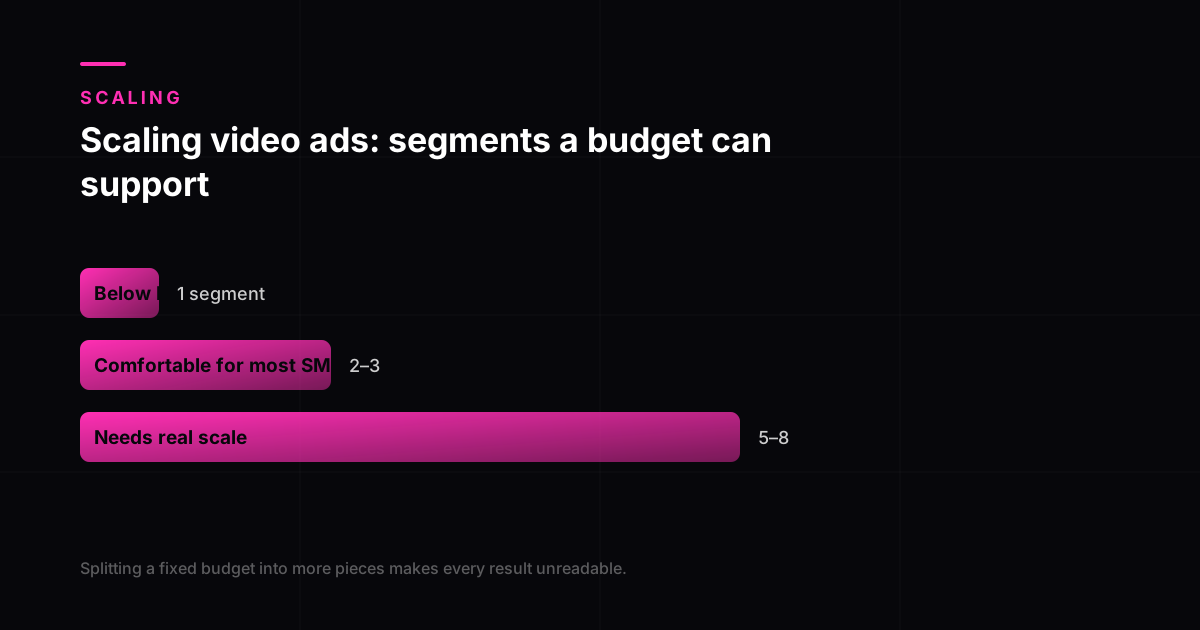
Splitting has a floor, and it is set by budget rather than by imagination. Each segment needs enough spend to leave Meta's learning phase, roughly 50 optimisation events in a rolling seven days, or you are running several under-funded tests instead of one readable one.
- Below the learning-phase floor
- 1 segment
- Comfortable for most SMEs
- 2 to 3 segments
- Needs real scale to read
- 5 to 8 segments
The constraint is events per ad set per week, not creative capacity. Producing eight segments is easy; funding eight enough to learn from is not.
The practical rule: add a segment only when the existing one is profitable and the budget can carry both past the floor. Splitting a fixed budget into more pieces does not find more buyers, it makes every result unreadable. how to find a winning creative covers the arithmetic, and our AI UGC service produces the per-segment variants once the matrix is decided.
When to scale and when to stop
- Scale a segment when its cost per acquisition holds steady across at least a week of increased spend.
- Hold when cost per acquisition drifts up but stays inside your target. Add creative rather than budget.
- Stop and rebuild when frequency climbs and cost per acquisition rises together. That is fatigue, and only new creative fixes it.
- Never scale a segment you have not measured separately. You will be scaling an average.
Where this sits next to the rest of the funnel
Segmenting creative is the middle of a sequence rather than the whole of it. Before it, you need one angle that already converts on a single audience, and how to size and read a creative test covers finding that. After it, the constraint becomes production volume rather than ideas, which is where what AI video ads cost starts to matter. And if your competitors are already running segmented creative, reading a competitor video ad strategy will show you which segments they have found and which they have left open.
Frequently asked questions
How do I scale video ads without cost per acquisition rising?
Add creative rather than budget. A winning ad works with a specific slice of your market, so pushing more spend through it delivers it to people further from that slice where the message fits worse. Building a separate variant for the next segment keeps the message matched as you expand, which is what actually holds cost per acquisition steady.
How many creative variants do I need per segment?
Think in message angles rather than segments. Each angle needs to be psychologically distinct from the others, because delivery systems now discount variants that hit the same emotional beat and can treat them as one ad even when the footage differs entirely. Two genuinely different angles beat six cosmetic variations of one, and the test is whether a variant makes a different argument rather than whether it looks different.
Should I still build separate audiences for each segment?
Much less than you used to. Targeting is substantially automated now, and paid teams have shifted the majority of their effort from segmenting audiences to producing creative because that is where the performance sits. Define the segment by the reason someone buys, build a distinct angle for it, and let the system find who those people are rather than describing them yourself.
When should I stop scaling a segment?
When frequency climbs and cost per acquisition rises together. That combination is fatigue, and no amount of budget management fixes it because the audience has simply seen the ad too often. Only new creative resolves it. If cost per acquisition drifts up while frequency stays flat, that is usually a targeting or offer issue instead.
What is a creative matrix?
A grid with audience segments on one axis and message angles on the other, where each meaningful cell gets its own variant. It makes the gaps visible: you can see immediately which segments have no tailored creative and which angles have never been tested against a particular audience. It also stops you producing five versions of the same message.
What limits how far I can scale?
Usually creative supply rather than budget, which surprises most teams. Media spend can be increased instantly; producing enough tested creative to absorb it cannot. If your campaign plateaus while budget is still available, the bottleneck sits upstream of the ad account, in how fast you can make and test new variants.