How to Cut Video Ad Production Costs Without Cutting Quality
Most of a traditional video budget is spent on logistics rather than on anything the viewer sees: crew, location, travel, scheduling and reshoots. AI production removes those line items while keeping concept, script, editing and sound design, which are the parts that actually determine whether an ad works.
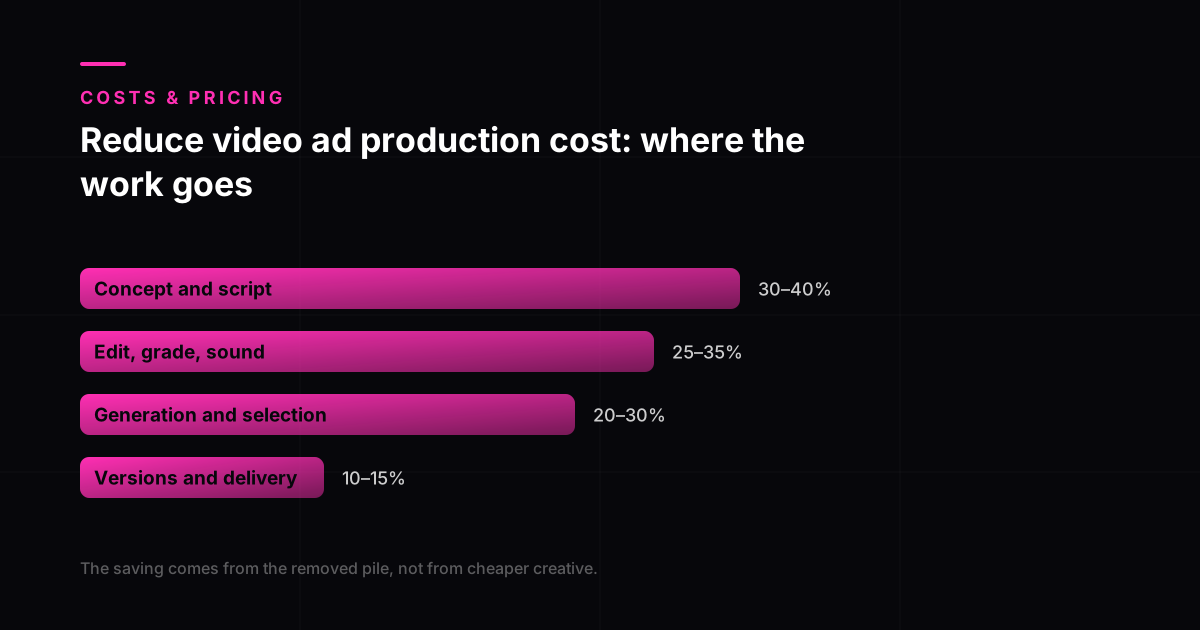
Where the money actually goes
Look at any conventional production quote and sort the lines into two piles: things the viewer sees, and things that exist so the shoot can happen. Removing the second pile is most of how smaller brands now compete with big-budget advertisers.
| Cost | Does the viewer see it? | Removed by AI production |
|---|---|---|
| Concept and script | Yes, in the result | No. Still needed. |
| Editing, grade, sound design | Yes | No. Still needed. |
| Crew day rates | No | Yes |
| Location or studio hire | Indirectly | Yes |
| Talent fees and usage rights | Indirectly | Yes |
| Travel and logistics | No | Yes |
| Equipment hire and insurance | No | Yes |
| Sample shipping | No | Yes |
| Reshoots | No | Yes |
| Scheduling delay | No, but costs you the window | Yes |
The second pile is usually the larger one. That is the saving. It is not a quality reduction, because none of it was reaching the screen.
- Concept and script
- 30 to 40%
- Edit, grade, sound
- 25 to 35%
- Generation and selection
- 20 to 30%
- Versions and delivery
- 10 to 15%
Our own split across recent projects. Everything in the top and second rows survives the move to AI production, which is why the saving comes from the removed pile, not from doing the creative more cheaply.
Read that against the first table and the logic of the saving becomes obvious. The categories AI removes are not on this chart at all, because they never reached the screen. The categories that remain are the ones deciding whether the ad works. Cutting into those is not a saving, it is a discount on the outcome.
What you should still pay for
Cutting these is where cheap AI video starts looking cheap.
- Concept and script, locked before generation. The single biggest determinant of whether the ad works. Nielsen puts creative at about half of advertising-driven sales effect, as much as every other factor combined.
- A real edit. Pacing, cut rhythm and structure are what stop generated footage feeling uniform and lifeless.
- Colour grade. Ungraded generated footage has a flat, plastic consistency that audiences read as fake even when they cannot say why.
- Sound design. Not a music bed. Built sound is most of the gap between a commercial that feels premium and one that feels generated.
- Platform-specific cuts. One file resized three ways underperforms on all three.
The number that actually matters
Cost per video is the wrong metric. Cost per tested variant is the right one, because testing is what produces the result you are buying.
A single expensive ad that fails costs you its full price plus the campaign window. Five cheaper variants where one wins costs less in total and leaves you knowing which hook works, which is an asset you reuse on every future round.
Five practical ways to reduce video ad production cost
- Batch. Brief five videos at once rather than one a month. The setup cost is paid once.
- Reuse structure. Once a format converts, produce against that skeleton instead of designing each ad fresh.
- Fix your product photography first. Good stills make everything downstream cheaper and better. Poor stills limit output no matter what is spent afterwards.
- Cut for platform at the brief stage, not afterwards. Retrofitting ratios costs more than planning them.
- Do not buy rush delivery by default. Standard timelines are already days, and rush pricing exists because someone else moves down the queue.
How large the production saving actually is
Published comparisons put the reduction from AI production at roughly 70 to 90 percent against conventional shooting, driven by removing crew, equipment and studio rather than by doing the creative work more cheaply. Reported per-minute figures illustrate the gap starkly, from a few dollars a minute for generation against a thousand dollars and up for traditional production of comparable length.
Two honest qualifications on that range. It compares against the specific quality tier of traditional production being replaced, so the percentage looks very different against a two-person crew than against a full unit. And it measures production only. The concept, script, edit and sound design do not get cheaper, which is exactly as it should be, because those are the parts that decide whether the ad works.
Where cutting costs backfires
Skipping the script stage to save a day. Accepting the first render because revisions feel like an extra. Choosing a vendor purely on lowest quote and then paying again to redo it. Running an untested single ad because variants looked like an upsell.
Each of those saves a small amount at the production stage and costs a larger amount in media spend, which is almost always the bigger number. Our own rates are published in full on the pricing page, per format, so the comparison above can be made against real figures rather than a quote you have to ask for.
The savings that are not savings
Four cuts that cost more than they save
Each of these reduces the invoice and increases the total spend, which is why they keep being made.
- Skipping the script stage. Saves a day, and produces the one thing that reliably fails: an ad with no argument.
- Resizing one file for every platform instead of cutting separately. Saves two edits, wastes the media spend behind three weak placements.
- Buying one ad instead of three variants. Saves two thirds of production, and leaves you with a single bet at long odds.
- Choosing the lowest quote without comparing deliverables. Frequently means paying twice, once to produce and once to redo.
The common thread is that all four save at the production stage and cost at the media stage, which is almost always the bigger number. Motion's study of 578,750 Meta creatives puts the winner rate near 5 percent, so the third one is the most expensive of the four despite looking like the most prudent. the testing method in full covers sizing the round properly, and the cost side in full covers what the variants actually cost.
The one line that should never be cut
If the budget has to give somewhere, give up variants before you give up the concept. The concept and script are where the outcome is decided, before anything is generated or shot. Every other line in the quote can be trimmed and recovered later. That one cannot: a cheaper version of the wrong argument is still the wrong argument, and the media spend behind it costs more than the saving.
Sizing the production budget against the media budget
A production quote only means something next to what you will spend distributing it. Gartner's 2026 CMO Spend Survey puts total marketing budgets at 7.8 percent of company revenue, and the FICCI-EY report shows Indian digital advertising taking about 63 percent of all ad spend. Creative is a minority line inside a minority line, so a production cost that rivals the media budget behind it has the proportions wrong, whichever direction you cut.
Frequently asked questions
How can I reduce video ad production costs?
Start by removing the logistics rather than the craft. Crew, location, travel, scheduling and reshoots are where most of a traditional budget goes and none of it reaches the screen. Decide aspect ratios at the brief stage rather than retrofitting them, batch production so setup is paid once, and supply good product photography, which makes everything downstream cheaper.
What should I never cut from a video budget?
The script, the concept and the edit. These are usually the smallest lines on a quote and they determine whether the ad works at all. Cutting them produces a cheaper video that costs more overall, because the media spend behind a weak ad dwarfs whatever was saved in production.
Is the cheapest quote ever the right choice?
Only when the low price reflects lower overheads rather than skipped work. Ask specifically what is included: who writes the hook, whether platform cuts are separate edits or resizes, what rights you get, and how many revisions. A quote that is cheap because it excludes the thinking is not cheaper, it is a different product.
What is cost per tested variant and why does it matter?
It is your total creative spend divided by the number of variants you actually got into market. It matters because paid social rewards testing, so a budget producing one polished ad is usually worse value than the same budget producing several testable ones. Judging production spend per video rather than per variant hides this completely.
Does rush delivery ever make sense?
Occasionally, for a genuine deadline you cannot move. As a default it is poor value, because standard AI production timelines are already days rather than weeks, and rush pricing exists because somebody else moves down the queue. Paying a premium to compress a five day turnaround into three rarely changes a campaign outcome.
Is it cheaper to produce everything in one batch?
Materially, yes, and it is the most reliable saving available. The concept, the script direction, the look and the setup are paid once and reused across everything briefed in the same run. Five videos briefed together cost far less than five briefed a month apart, because the second brief in a batch inherits decisions the second brief in isolation has to make again. The practical version is to plan a quarter of creative at once even if you release it monthly.
Should I cut costs by reusing one video across every platform?
No, and this is the saving that most reliably costs more than it saves. A Meta cut, a listing video and a product page loop have different lengths, different safe areas and different sound assumptions. One file resized to three shapes produces three worse ads rather than three ads, and the wasted media spend behind them exceeds what separate edits would have cost. Cut separately from the same footage. That part genuinely is cheap.