AI Video Ads vs Traditional Video Ads: An Honest Comparison
AI production wins on speed, cost per variant and iteration. Traditional production wins on human performance, real locations and fine material detail. For paid social, where creative fatigues in weeks and testing volume decides results, iteration speed matters more than either cost or polish.
AI video ads vs traditional video ads: the comparison in full
| AI production | Traditional production | |
|---|---|---|
| First cut | 3 to 5 days | 3 to 6 weeks |
| Crew | None | Director, DOP, gaffer, stylist, talent |
| Location | Generated | Hired, plus travel and permits |
| Product samples | Not shipped | Shipped, then returned |
| Cost of variant two | Hours of work | A second shoot day |
| Changing one line | A re-render | A reshoot, if talent is free |
| Talent usage rights | Nothing to license | Time-limited, renewable |
| Human performance | Weak | Strong |
| Specific real location | Cannot do it | Can do it |
| Fabrics, liquids, reflections | Still unreliable | Reliable |
| Where budget goes | Concept, script, edit, sound | Logistics, people, equipment |
Where traditional still wins, plainly
- A film that lives or dies on a real actor carrying real emotion. AI presents. It does not act.
- A location your audience must recognise. AI can build a place. It cannot build that place.
- Material detail current models render badly: certain fabrics, liquids, reflective and transparent surfaces.
- Anything where a real, verifiable customer must be on camera making a claim.
If your brief sits in that list, AI is the wrong tool and any honest producer will tell you so at the brief stage.
Where AI wins, plainly
- Volume. Ten variants of a tested concept is a normal week, not a normal budget. This matters more than it sounds: Motion's study of 578,750 Meta creatives puts the winner rate near 5 percent, so the method that can afford twenty attempts beats the one that can afford two.
- Speed to market. A trend, a competitor move or a stock issue can be answered the same week.
- SKU coverage. Forty products can each get a video. A studio day per SKU never made financial sense.
- Iteration. The ad that underperforms gets fixed rather than written off.
The difference that actually matters
Cost gets all the attention and it is the least interesting difference. The one that changes results is iteration speed.
Paid social creative fatigues in weeks. A traditional production cycle of 3 to 6 weeks means your creative is arriving at roughly the speed it decays. You are running to stand still, and every ad has to be right first time because there is no second attempt inside the campaign window.
At 3 to 5 days, the cycle inverts. You can be wrong on purpose, cheaply, early, and use what you learn while the campaign is still live. That is a different way of working, not just a cheaper one.
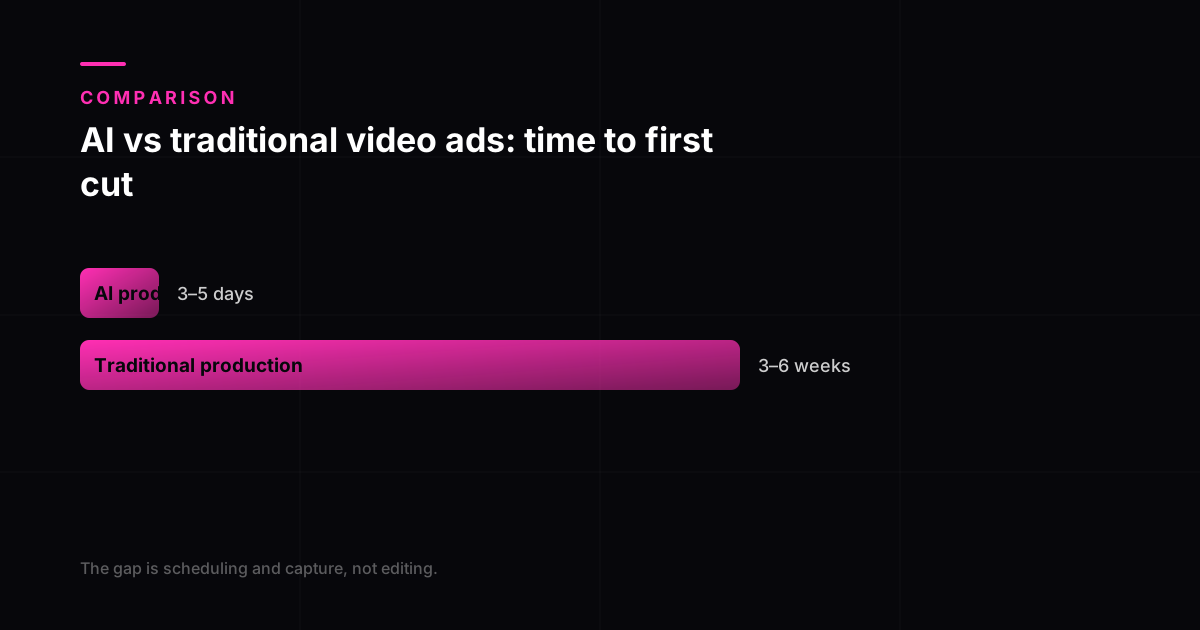
- AI production
- 3 to 5 days
- Traditional production
- 3 to 6 weeks
Same brief. The gap is scheduling, crew and capture. The edit takes about as long either way.
Why the speed gap compounds
The advantage is not one cycle, it is how many cycles fit in a quarter. Traditional production at three to six weeks gives you roughly four to six rounds a year. AI production at three to five days gives you that many in a quarter, and each round starts from what the last one taught you. Two teams with identical budgets end the year with very different amounts of knowledge about their own audience.
There is a floor on how fast you should actually go, and it is set by the platform rather than by production. Meta ad sets need roughly 50 optimisation events in a rolling seven-day window to leave the learning phase, so a round that ends after three days is measuring noise. The practical cadence is produce fast, then let each round run long enough to mean something. the creative testing method sets out the arithmetic.
The hybrid most brands land on
Shoot the hero asset traditionally, once a year, for the brand film and the website. Produce everything downstream with AI: the variants, the SKU coverage, the seasonal cuts, the platform-specific edits.
That splits spend where each method is genuinely stronger, and it is the arrangement most likely to survive a budget review, because the expensive part has one visible flagship attached to it. What the traditional half costs is set out in what a traditional TVC costs; the AI half is in what the Indian market charges. Examples of both are on our work page.
What "quality" actually means in this comparison
Most arguments about AI versus traditional quality are really arguments about two different things wearing one word. Separate them and the disagreement mostly dissolves.
| Sense of "quality" | Who wins | Why |
|---|---|---|
| Technical finish: grade, sound, resolution | Level | Both are finished in the same edit suite by the same craft |
| Performance: a real actor carrying emotion | Traditional | AI presents; it does not act |
| Fidelity to a real place or product | Traditional | A generator builds a plausible place, not that place |
| Consistency across many assets | AI | One look, applied identically across fifty cuts |
| Whether the idea is any good | Neither | That is decided in the brief, before either method starts |
The last row is the one that decides campaigns. Nielsen's effectiveness research measured reach, targeting, recency, context and creative and found creative the largest of the five. Production method is not on that list at all. A well-conceived AI ad beats a beautifully shot bad idea, and the reverse is equally true.
How to decide for your next campaign
- Do you already know what works? If yes, traditional quality is worth paying for. If no, buy attempts instead of polish.
- Does the brief need a real person to act, or a real place to be recognised? That is a traditional shoot, and no budget argument changes it.
- How many cuts, ratios and SKUs does this campaign actually need? Past about three, the arithmetic stops being close.
- How fast does your creative fatigue? If it burns out in weeks, a six-week production cycle is arriving late by design.
- Is there a compliance or disclosure dimension? Both routes can handle it, but only if it is decided at the brief stage.
If more than two of those point the same way, the decision is already made. Nine questions to ask an AI video agency covers how to test whether a producer will tell you honestly when AI is the wrong tool.
Frequently asked questions
Are AI video ads as good as traditionally produced ones?
For many kinds of work, yes, and for some, not yet. Product-led films, atmospheric brand pieces and stylised work reach a genuinely high standard. What remains harder is a long unbroken performance from a consistent human character, a specific real location your audience recognises, and flawless fine material detail. The honest approach is choosing projects that play to what each method does well.
What is the main advantage of AI video ads?
Iteration speed, more than cost. At three to five days you can be wrong on purpose, cheaply and early, then use what you learn while the campaign is still running. At three to six weeks you are matching the pace of creative fatigue rather than beating it, so every ad has to be right first time.
When is traditional production still worth paying for?
When the film depends on a real performance carrying real emotion, when a recognisable real location matters, when a celebrity endorsement is the point, or when fine material detail such as fabric, liquid or reflective surfaces has to be flawless. Also when you already know exactly what works and are buying quality rather than searching for the answer.
Can I mix AI and traditionally shot footage in one ad?
Yes, and hybrid is what most real projects already are: generated footage, a real voice, real product photography as reference, and a human edit. The thing to watch is consistency of grade and lighting across the join, since mismatched footage is what makes a film read as assembled from parts.
Does AI production mean lower quality?
It means a different set of constraints, not a lower ceiling. Most AI video that looks cheap is cheap for reasons that have nothing to do with the model: uniform shot lengths, no colour grade, a stock music bed and no point of view. what separates premium from cheap covers what actually separates the two.
Do I have to disclose that an ad was made with AI?
On the major platforms, yes, and it is the advertiser's responsibility rather than the producer's. Meta publishes an AI content labelling policy and expects advertisers to label synthetic media; TikTok requires the same. Separately, the FTC's rule on fake reviews and testimonials means a generated presenter cannot claim to be a real customer, whatever the labelling says. Disclosure itself costs you very little in performance, since audiences largely expect it now. Getting it wrong costs an ad account.