How to Choose an AI Video Agency: 9 Questions to Ask First
The fastest filter is to ask what happens when the first cut misses, who owns the footage, and whether the price is published. An agency doing real work answers all three immediately. A reseller running a subscription hedges on all three, because the answers depend on a tool they do not control.
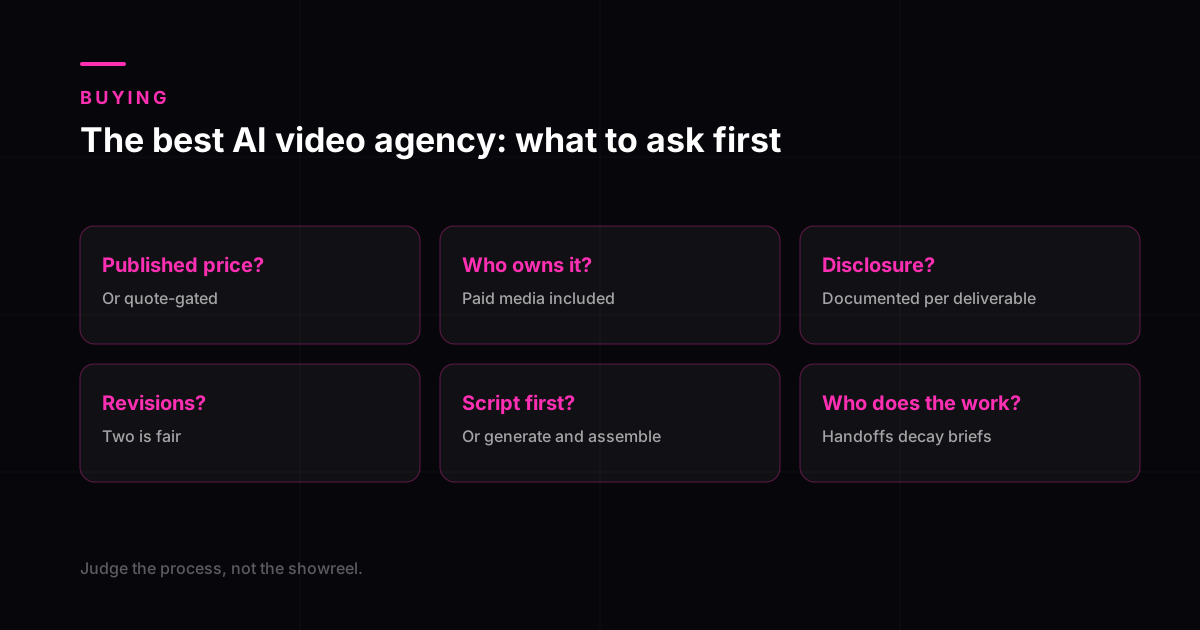
Why the best AI video agency is hard to judge from outside
AI video has almost no barrier to entry. A subscription and a weekend gets anyone a portfolio page. The reels on two websites can look identical while the work behind them is completely different.
So judge the process, not the showreel. These nine questions do that, and every one of them is answerable in a single email before you book a call.
1. What is the price, and is it published?
A published price means someone has done enough of this work to know what it costs them. Quote-gating usually means the number is being set by what they think you can pay. Neither is disqualifying on its own, but the published one tells you more.
2. Who owns the video, and for how long?
You want full commercial rights, on final payment, with paid media included and no time limit. Ask specifically about paid media. Some contracts grant organic use and quietly exclude advertising, which is the one use you were buying it for.
3. How do you handle AI disclosure?
First settle the shape of supplier. Freelancer, agency or in-house is the prior question. Labelling synthetic media is an advertiser obligation on both Meta and TikTok, and Meta publishes its AI content labelling policy. The FTC's rule on fake reviews and testimonials prohibits a testimonial from a person who does not exist. An agency that cannot answer this clearly has not read the policies, which means the compliance risk lands on you rather than on them.
4. How many revision rounds are included?
Two is a fair standard. One is tight. Unlimited is a warning sign, not a benefit, because it usually means the process has no approval stage and expects to iterate its way to something acceptable.
5. What happens before anything gets generated?
The right answer involves a script and a concept, approved by you, before a frame exists. If generation starts first and the story is assembled from whatever came out, you are buying a slot machine.
6. Will you tell me if AI is the wrong tool for this?
There are real limits. A film needing a genuine human performance carrying real emotion. A specific real location your audience recognises. Fine material detail like certain fabrics, liquids and reflective surfaces, which AI still renders badly. An agency that claims no limits has either not hit them yet or will not tell you when they do.
7. Which models do you use, and why that one?
There is no best AI video model, and anyone who names one is describing their subscription. The useful answer is per-shot reasoning: one model for photoreal product motion, another when the shot needs believable physics, another for directed camera work, and a real camera when none of them can do it.
8. Can I see the same product cut for two different platforms?
Meta wants a hook in two seconds and captions that work on mute. Amazon wants clean product focus and a listing-compliant cut. Shopify wants a short loop that does not slow the page. If the portfolio only ever shows one export resized three ways, they are not cutting for platforms, they are exporting for them.
9. Who is actually doing the work?
Ask whether you will speak to the person making the video. Handoffs are where briefs decay. This is also where a small operation genuinely beats a large one, and where a large one should be able to explain its process well enough that it does not matter.
The nine questions, and what the answers mean
| Ask this | A good answer | A warning sign |
|---|---|---|
| What is the price, and is it published? | A published number, or a real range given immediately | Quote-gated with no range at all |
| Who owns the video, and for how long? | Full commercial rights on final payment, paid media included, no time limit | Organic use granted, paid media quietly excluded |
| How do you handle AI disclosure? | Names the Meta and TikTok labelling rules and the FTC limit on synthetic endorsers | A shrug, or "nobody really checks" |
| How many revision rounds are included? | Two, defined, with an approval stage | Unlimited |
| What happens before anything is generated? | A script and concept you approve before a frame exists | Generation first, story assembled from the output |
| Will you tell me if AI is the wrong tool? | Names specific limits: human performance, real locations, fabric and liquid detail | Claims there are no limits |
| Which models do you use, and why that one? | Per-shot reasoning across several, including using a real camera | One model named as the best |
| Can I see one product cut for two platforms? | Genuinely different cuts, not one export resized | The same file in three aspect ratios |
| Who is actually doing the work? | You speak to the person making the video | Cannot say, or several handoffs deep |
Three things a portfolio should show you
- The first two seconds of every piece. That is where an ad is won, and a portfolio that opens on logos is telling you nobody thought about the feed.
- The same product handled more than one way, which proves the decisions are being made per brief rather than per template.
- Written context. What the constraint was, what was decided, what happened. A muted autoplay grid with no words is a showreel, not evidence.
Two questions that reveal genuine expertise
Beyond the nine, these two separate someone who has actually produced this work from someone reselling a subscription, because both have answers only experience supplies.
- Which parts of my product will be hard to generate? A real producer names them without hesitation: hands in close-up, legible packaging text, pouring liquids, fabric in motion, and holding a character consistent across shots. Someone who says everything is fine has not hit the limits yet.
- How will you avoid every shot being the same length? Models generate in fixed units of roughly 5 to 15 seconds. Anyone who has edited generated footage knows the clips must be cut down rather than used whole, and will say so. This is the single most common reason AI video looks cheap.
The red flags, condensed
- Guaranteed performance. Nobody can promise a video will convert, and anyone promising it is guessing with your budget.
- No published pricing and no pricing conversation until after a call.
- Vague answers on rights, usage or disclosure.
- A portfolio with no words on it.
- Unlimited revisions offered as a headline benefit.
- A single named model presented as the best one.
None of this requires you to understand AI video production. It requires the other side to explain their process in plain language. If they cannot, that is the answer.
What the answers should cost you
Price is the question people ask first and weigh worst, because a quote is only comparable once you know what is inside it. Two numbers that look 3x apart are often quoting different amounts of work.
- Concept and script
- 30 to 40%
- Generation and selection
- 20 to 30%
- Edit, grade, sound
- 25 to 35%
- Versions and delivery
- 10 to 15%
Our own split across recent AI ad projects. The proportions move with the brief, but generation is consistently the smallest expensive-looking part, which is why a quote priced only on render time is quoting the wrong thing.
That shape explains the single most common pricing mistake: assuming the generation is the product. It is roughly a quarter of the work, and it is the quarter a subscription can do for anyone. The rest is why two agencies with identical tools return different ads. AI video agency vs AI video tool covers where the line actually falls, and AI video ad cost in India covers the market rates. Ours are published in full on the rate card, which is the same test question nine applies to everyone else.
Frequently asked questions
How do I choose an AI video agency?
Judge the process rather than the showreel, because the reel tells you what a tool can render and not what the team decides. The three fastest filters are what happens when the first cut misses the brief, who owns the footage and the commercial rights, and whether pricing is published. A team doing real work answers all three immediately.
What questions should I ask before hiring?
Who writes the hook and what is it based on. How many aspect ratios are included and whether they are separately cut or resized. Who handles AI disclosure and whether you get documentation. What commercial rights you receive and for how long. How many revision rounds are included and what counts as one. And, most revealing, when they would tell you AI is the wrong tool for a brief.
Is a cheaper AI video agency worth the risk?
It depends what the low price is buying. If it reflects lower overheads, that is fine. If it reflects skipping the concept, the script and the platform-specific cuts, you are buying rendering rather than advertising. The cost of a weak ad is not the fee, it is the media spend you put behind it while it fails to work.
Why is unlimited revisions a red flag?
Because it usually signals no defined scope and no confidence in getting the brief right. Two well-defined revision rounds with a clear definition of what counts as a revision is a stronger commitment than unlimited, which in practice tends to mean a long grind toward something nobody is accountable for. It also quietly shifts the burden of direction onto you.
Should an agency be able to guarantee results?
No, and anyone offering it is guessing with your budget. Creative performance depends on the offer, the audience, the landing page and the market, none of which a producer controls. What a good agency can commit to is process: an approved script before production, defined deliverables, stated rights and a named person accountable for the work.
How do I compare two AI video quotes that look very different?
Put both against the same deliverable list before comparing the numbers, because a large gap usually means they are quoting different amounts of work rather than different rates. Check five things: how many separately cut aspect ratios are included, how many variants, what commercial rights you get and for how long, how many revision rounds and what counts as one, and whether concept and scripting are inside the price or billed separately. Two quotes only become comparable once those five match.