Ad Film Making Cost in India: What a 30-Second Commercial Costs
Ad film quotes in India vary enormously because the number is driven by production days, crew size, talent and location rather than by the finished length. A 30-second commercial and a 60-second commercial shot on the same day cost almost the same. What moves the price is how many days, how many people and whose face is on screen.
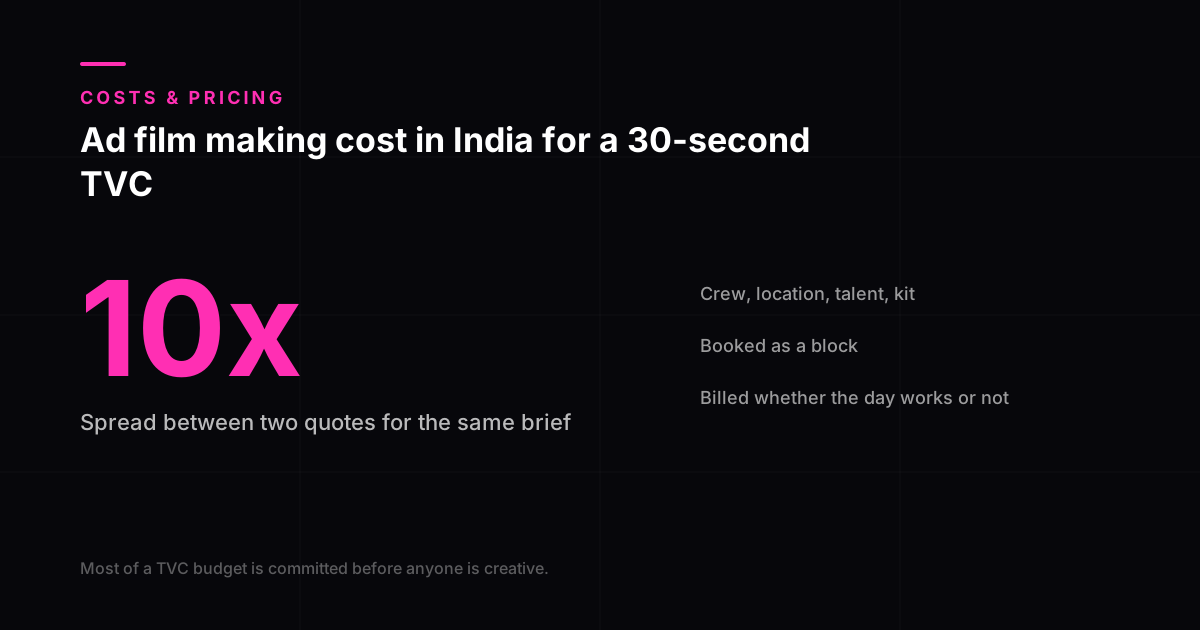
Why two quotes for the same brief differ by 10x
Because they are not the same product. One is a two-person crew and a rented space. The other is a director with a reel, a full unit, a location, and a known face. Both are honestly described as an ad film.
Ask what is actually in the number before comparing quotes. The line items below are where the money goes.
Ad film making cost in India for a 30-second TVC
Published Indian production figures for 2026 cluster into fairly clear bands, and the thing that moves you between them is almost always whose face is on screen.
- Small-business TVC
- ₹5L to ₹15L
- Non-celebrity, single location, full crew
- ₹15L to ₹25L
- With a regional actor or mid-tier influencer
- ₹30L to ₹50L
- With a national celebrity
- ₹75L and up
Production only, before any media spend. The gap between the second and third bars is almost entirely the face: same script, same location, same crew. That single decision moves the budget more than every other choice combined.
Note the last column on that final row. None of these figures include media. Buying the airtime to run the film is a separate budget, and it is routinely larger than the production one.
What an ad film budget contains, line by line
Typical published Indian rates for the individual components. Useful for reading a quote you have been given, and for spotting which line somebody has quietly inflated or left out.
| Line item | Typical range | Viewer sees it? |
|---|---|---|
| Scriptwriting | ₹15,000 to ₹50,000 | Yes, in everything |
| Storyboarding | ₹8,000 to ₹20,000 | Indirectly |
| Recce and location scouting | ₹5,000 to ₹15,000 per day | No |
| Director of photography | ₹25,000 to ₹1,00,000 per day | Indirectly |
| Camera package, 4K or 8K | ₹10,000 to ₹40,000 per day | Indirectly |
| Lighting and grip | ₹8,000 to ₹25,000 per day | Indirectly |
| Talent | ₹10,000 to ₹1,00,000 and up | Yes |
| Editing | ₹15,000 to ₹60,000 | Yes |
| Colour grade | ₹10,000 to ₹40,000 | Yes |
| Voice over | ₹8,000 to ₹30,000 | Yes |
| Sound design and mix | ₹10,000 to ₹25,000 | Yes |
| Music or jingle | ₹30,000 to ₹3 lakh | Yes |
| VFX and motion graphics | ₹25,000 to ₹5 lakh | Yes |
Roughly half those lines never reach the screen. They exist so the shoot can happen. That is not waste in a traditional production, it is the cost of doing it, but it is worth seeing clearly. What a video production company actually does breaks those stages down line by line.
The usage rights trap
Talent fees are usually quoted for a term and a territory. One year, India, digital only. Extending to television, or to a second year, or to another country, triggers a renewal negotiation with someone who knows you need it.
Read this clause before signing. A film you cannot legally run next year is not an asset, and this catches brands out repeatedly.
What changes with AI production
- Production days, crew, location, equipment and styling come out of the budget entirely.
- Talent usage rights disappear, because there is no real face to license.
- Concept, script, edit, grade, sound design and music stay, because those are what make it feel like a commercial rather than footage.
- The schedule compresses from weeks to days, which often matters more than the money.
When to still shoot traditionally
When the film depends on a real performance carrying real emotion. When you need a specific real location your audience recognises. When a celebrity endorsement is the point. When fine material detail like fabric, liquid or reflective surfaces must be flawless.
Those are real limits and a good producer will name them at the brief stage rather than after you have paid.
Where the money goes on a traditional ad film
The reason a TVC budget resists compression is that most of it is committed before anyone is creative. Crew, location, talent and equipment are booked as a block, and they are billed whether the day goes well or badly.
That is the structural difference from AI production rather than a difference of degree: the traditional invoice front-loads fixed costs that never reach the screen, while an AI invoice concentrates on concept, edit and sound, which do. Neither is automatically better value. A shoot buys a real performance and a real place, and those remain genuinely uncopyable. It does mean the two cannot be compared line for line, and a quote that looks ten times higher is usually buying a different set of things rather than the same thing at a markup.
What survives the switch is the part that decides outcomes anyway: Nielsen attributes about half of advertising-driven sales effect to the creative itself, as much as reach, targeting, recency and context combined. AI versus traditional video ads sets out where each still wins, the Indian rate card by format covers the other side of the quote, and our own figures are published per format on the pricing page.
How to brief for an accurate quote
- Finished length and how many cutdowns you need.
- Every aspect ratio required, listed at the start rather than added later.
- Where it runs and for how long, since that determines rights.
- Whether a real human must be on camera.
- Your actual deadline, not a comfortable one.
Why the creative half survives either way
Whichever route you take, the same part of the budget decides whether the film works. Nielsen found creative contributes as much to advertising-driven sales as every other factor put together. That contribution is the concept, the script and the edit: the lines that appear on both a TVC quote and an AI one. Cutting them is the only saving that reliably costs more than it saves.
The market these budgets sit in
Worth knowing which way the money is moving before committing to a shoot. The FICCI-EY media and entertainment report puts Indian advertising growth at 13.5 percent in 2025, with digital advertising up 26 percent to ₹947 billion and now about 63 percent of all ad revenue. A thirty-second TVC is priced for a channel that is no longer where most Indian ad money goes, which is the commercial argument behind this whole comparison rather than a technical one.
Frequently asked questions
How much does an ad film cost in India?
For a 30-second TVC in 2026, published figures put a non-celebrity single-location film with a full professional crew at roughly ₹15 lakh to ₹25 lakh. Small-business productions are genuinely achievable at ₹5 lakh to ₹15 lakh. Adding a regional actor or mid-level influencer takes it to ₹30 lakh to ₹50 lakh, and a national celebrity past ₹75 lakh. None of those include the media budget to actually run it.
Why is there such a huge range in ad film quotes?
Because a two-person crew in a rented space and a full unit with a known face are both honestly described as an ad film. The single biggest swing factor is talent: the same script, same location and same crew can double or triple in cost purely on whose face appears. After that it is production days, then post-production complexity, particularly VFX and original music, which each span an order of magnitude on their own.
Does a 60-second ad cost twice as much as a 30-second one?
No, and this surprises people. Cost is driven by how many days you shoot, how many people are on set and whose face is on screen, not by finished runtime. Two films shot on the same day with the same unit cost close to the same regardless of final length. Extra length affects post more than production.
What are talent usage rights and why do they matter?
Talent fees are normally quoted for a defined term and territory, such as one year, India, digital only. Running the film on television, into a second year, or in another country triggers a renewal negotiation with someone who knows you need it. Read this clause before signing, because it is the most common way a finished film becomes unusable.
Is AI production actually cheaper for a commercial?
For the production stage, substantially, because days, crew, location, equipment, styling and talent rights all come out of the budget. Concept, script, edit, grade, sound design and music stay, since those are what make it feel like a commercial rather than footage. The schedule compressing from weeks to days often matters more to a launch than the money does.
When should I still shoot a commercial traditionally?
When the film depends on a real performance carrying real emotion, when you need a specific real location your audience will recognise, when a celebrity endorsement is the point, or when fine material detail such as fabric, liquid or reflective surfaces has to be flawless. A good producer names these limits at the brief stage rather than after you have paid.