What Does a Video Production Company Actually Do?
A video production company takes a brief and returns a finished video, handling three stages: pre-production (concept, script, planning), production (capturing or generating the footage), and post-production (edit, colour, sound, delivery). Most of the work that determines whether the video succeeds happens in the first stage.
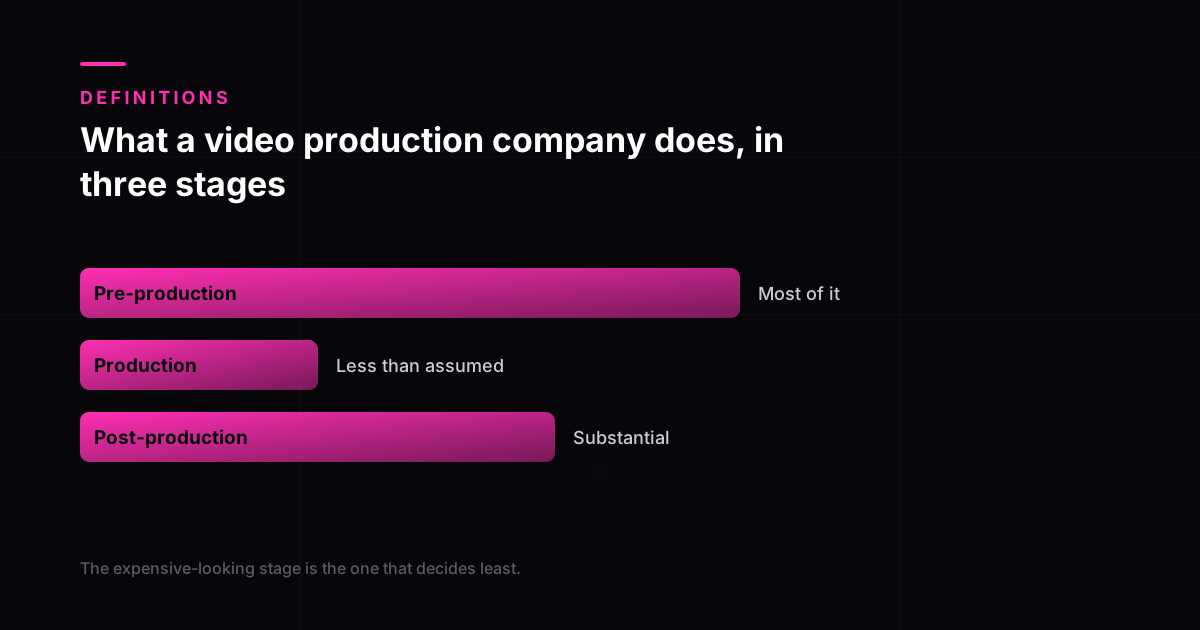
What a video production company does, in three stages
| Stage | What happens | Share of the outcome |
|---|---|---|
| Pre-production | Brief, concept, script, storyboard, planning | Most of it |
| Production | Shooting, or generating the footage | Less than people assume |
| Post-production | Edit, colour grade, sound design, versions, delivery | Substantial |
That middle row surprises people. Capture is the visible, expensive-looking part, but a technically perfect shoot of a badly conceived idea produces a badly performing video. The decisions in stage one set the ceiling.
What pre-production actually involves
- Interrogating the brief. Who is this for, what should they do, what stops them.
- The concept. One idea the film is about, not a list of things to include.
- The script. Locked and approved before anything is captured or generated.
- Format decisions. Length, aspect ratios, platform-specific cuts, captions.
- Compliance. Claims, disclosure, rights, anything category-regulated.
Why this stage carries the most weight is measurable rather than a matter of taste. Nielsen found creative to be the largest single driver of advertising-driven sales, outweighing reach, targeting and placement individually. The creative is settled here, before a camera is unpacked or a model is prompted, which is why a company that rushes this stage cannot make the time back later.
What changes with AI production
Stage two changes almost entirely. Stages one and three barely change at all. Vendor-published comparisons put the production-stage cost reduction at roughly 70 to 90 percent and timeline reduction near 80 percent; those figures come from companies selling the method rather than from independent research, so treat the direction as reliable and the precision as marketing. What is not in dispute is the shape of the change: an entire stage is removed rather than performed more efficiently. AI and traditional video ads compared goes through where each still wins.
| Traditional | AI-produced | |
|---|---|---|
| Pre-production | Concept, script, casting, recce, scheduling | Concept, script, shot planning |
| Production | Shoot days, crew, location, talent | Generation, selection, iteration |
| Post-production | Edit, grade, sound, VFX, versions | Edit, grade, sound, versions |
| Timeline | 3 to 6 weeks | 3 to 10 days |
- Traditional shoot
- 21 to 42 days
- AI production
- 3 to 10 days
Same brief, same deliverable. The gap is scheduling and capture, not editing. Post-production takes about as long either way.
What post-production actually involves
This is the stage clients see least and underestimate most. It is also the one AI production barely touches, because none of it is about capturing footage.
The edit
Selecting takes, ordering them, and deciding pace. On an AI project the selection problem is larger rather than smaller: a generator will happily return forty usable clips, and choosing between them is judgement, not filtering. Pacing is what separates a film from a sequence of shots, and it is the single most common thing missing from cheap AI video.
Colour and sound
A colour grade makes separately produced shots look like one film. Ungraded generated footage betrays itself immediately, because each clip carries its own slightly different lighting and colour cast. Sound is roughly half the perceived quality of a video and receives a small fraction of the attention: room tone, a music bed that fits the cut, and effects placed on the actions that need weight.
Versions and delivery
One film becomes many files. A vertical cut, a square cut, a widescreen cut, a subtitled version, a muted-autoplay version with burned-in text. These are separate edits with different safe areas, not one file exported at three sizes. Captions belong here too, and they are not optional extras: WCAG requires captions on pre-recorded video at Level A.
What you should expect to receive
- A written script and concept before production starts, for approval.
- Platform-ready files in every aspect ratio agreed at the brief stage.
- A defined number of revision rounds, stated up front.
- Full commercial rights on final payment, with paid media explicitly included.
- Documentation of any AI disclosure requirements per deliverable, matched to the platform's own AI labelling policy rather than to a general assurance.
Company, studio, agency or freelancer
The labels are used loosely. What matters is who does the thinking, who does the making, and whether you will speak to either of them. Handoffs are where briefs decay, so ask directly.
- Production company. Makes the thing. Usually strongest on craft, and expects a brief rather than writing your strategy.
- Agency. Decides what to say and often subcontracts the making. You pay for the thinking and for the coordination.
- Studio. Loosely used. Sometimes a facility you hire, sometimes a production company with a nicer word.
- Freelancer. One person doing several of these jobs. Cheapest and fastest when the brief is clear, riskiest when it is not, because there is no second opinion in the room.
The distinction matters less than the handoff count. Every boundary between the person who understood the brief and the person cutting the film is a place for it to decay. Nine questions to ask before choosing an AI video agency covers how to test that in a first call, and ad film making cost in India covers what the traditional route actually bills. If you would rather deal with one producer end to end, that is what hiring an AI video creator directly means here.
What a production company will need from you
The half of the process clients control is usually the half that decides the schedule. A brief that arrives complete removes most of what makes projects run late.
- One decision-maker with final approval. Two is a delay; a committee is a rewrite.
- The actual objection you are trying to answer, not a list of features you would like mentioned.
- Brand assets in usable form: logo files, fonts, colour values, and any legal wording that must appear verbatim.
- Product photography or samples early, because poor source material limits what any method can do with it.
- Every placement the video will run in, named at the brief stage. Adding a ratio afterwards is a new edit, not an export.
- Your deadline, and which part of it is real. Most timelines are set by approvals rather than by production.
Feedback is the other half. Consolidated notes from one person, given against the script before anything is produced, cost almost nothing; the same notes given against a finished cut cost a revision round. That single habit does more for a timeline than any production method.
Frequently asked questions
What does a video production company do?
It takes a brief and returns a finished video, covering three stages: pre-production, which is concept, script and planning; production, which is capturing or generating the footage; and post-production, which is edit, colour, sound and delivery. The first stage sets the ceiling on how good the result can be, even though the second is the part that looks like the real work.
What is the difference between a production company and an agency?
Traditionally an agency handles strategy and creative direction while a production company executes the film, though in practice the labels overlap heavily and many outfits do both. The useful question is not which label they use but who develops the concept, who makes the video, and whether those are the same people. Every handoff between them is a place a brief can decay.
What should be included in a video production quote?
At minimum: an approved script and concept before production begins, platform-ready files in every aspect ratio agreed at the brief stage, a stated number of revision rounds, full commercial rights on final payment including paid media, and documentation of any AI disclosure per deliverable. If aspect ratios or usage rights are vague, the quote is not comparable to another one.
How long does video production take?
Traditionally three to six weeks for a commercial, and roughly three to ten days when produced with AI, because the shoot days, scheduling and location logistics come out. What does not compress is your own approval cycle, and in practice that is what most often sets the real timeline rather than the production itself.
Do I need a production company or can I use a tool?
A tool is the right answer when you know exactly what you want, the stakes are low and you have time to iterate yourself. A production company is worth it when the concept matters, when compliance is involved, or when the cost of a mediocre video, in media spend behind it, exceeds the saving. AI video agency vs AI video tool covers the trade properly.
Who owns the video once it is delivered?
You should, in full, on final payment, with paid media explicitly included and no time limit. This is worth reading rather than assuming, because it is the clause that most often differs between two quotes that otherwise look alike. Traditional production frequently licenses talent and music for a fixed term and a fixed set of channels, so a video you paid for outright can still expire. Ask for the position on stock assets, music, and any presenter likeness separately, since those are the three that usually carry the restriction.