Brand Film vs Product Ad: Which Does Your Launch Need?
A brand film sells the brand and the feeling. A product ad sells the thing and the reason to buy. A launch usually needs both: the film to set the tone, the ad to move units. The common mistake is buying one and expecting it to do the other job, which is how brands end up with a beautiful film that sells nothing.
People use the terms interchangeably, then wonder why the video does not do its job. They are two tools with two jobs, and the confusion is expensive in both directions. A brand film asked to drive sales this month underperforms. A product ad asked to make people love the company falls flat.
Brand film vs product ad: the difference in one line each
- Brand film: tells you what the company is about and why to care. Emotion first.
- Product ad: tells you what the thing does and why to buy it. Benefit first.
- A launch usually needs both: the film sets the tone, the ad converts the interest.
How they actually differ
| Brand film | Product ad | |
|---|---|---|
| Sells | The company and what it stands for | The product and the reason to buy |
| Opens on | A feeling, a story, a tension | The product or the problem it solves |
| Length | Sixty to ninety seconds, sometimes more | Fifteen to thirty seconds |
| Success measured by | Recall, sentiment, search lift, share | Click-through, cost per acquisition, sales |
| Shelf life | A year or more | Weeks before fatigue |
| How many you need | One, made well | Many, tested continuously |
| Lives on | Homepage, launch moment, pitch decks | Paid social, marketplace listings, retargeting |
The research behind the split
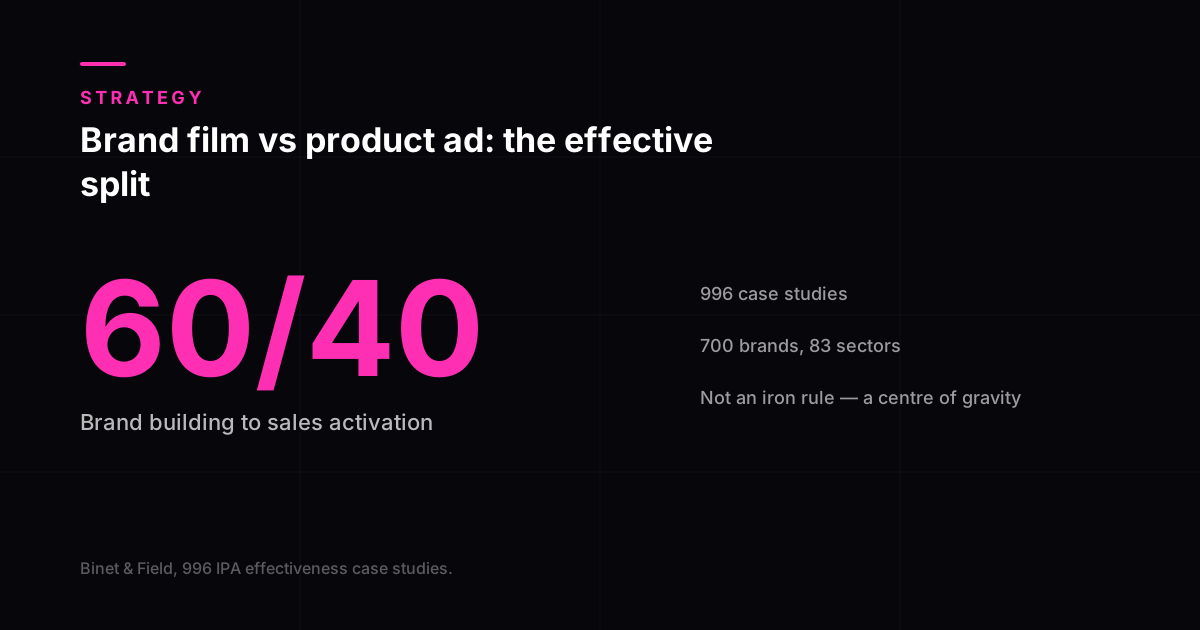
This is not just a producer’s opinion. Les Binet and Peter Field examined 996 advertising effectiveness case studies for the IPA, drawn from 700 brands across 83 sectors and more than 30 years of data, and published the result as The Long and the Short of It. The most effective campaigns split budget roughly 60 percent to brand building and 40 percent to sales activation.
Two findings from that work matter more here than the ratio itself.
- The two jobs work on different timescales. Brand building creates the mental availability that sustains share over time; activation converts demand that already exists. Measuring the first on the second’s timeline is how brand work gets cancelled.
- Binet is explicit that a single piece of advertising should not attempt both. That is the same conclusion this article reaches from the production side, arrived at from the data side.
- The effects decay when you stop. Awareness falls off within about three months of advertising stopping, and around half of tested brands showed sales declines within a year.
Why measuring them the same way ruins both
This is where most of the real money gets wasted. A brand film gets commissioned, it runs as a paid ad, somebody checks the return on ad spend after two weeks, and the number is poor. The conclusion drawn is that the film failed. What actually happened is that a tool built for memory was measured on immediate transaction.
The reverse happens too. A product ad performs well on cost per acquisition, so it gets pushed everywhere, including places where a first-time viewer meets the brand. It converts the people already looking and does nothing to make anyone care, and then the brand wonders why growth plateaus once the obvious buyers are exhausted.
If you can only afford one
Buy the product ad. This is not the romantic answer, and it is nearly always the right one for a brand that is not yet known.
Brand films work by deepening a relationship. If no relationship exists, there is nothing to deepen. A beautifully made film about the values of a company nobody has heard of is a film nobody watches. The product ad gets you customers, and customers are what make a brand film worth making later, because then there are people who care enough to watch it.
The exception is a category where the product is genuinely undifferentiated and the brand is the only real difference. Perfume, fashion, and some drinks categories work that way. There the brand film is the product ad.
How to sequence them at launch
- Before launch: the brand film goes out first, on owned channels and to press, to establish what this is and why it exists.
- At launch: product ads carry the volume, in several variants, tested against each other from day one.
- After launch: the brand film keeps working on the homepage and in pitch decks. The product ads get replaced as they fatigue.
- Ongoing: new product ads continuously, a new brand film rarely.
The budget split follows from that. The brand film is one considered piece. The product ads are a stream, and the stream is where the ongoing spend goes. If you are working out what that costs in practice, ad film making cost in India breaks down the ranges, and what makes an AI commercial look premium covers the craft side of the film itself.
How to budget for both
The usual failure is not choosing wrongly between them, it is funding one and calling it a strategy. The split has an evidence base rather than being a matter of taste.
- Brand building
- 60%
- Sales activation
- 40%
Binet and Field's analysis of 996 IPA effectiveness case studies, across 700 brands and 83 sectors. Binet is explicit that 60/40 is a centre of gravity rather than a rule, and shifts with brand size, price point and category.
What that means for a small budget
A brand with a modest budget cannot fund two separate productions, and does not need to. Produce both from one concept and one session: the brand film is the longer cut, the product ad is the shorter one built from the same material with a different ending. That is one production and two deliverables rather than two productions. The Long and the Short of It is the underlying research, and AI video ad cost in India covers what each cut costs. Our commercial production scopes them together for exactly this reason.
Frequently asked questions
Can one video be both a brand film and a product ad?
Rarely, and the effectiveness research agrees. Les Binet, whose IPA work with Peter Field underpins most modern thinking on this, has said directly that marketers should not try to do brand building and drive sales in the same piece of advertising. Practically, the two have different openings, lengths and endings, so a single video attempting both is too slow to convert and too transactional to move anyone. Produce them together from one concept, then cut them separately.
What is the 60/40 rule?
A finding from Binet and Field’s analysis of 996 IPA advertising effectiveness cases: the most effective campaigns allocate roughly 60 percent of budget to brand building and 40 percent to sales activation. Binet stresses it is not an iron rule and shifts with brand size, price and category. Its practical value is as evidence that both jobs need funding, at a time when performance takes close to 70 percent of marketing budgets.
How long should a brand film be?
Long enough to earn the feeling, which usually means sixty to ninety seconds. Because a brand film is generally watched by choice rather than served as an interruption, length is less punishing than it is in paid social. That is permission to take time, not an instruction to. A ninety second film with sixty seconds of substance is worse than a sixty second film.
Do we need a brand film if we only sell on marketplaces?
It is lower priority. On Amazon or a similar marketplace the shopper is comparing products on a page, and brand storytelling has limited room to work. Spend on listing video and product ads first. A brand film becomes worth it when you are driving traffic to your own site, where you control the whole experience and the brand can actually do work.
How often should each one be replaced?
A brand film can run for a year or more, and replacing it too often undermines the recognition it exists to build. Product ads fatigue in weeks in paid social, which is why they need to be produced as a stream rather than as a one-off. Budget for one film and many ads, not for one of each.