What Is a Product Video? Types, Uses and What Makes One Work
A product video is a short video that shows a physical or digital product in use, so a buyer can judge size, function and quality without holding it. It differs from a brand film, which sells the company rather than the item, and from a tutorial, which teaches an existing customer rather than convincing a new one.
What separates it from other video
| Video type | Sells | Audience |
|---|---|---|
| Product video | This specific item | Someone deciding whether to buy |
| Brand film | The company and what it stands for | Someone deciding whether to care |
| UGC ad | Trust, via a peer-style recommendation | Someone scrolling, not shopping |
| Tutorial | Understanding | Someone who already bought |
| Explainer | A concept or service | Someone who does not understand the category |
These get conflated constantly, and the result is a video doing two jobs badly. A launch usually needs a brand film and a product video, produced separately, not one video attempting both.
Where product video runs
- Product detail pages on your own store, where it directly affects add-to-cart rate.
- Amazon listings, which have their own specs and content rules for video.
- Paid social, where it competes for attention against everything else in a feed.
- Email and retargeting, where the viewer already knows the product exists.
- Retail and trade contexts, where the video plays without sound.
Each of these wants a different cut. A page loop should be short and silent. A Meta ad needs a hook in the first two seconds and captions that carry the message on mute. Resizing one file for all five is why so much product video underperforms everywhere at once. The listing case is the strictest: a good Amazon listing video follows Amazon's own content rules, and the same account already has to meet Amazon's image standards before zoom will even switch on.
The four things every effective one does
- Establishes scale within the first few seconds. A hand, a surface, a familiar object.
- Shows the product moving or being handled, because that is what a photo cannot do.
- Leads with one benefit rather than listing every feature.
- Works on mute. Most feed views have no sound, so captions and visuals must carry it alone.
How long it should be
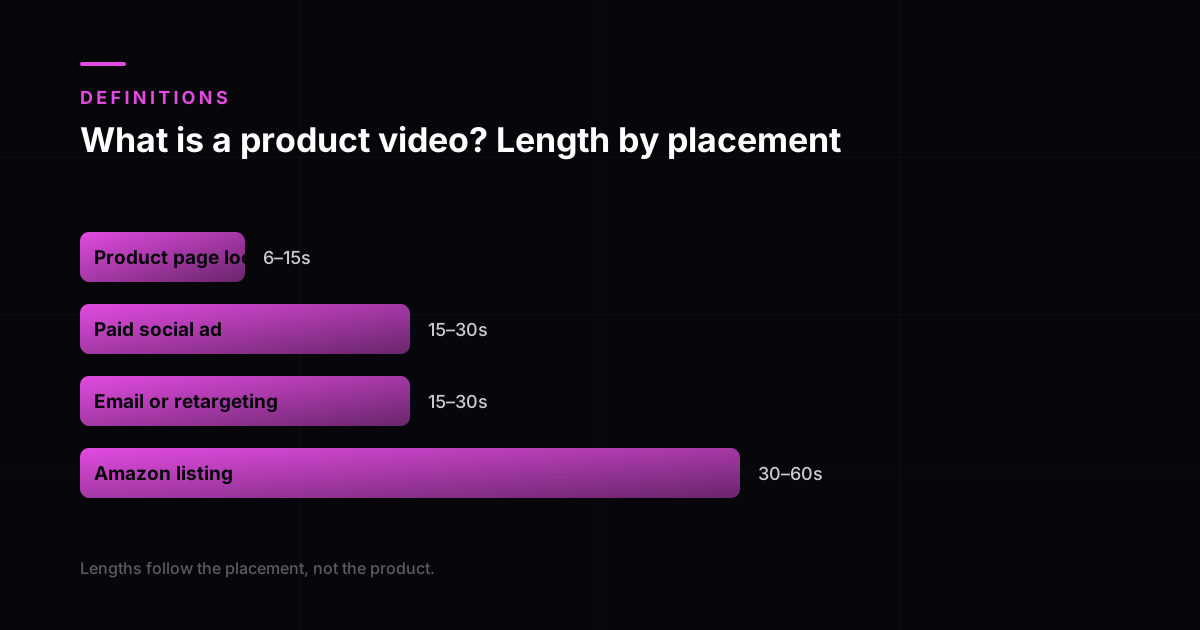
| Placement | Typical length |
|---|---|
| Product page loop | 6 to 15 seconds, silent, looping |
| Paid social ad | 15 to 30 seconds |
| Amazon listing video | 30 to 60 seconds |
| Email or retargeting | 15 to 30 seconds |
Longer is not better. A product video ends when the doubt is removed. Anything after that is where people leave, and the drop-off is measurable: videos under sixty seconds are reported to be watched to the end around 68 percent of the time, against roughly 50 percent for videos in the two to five minute range.
- Product page loop
- 6 to 15s
- Paid social ad
- 15 to 30s
- Email or retargeting
- 15 to 30s
- Amazon listing video
- 30 to 60s
Lengths follow the placement, not the product. The same footage is cut four times rather than exported four times.
Design the page loop for silence
The product page loop is the one most often got wrong, because it is the one least like an ad. It autoplays muted, it repeats, and nobody chose to watch it. That means no voiceover carries anything, the first frame has to be legible on its own, and the loop point should not jump. Anything requiring narration belongs in a longer cut further down the page.
Captions are the other half of designing for mute, and on an owned page they are also an accessibility obligation rather than a preference: WCAG requires captions on pre-recorded video with audio at Level A. Burn them in for social, where player settings are not yours to control.
Worth being straight about one point where published guidance genuinely disagrees. For a product page, some sources put the practical default at 30 to 60 seconds and others at 60 to 90. Both camps agree on the shape underneath: an autoplaying loop wants 8 to 15 seconds, and anything a visitor consciously chooses to watch can take longer. Treat that disagreement as permission to let the doubt decide the length rather than looking for a magic number.
How to brief a product video
The brief is where a product video is won, and it is shorter than most people expect. Four lines are usually enough, and each one closes off a way the video can go wrong.
- The doubt. One sentence naming what stops this specific person buying. Not "showcase the product".
- The proof. The single shot that settles that doubt: the hand for scale, the pour for texture, the fold for size.
- The placement. Page loop, paid social or listing, because that decides length, sound and safe areas before anything is shot.
- The one line the viewer should leave with. If you cannot write it, the video does not have a point yet.
That the brief matters more than the camera is not a producer's preference. Nielsen's research puts creative ahead of every other lever it measured: ahead of reach, of targeting, of recency and of placement context. The creative is decided in those four lines.
What a product video costs
Product video is usually priced per video, with the first one carrying the concept and the rest reusing it. That is why a set of five rarely costs five times one, and why buying a single video is the least efficient way to buy any. Our figures are published per format on the pricing page, and what AI video ads cost in India covers the wider market.
If you already have good stills and no budget for a shoot, that is not a dead end: a product video can be built from photographs, which changes the arithmetic for brands carrying dozens of SKUs. Our product video service works that way by default.
How to tell whether yours is working
A product video is one of the few pieces of creative you can measure honestly, because the page it sits on already reports a conversion rate. The mistake is measuring the wrong window.
- Compare the same product against itself, split-tested where your platform allows it, rather than this month against last month.
- Watch add-to-cart rate rather than time on page. A video that holds attention and sells nothing is not working.
- Check the return rate over the following quarter. On sized or physical goods this often moves more than conversion does.
- Look at whether pre-sale questions about that product fall. That is the doubt being answered before someone has to ask.
- Give it a full purchase cycle before judging. On considered purchases a fortnight tells you almost nothing.
If none of those move, the doubt you targeted was probably not the one stopping the sale. That is a brief problem rather than a production problem, and re-shooting the same idea more expensively will not fix it. Do product videos increase Shopify conversions covers the testing method in detail.
Where to put it on the page
Placement decides whether the video is watched at all. Baymard Institute found that 35 percent of e-commerce sites embed product videos where users cannot find them, while 41 percent of users do watch when the video is findable. Their recommendation is to mix video thumbnails directly into the product image gallery with a clear play icon, rather than separating them behind a tab or placing them far down the page. A third of tested users struggled with the tabbed pattern.
Frequently asked questions
What is a product video?
A short video showing a physical or digital product in use, so a buyer can judge size, function and quality without holding it. Its job is narrower than most video: it exists to remove a specific doubt that is stopping a purchase, which is why it works best when you know which doubt you are addressing.
What is the difference between a product video and a UGC ad?
A product video shows the item, usually from the brand’s point of view, to someone already considering it. A UGC ad borrows the style of a customer recommendation to catch someone who was not shopping at all. They sit at different points in the funnel, and a UGC ad that behaves like a product video tends to be scrolled past.
How many product videos do I need?
One per doubt that is actually costing you sales, which for most products means three to five rather than one. Read your support inbox and your lower-rated reviews, list the recurring objections, and build a video for the top few. One general video attempting to answer everything answers nothing in particular.
How long should a product video be?
An autoplaying loop on a product page wants 8 to 15 seconds. A video someone chooses to play can run 30 to 90 seconds, and published guidance disagrees within that band, which is a fair reflection of how much it depends on the product. The reliable finding is that videos under a minute get finished around 68 percent of the time against roughly 50 percent for two-to-five minute videos, so shorter holds more people.
Do product videos need sound?
They need to work without it. Most feed views happen on mute, and on a product page a video that suddenly plays audio is more likely to be closed than watched. Design for silence with captions and clear visuals, then treat sound as an enhancement for the minority who turn it on.
Can one product video work on my website and on Amazon and on Meta?
The same footage can, the same export cannot. A product page loop wants six to fifteen silent looping seconds. An Amazon listing video wants a warm shopper answered in thirty to sixty. A Meta ad wants a hook in two seconds. Those are three different edits from one production, and treating them as one file is the most common reason product video underperforms.