12 Product Video Ideas That Actually Sell (With When to Use Each)
The highest-converting product video formats are the problem-solution demo, the before and after, the unboxing, the scale reference and the objection-handler. Which to use depends on where the buyer is: awareness needs a hook, consideration needs proof, and the checkout stage needs the specific doubt removed.
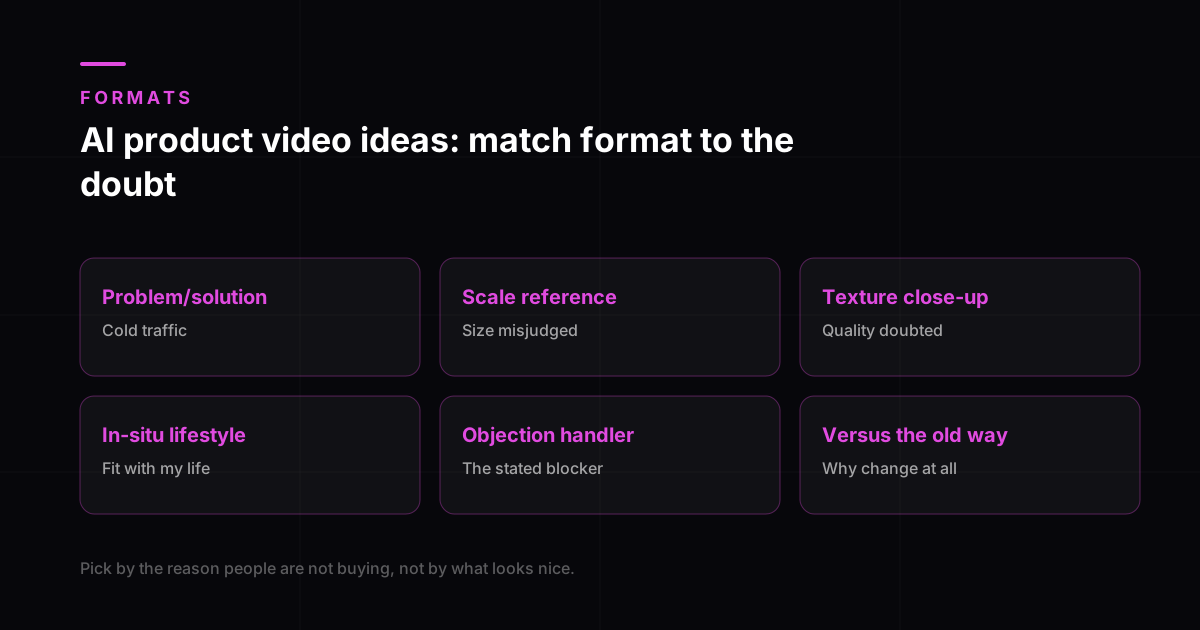
AI product video ideas: match the format to the doubt
A product video has one job: remove the specific reason someone is not buying. Different formats remove different doubts. Picking by what looks nice is why most product video underperforms.
| # | Format | Removes the doubt | Best stage |
|---|---|---|---|
| 1 | Problem then solution | "Do I even need this?" | Awareness |
| 2 | Before and after | "Does it actually work?" | Consideration |
| 3 | Scale reference | "How big is it really?" | Checkout |
| 4 | Texture and material close-up | "Does it feel cheap?" | Checkout |
| 5 | Unboxing | "What do I actually receive?" | Checkout |
| 6 | How to use, 3 steps | "Is it complicated?" | Consideration |
| 7 | In-situ lifestyle | "Will it fit my life?" | Awareness |
| 8 | Objection handler | One named objection | Checkout |
| 9 | Comparison against the old way | "Why not just keep doing X?" | Consideration |
| 10 | Ingredient or component breakdown | "What is in it?" | Consideration |
| 11 | Speed run, real time | "How long does it take?" | Consideration |
| 12 | Range or variant showcase | "Which one do I pick?" | Checkout |
Make them psychologically distinct, not just visually different
One thing has changed about how these get used, and it changes which formats you should pick together. Meta’s delivery is now heavily automated: its Advantage+ system reallocates budget between variants automatically, and more than four million advertisers now use its generative tools. When the system is choosing between your variants rather than you choosing, what it needs is variants that are genuinely different arguments, not the same argument shot five ways.
Treat that as a design constraint rather than a proven mechanic. Nobody outside Meta can see exactly how redundancy is scored. What is observable, and enough to plan around, is that automated allocation rewards a set that covers distinct objections and gets little to work with from a set that covers one objection repeatedly.
So the useful question when choosing from the table above is not how many formats you can produce, it is how many genuinely different arguments they make. A texture close-up and an in-situ lifestyle shot both say this is a nice object; they are closer to one variant than two. A texture close-up and an objection handler say completely different things, and that pairing gives the system something to work with.
This also raises the value of the formats most brands skip. The objection handler and the comparison against the old way are the two that are hardest to confuse with anything else, which is exactly why they are worth producing even though they are less pleasant to look at than a lifestyle shot.
The five worth starting with
If you can only make five, make these. They cover the widest range of doubt with the least overlap.
- Problem then solution, for cold traffic. Nothing else works as a first touch.
- Scale reference, because size confusion is one of the most common returns reasons in e-commerce.
- Texture close-up, for anything where perceived quality decides the sale.
- Objection handler, built from your actual support inbox rather than guesswork.
- Before and after, if your product produces a visible change. If it does not, skip it rather than fake it.
Three that almost never work
| Format | Why it fails |
|---|---|
| Full feature list read aloud | Nobody buys a specification. They buy one outcome. |
| Slow 360 spin on white, no context | Shows shape and nothing else. A photo does this cheaper. |
| Founder story as a product ad | Good brand content, poor conversion asset. Different job. |
How to pick yours in ten minutes
- Read your last 30 support messages and pre-sale questions. Write down every recurring doubt.
- Read your 1 and 2 star reviews. Those are objections you failed to answer before purchase.
- Rank the doubts by frequency. The top three each get a video.
- Pick the format from the table above that removes that exact doubt.
- Cut each one separately for where it runs. A Meta ad, an Amazon listing and a Shopify loop want different things.
That process takes an afternoon and it replaces guessing with reading. The doubts are already written down in your own inbox, in the customer’s own words. Prioritise the doubt that appears most often rather than the one that is easiest to film. If you would rather have the set produced than scripted one at a time, our AI product video service cuts them as a batch.
How many of these you actually need
Twelve formats is a menu, not a plan. The number to produce is set by how many distinct doubts your buyers have, and for most products that is between three and five.
- Hero product, full treatment
- 4 to 6 videos
- Core range
- 2 to 3 each
- Long tail
- 1 each
Coverage beats depth below the hero tier. One honest video on every SKU outperforms six on one and none on the rest.
Which of the twelve to pick is a question about your own inbox rather than about best practice. The doubts are already written down in pre-sale questions and one and two star reviews, in the customer's own words. There is now a second place to read them: Amazon's conversational shopping assistant exists because shoppers ask questions in sentences rather than keywords, and the questions your category gets asked are the shortlist of doubts your video should be removing.
Producing the set without producing it twice
Brief them together, cut them separately
The economics only work if the set is briefed in one run. Concept, look and setup are paid once; the fourth video reuses all of it. Briefed a month apart, each one pays the setup again. A product video can be built from existing photographs, which is what makes covering a long tail realistic at all, and what a product video has to do covers what each placement needs. Our product video service scopes them as a batch.
Why the scale reference is not optional
One format on that list is doing more work than the others. Baymard Institute's product page research found that 42 percent of users try to judge a product's size from its images, while 28 percent of sites provide no in-scale image at all, a benchmark drawn from 60 of the largest e-commerce sites. Size is the doubt buyers try hardest to resolve and the one a catalogue photo answers worst, which is why the scale reference belongs in the first five you make rather than somewhere in the twelve.
Frequently asked questions
What kind of product video converts best?
The one that removes the specific doubt stopping your buyers, which varies by product. Across most categories the consistently strong performers are the problem-solution demo for cold traffic, the scale reference for anything whose size gets misjudged, and the objection handler built from real support questions. There is no universally best format, only a best match to a known hesitation.
How do I know which doubt is costing me sales?
Read your last thirty pre-sale questions and support messages, then read your one and two star reviews. Recurring themes in the first group are doubts that delay purchase; recurring themes in the second are doubts you failed to answer before purchase. Rank by frequency and give the top three a video each.
Why do 360 spin videos not work?
Because a rotation shows shape and nothing else, and a photo carousel communicates shape more cheaply and more quickly. Spins feel productive to make because they look polished, but they answer no question a buyer actually has. If size, texture or function is the doubt, a spin addresses none of them.
Should I make one video or several?
Several, each doing one job, rather than one attempting everything. A video that tries to establish scale, demonstrate use, show texture and handle an objection runs long and answers each point too briefly to be convincing. Three focused videos placed where each doubt arises will outperform one comprehensive one.
Can I use the same video for ads and my product page?
Not the same export. An ad has to earn attention from someone who was not shopping, so it needs a hook. A product page video is watched by someone already evaluating the item, so it should get straight to the demonstration. Same footage, different edits, different opening seconds.