AI Video Agency vs AI Video Tool: Which Do You Actually Need?
Buy a tool if you already know which angle sells your product, which hook survives two seconds, and how a Meta cut differs from an Amazon cut. Hire an agency if you want those decisions made for you. The tool is cheaper per video and more expensive per good video, because the cost moves into your own hours.
An AI video agency and an AI video tool are not the same product
A tool sells rendering. You supply the decision, it supplies the output. An agency sells the decision, and the rendering comes with it.
That distinction gets lost because both are marketed with the same footage. The demo reel on a tool site and the portfolio on an agency site look similar. What differs is who did the thinking that produced them.
The comparison, including where the tool wins
| AI video tool | AI video agency | |
|---|---|---|
| Cost of the first video | Low, often a monthly fee | Higher |
| Cost of the fortieth good video | Higher, paid in your hours | Lower per video |
| Who writes the hook | You | They do |
| Who picks the angle | You | They do |
| Platform-specific cuts | One export, resized | Cut separately per platform |
| Turnaround once you know what you want | Minutes | Days |
| Turnaround including the thinking | However long thinking takes you | Days |
| Tells you AI is wrong for this brief | Never | Should, and a good one will |
| Scales without your time | No | Yes |
The maths most brands get wrong
A tool subscription looks like the cheap option because the comparison is subscription against invoice. That is the wrong comparison. The real one includes your time.
Generating a video takes minutes. Deciding what to generate takes a marketer a morning, and then the first three attempts are wrong, because writing a hook that survives two seconds is a craft with a learning curve. Multiply that by the number of variants a paid campaign actually needs.
How cheap generation has actually become
It is worth seeing the raw numbers, because they settle the argument. Current per-second API pricing for the leading video models in 2026 runs roughly as follows.
- Veo 3.1 Lite
- $0.25
- Kling 3.0
- $0.45 to $0.70
- Sora 2
- $0.50
- Veo 3.1 Fast, 720p with audio
- $0.75
- Veo 3.1 Standard, 4K
- $2.00
Approximate API pricing, 2026. The spread from cheapest to dearest is roughly eightfold, and the whole range still sits below the cost of ten minutes of a marketer’s time. That is the entire argument: the expensive input was never the rendering.
Consumer subscriptions sit in the same territory, starting around $8 a month at the entry level and running to roughly $65 to $76 a month for high-volume plans.
When the tool is the right answer
- You have an in-house marketer who already writes ad creative and knows what works for your audience.
- You need volume of a format you have already validated. The angle is proven, you just need more of it.
- Your budget genuinely cannot support agency pricing yet, and something imperfect running beats nothing running.
- You are testing whether video works for you at all, before committing real money to it.
In all four cases, buy the tool. It is cheaper and it will do the job. Anyone who tells you otherwise is selling.
When an agency is the right answer
- You do not know which angle sells your product yet, and finding out by trial and error is expensive.
- You need the same product cut differently for Meta, Amazon and a Shopify page, and you know that resizing one file is why that usually underperforms.
- Nobody on your team wants to own it. A tool with no owner produces nothing, and most abandoned subscriptions died this way.
- You need someone accountable for whether it works, not just for whether it rendered.
- You want to be told when AI is the wrong tool, before you have paid, rather than after.
The hybrid most brands land on
Bring in an agency for the campaign that establishes the angle. Get the scripts, the hooks and the platform specs out of it. Then use a tool in-house to produce variants against a formula that has already been proven to work.
That splits the spend sensibly: you pay for judgement once and for rendering continuously. It is also the arrangement most likely to survive a budget review, because the expensive part has a visible output attached to it.
The failure mode to avoid is the reverse. Buying a tool, producing forty mediocre variants of an angle that was never tested, and concluding that AI video does not work. The angle did not work. The tool rendered it faithfully.
The real cost comparison
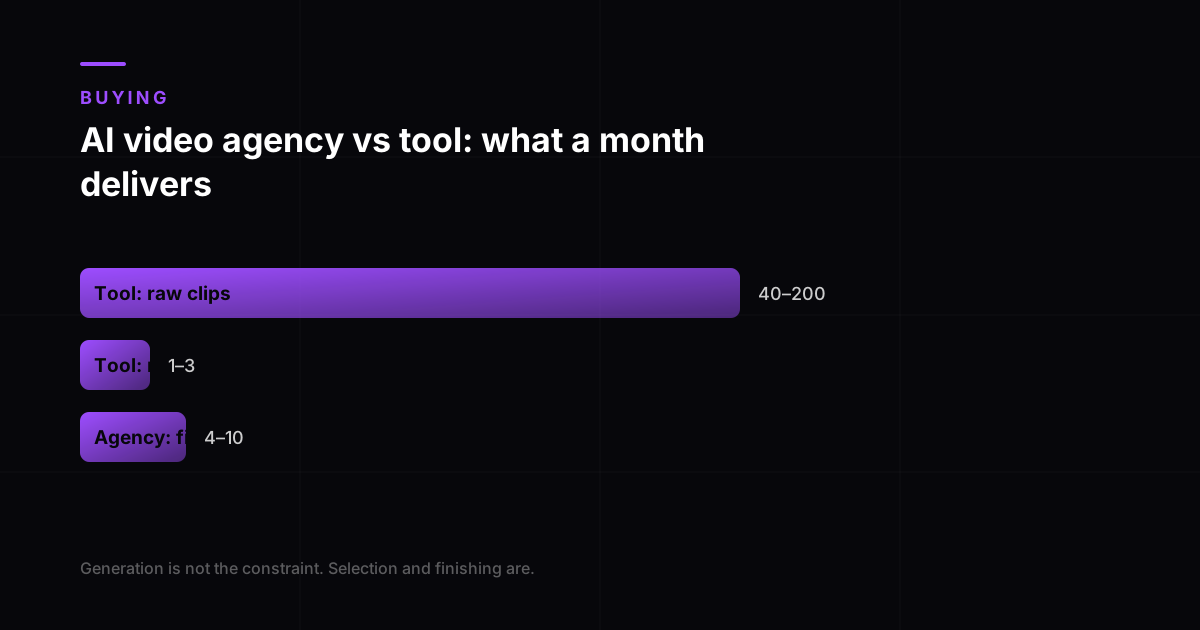
A subscription looks dramatically cheaper than an agency until you count what each actually delivers. The honest comparison is per usable ad, not per month.
- Tool: raw clips generated
- 40 to 200 clips
- Tool: ads you would actually run
- 1 to 3
- Agency: finished, platform-cut ads
- 4 to 10
A tool produces clips; the conversion rate from clip to runnable ad is where the time goes, and that time is yours rather than billed.
The gap between the first two rows is the whole argument. Generation is not the constraint and has not been for some time. Selection, direction and finishing are. A subscription hands you the cheap part and keeps the expensive part on your desk, which is fine if you have the judgement and the hours, and expensive if you do not.
The hybrid that usually wins
Most brands that run both end up in the same place: an agency establishes the concept, the look and the first set of platform cuts, then the in-house team uses a tool to produce variants against that template. The expensive judgement is bought once; the cheap repetition is done internally. It fails in the other order, because a template nobody set is not a template.
Whichever way you go, the questions that separate a real producer from a reseller are the same: nine questions to ask an AI video agency covers them, AI video ad cost in India covers the market rates, and hiring a producer directly is the version of this with one person accountable end to end.
What neither option gives you
Both routes leave the same thing on your side of the table: knowing what the ad should argue. A tool renders a prompt and an agency writes a script, but the decision about which objection is stopping your buyers comes from your inbox, your reviews and your sales calls. That is also the decision that matters most. Nielsen ranks creative as the biggest single driver of advertising-driven sales, ahead of reach and of targeting. Arriving at either option with that decided is what separates a good outcome from an expensive one. Why intentional AI ads outperform covers making it, and seven UGC ad script formats covers turning it into scripts.
What the spending pattern implies
The build-or-buy question sits inside a wider budget reality. Gartner's 2026 CMO Spend Survey puts marketing budgets at 7.8 percent of company revenue, essentially flat year on year, while noting that more AI-ready marketing organisations report higher budgets than the average. Flat budgets and rising creative demand are why the tool looks attractive; the reason teams still end up buying judgement is that a subscription raises output without raising the hit rate.
Frequently asked questions
Should I use an AI video tool or hire an agency?
Buy the tool if you already know which angle sells your product, which hook survives two seconds, and how a Meta cut differs from an Amazon cut. Hire an agency if you want those decisions made for you. The honest framing is that the tool is genuinely the right answer for a good number of brands, and anyone who tells you otherwise is selling.
Are AI video tools good enough to replace an agency?
For rendering, comfortably. Generation stopped being the bottleneck once these tools got good. What they do not supply is the judgement about what to generate: the angle, the hook, the pacing, the platform-specific cut, and the decision to tell you AI is wrong for a given brief. That is not a criticism of the software, it is what the product is.
What is the real cost difference?
A subscription against an invoice is the wrong comparison, because it omits your time. Raw generation now costs roughly $0.25 to $2.00 for a five-second clip, and entry subscriptions start around $8 a month. Deciding what to generate takes a marketer a morning, and the first three attempts are usually wrong. Multiply that by the variants a paid campaign needs and the tool often stops being cheaper per usable ad, because the expensive input was never the rendering.
Can I use both?
This is where most brands sensibly land. Bring in an agency for the campaign that establishes the angle, take the scripts, hooks and platform specs out of it, then use a tool in-house to produce variants against a formula already proven to work. You pay for judgement once and for rendering continuously.
Why did my AI video tool subscription not work out?
Two causes account for most of it. Either nobody owned it, and a tool with no owner produces nothing, which is how most abandoned subscriptions die. Or it was used to produce many variants of an angle that was never validated, which produces a lot of faithful renderings of an idea that did not work.