Why Intentional AI Ads Outperform: Strategy Before Software
AI video ads work when the strategic decisions are made before generation and fail when generation replaces the decisions. The model renders what it is told with equal fidelity whether the instruction was considered or not, which is why identical tools produce both effective advertising and unusable footage.
The honest answer to "do AI ads work"
Yes, and the variance is enormous. The same models, in different hands, produce advertising that lowers cost per acquisition and footage that nobody watches past second two.
That variance is not random and it is not about model choice. It comes from whether anyone decided what the ad was about before generating it.
This matters more now than it did two years ago, because the platforms have moved the leverage. With targeting substantially automated, Nielsen measured creative as the dominant driver of advertising-driven sales, reaching as high as 89 percent for digital work where the creative is strong. The decisions this article is about are no longer one input among several. They are most of the outcome.
There is a second reason intention has become non-negotiable. Newer delivery systems reportedly discount variants that are psychologically redundant, treating two ads that hit the same emotional beat as effectively one ad even when the footage differs. Generating without deciding produces exactly that: many files, one idea, and an auction that sees through it.
What intentional means
Five decisions, made before a single frame is generated, written down, and locked.
| Decision | The question it answers |
|---|---|
| Audience | Who exactly is this for, and what do they already believe? |
| Angle | Which single benefit leads, and what are we deliberately not saying? |
| Hook | What happens in the first 2 seconds that stops the scroll? |
| Objection | What is the one reason they will not buy, and where do we handle it? |
| Platform | Where does this run, and how does that change the cut? |
Five answers. None of them require any knowledge of AI. All of them determine whether the resulting ad performs.
What unintentional looks like
Generate twenty clips. Pick the ones that look nicest. Assemble them into something roughly the right length. Add a music track. Ship it.
The result is technically competent and commercially inert. Every shot is the same length because nobody decided on pacing. The lighting is uniform because nobody decided on a look. There is no hook because nobody decided what the first two seconds were for. It fails, and the conclusion drawn is that AI video does not work.
| Intentional | Generated | |
|---|---|---|
| Starts with | A decision about the buyer | A prompt |
| First 2 seconds | Designed to stop a scroll | Whatever came first |
| Shot lengths | Varied for rhythm | Uniform |
| Which benefit leads | Chosen, one | All of them, listed |
| Objection | Handled explicitly | Ignored |
| Judged on | Cost per acquisition | Whether it looks nice |
| When it fails | You know which decision was wrong | You know nothing |
That last row is the compounding difference. An intentional ad that fails still teaches you something reusable, because you changed one known variable. An unintentional ad that fails teaches you nothing, so the next attempt is another guess.
How to brief intentionally
A brief that produces good work is short and specific. Four lines usually beats four pages.
- Who this is for, in one sentence, describing a person rather than a demographic bracket.
- The single benefit that leads, and what you are deliberately leaving out.
- The objection that stops them buying, in their words, taken from real support messages or reviews.
- Where it runs and what the success metric is.
If you cannot answer the third one, that is the most useful thing this article can tell you. Read your last fifty support messages or reviews before commissioning anything. The objection is written there in the customer’s own language, and an ad that answers it directly outperforms one that lists features.
The measurable consequence
Intentional production makes results attributable. You know which hook won, which angle lost, which objection mattered. Over three or four rounds that record becomes a genuine asset, and it is the thing a competitor cannot copy from your public ads.
The ad is disposable. The learning is not. Producing intentionally is what converts spend into learning instead of into footage.
Why the odds make intention necessary
Intention sounds like a preference until you look at the hit rate. Creative testing is a numbers game, and the numbers are worse than most brands plan for.
- Become genuine winners
- Around 5%
- Mediocre or switched off
- Around 95%
Motion's 2026 benchmark study across 578,750 creatives, 6,015 advertiser accounts and $1.29 billion in Meta spend. A winner is defined as a creative spending at least ten times its account median.
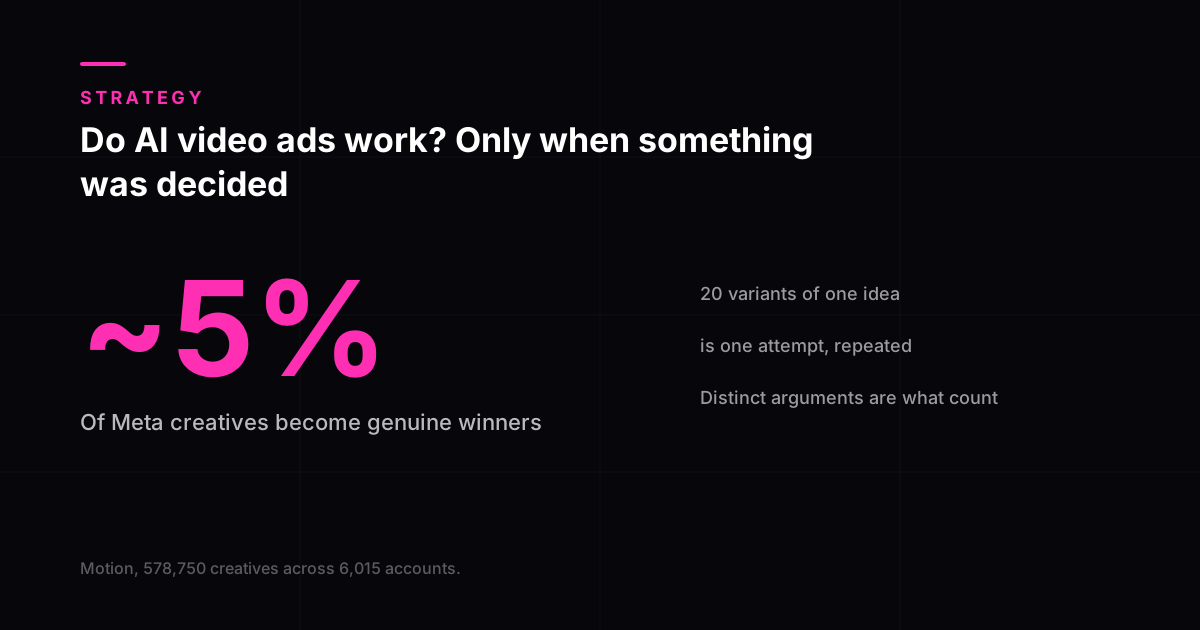
Motion's analysis puts the winner rate near 5 percent. Generated ads do not change that ratio; they change how many attempts you can afford. Which is precisely why intention matters more, not less. Twenty unintentional variants of the same idea are one attempt repeated twenty times, and the hit rate applies to distinct arguments rather than to distinct files.
The test that separates the two
Ask what you will learn if a variant loses. An intentional variant answers that immediately: this audience does not respond to the price objection. An unintentional one answers nothing, because nobody decided what it was testing. If a losing ad teaches you nothing, it was footage rather than an experiment, and you paid for it either way.
The mechanics of running those tests properly are in the method for testing creative, the argument structures worth testing are in seven UGC ad script formats, and hiring a producer directly is the version where the deciding happens before the generating.
What to do with the ads that lose
Most of what you produce will not win, and the intentional version of this is not producing fewer losers. It is extracting something from each one. A losing ad answers a question if the question was decided in advance.
- Record which single decision the variant was testing, before it runs. One line is enough.
- Note what the loss rules out, not just that it lost. "Price objection does not move this audience" is reusable.
- Keep the losing hooks in a file. A hook that fails for one product frequently works for another.
- Retire the angle, not the format. The two get confused, and brands abandon structures that were fine.
- Never rebuild a loser at higher production value. If the argument was wrong, a better-looking version of it is still wrong.
After three rounds that file is the actual asset, a written record of what your buyers respond to, which no competitor can read off your ad library. Reading a competitor's video ad strategy covers why that matters, and seven UGC ad script formats covers the structures worth testing against it.
What "good" looks like when it is measured
Intention has observable components rather than being a matter of taste. Thinkbox's neuro study of 150 TV ads found products woven into a narrative produced around 1.4 times more peaks of strong brain response than overt presentation, that ads featuring people delivered roughly 15 percent greater relevance, and that music driving the action produced significantly more memory peaks than music laid underneath it. Each of those is a decision someone makes before generation starts, which is precisely the difference this article is about.
Frequently asked questions
Do AI video ads actually work?
Yes, and the variance between projects is enormous. The same models in different hands produce advertising that lowers cost per acquisition and footage nobody watches past second two. The difference is not the model, it is whether anyone decided what the ad was about before generating anything.
Why did our AI video ads fail?
The most common cause is that generation replaced the decisions rather than following them. If nobody chose the audience, the single leading benefit, the hook and the objection being handled, the output is technically competent and commercially inert. It usually shows: uniform shot lengths, uniform lighting, every benefit listed, and no first two seconds worth staying for.
Does the choice of AI model matter?
Less than almost anyone expects. A stronger model gives you cleaner footage to work with, which raises the ceiling. It does not choose the angle, write the hook, decide the pacing or handle the objection. Teams that switch models hoping to fix performance are usually solving the wrong problem.
What makes a good brief for an AI video ad?
Four lines beats four pages: who this is for described as a person rather than a demographic, the single benefit that leads and what you are leaving out, the objection that stops them buying in their own words, and where it runs plus the success metric. The third line is the one most briefs omit and the one that most improves the result.
How do I know if my ads are intentional or just generated?
Ask what happens when one fails. If you can say which decision was wrong, the process is intentional and the failure is useful. If the only available conclusion is that the ad did not work, nothing was decided in advance, so there is nothing to learn from and the next attempt is another guess.
Does this mean AI ads need more work than traditional ones?
No, it means the work moves. A traditional shoot forces the decisions early because the crew is booked and the day is expensive, so the thinking happens whether you planned it or not. Generation removes that forcing function entirely: you can produce something before deciding what it is for. The total amount of judgement required is the same. What changes is that nothing external makes you do it, so it has to be deliberate.