How to Stay Ahead of Competitors With Winning Video Ads
Every ad your competitors run on Meta is publicly visible in the Meta Ad Library, and TikTok publishes a similar archive. Read what they are running, identify which angles they are not covering, and win on refresh speed, since creative velocity is the one advantage a competitor cannot buy back quickly.
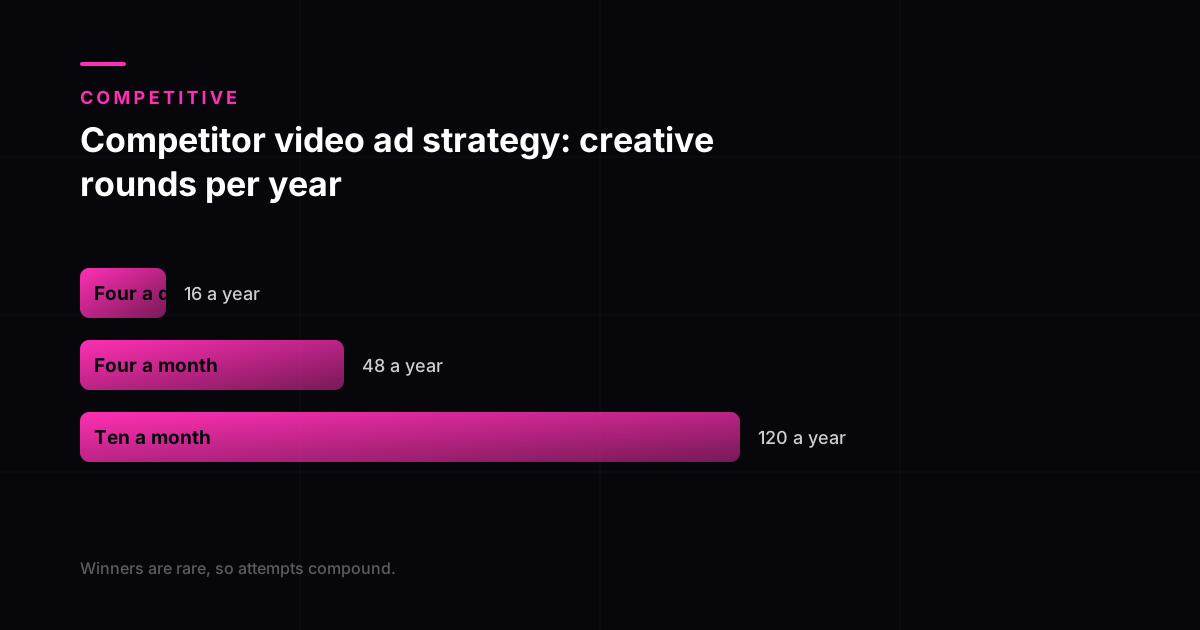
You can see your competitor's entire video ad strategy
The tool is the Meta Ad Library, and the detail most people do not realise is that you do not need a Facebook account to use it. No login, no Business Manager, no developer key. It is a public transparency database covering every ad currently running across Facebook, Instagram, Messenger and the Audience Network. Search a brand’s Page name, filter to active ads, and read.
Recent additions have made it more useful still: impression filtering, visibility into Threads and WhatsApp placements, and cumulative spend data on some ads.
What it will not tell you
Two limitations are worth knowing before you build a routine around it, because both quietly distort what you conclude.
- Non-political ads vanish the moment they stop running. If a competitor paused a campaign last month, it is gone entirely, so you are always looking at a survivorship-biased snapshot of what is live today rather than a history.
- Search is flat. You can filter by country and media type, but not by engagement, creative longevity or whether an ad is scaling. Duration has to be read manually, ad by ad.
The practical consequence of the first point is that you should check regularly rather than once. A monthly look builds the history the library itself does not keep.
Meta operates a public Ad Library showing every advert currently running on Facebook and Instagram, searchable by advertiser. TikTok publishes a comparable ad archive. Both are free, require no account relationship with the competitor, and are intended to be public.
Most brands never look. This is the cheapest competitive research available in advertising and it is sitting open.
What to actually record
| What to note | What it tells you |
|---|---|
| How long an ad has been running | Long-running ads are working. Nobody pays to keep a loser live. |
| How many variants are live | Their testing volume, and therefore their creative budget |
| The first 2 seconds | The hook they believe in |
| Which benefit leads | Their positioning, stated plainly |
| Format used | UGC, demo, founder, cinematic |
| What they never mention | The gap. Usually the most valuable column. |
Run this across your five closest competitors once a month. It takes under an hour and it replaces guessing about the market with observing it.
- Four creatives a quarter
- 16 a year
- Four creatives a month
- 48 a year
- Ten creatives a month
- 120 a year
Winners are rare, so attempts compound. Motion's analysis of 578,750 Meta creatives puts the winner rate near 5 percent, which makes the top row roughly one winner a year and the bottom row roughly six.
That arithmetic is the whole argument for velocity. At a 5 percent hit rate, Motion's figure across 6,015 advertiser accounts and $1.29 billion in spend, sixteen attempts a year buys you about one winner and very little knowledge. Forty-eight buys several, plus a written record of what your audience responds to. The competitor who ships quarterly is not merely slower; they are sampling too little to learn anything reliable.
Reading the gap
The useful finding is rarely what everyone is doing. It is what nobody is doing.
- If all five run polished studio-style product ads, unpolished UGC is open.
- If all five lead on price, quality and durability are open.
- If all five speak to first-time buyers, the repeat customer and the switcher are open.
- If none of them address the obvious objection your support inbox sees weekly, that objection is an entire ad.
Copying the leader puts you second in a race already being run. Filling the gap puts you first in one nobody entered. The two gaps worth checking first are format and objection: UGC ad script formats covers the angles most competitors never script, and what separates an ad from footage covers why a deliberate argument beats a better-looking one.
Creative velocity as a moat
A competitor can copy your hook within a fortnight of seeing it, because your ads are in the same public library. What they cannot copy quickly is the rate at which you produce and test new ones.
If they ship four creatives a quarter and you ship four a month, you accumulate roughly three times the learning per year. By the time they have copied a winning hook, you are two rounds past it.
A refresh cadence that holds
| Signal | What it means | Action |
|---|---|---|
| Frequency rising, cost per acquisition rising | Creative fatigue | Refresh now, not next month |
| Cost per acquisition stable, frequency stable | Working | Leave it. Produce the next round in parallel. |
| 3-second view rate falling | Hook worn out | New hook, same body |
| Competitor launches your angle | Copied | Move to the next tested angle already in reserve |
The last row is the reason to keep a reserve. If your entire campaign rests on one winning creative, being copied is a crisis. If you have three tested angles waiting, it is a Tuesday.
Turning the audit into a monthly routine
The reason most competitor research produces nothing is that it happens once, in a strategy document, and is never repeated. The value is in the series rather than the snapshot, because the library only shows you what is live today.
- Same day each month. Diarise it, an hour, five competitors.
- Screenshot the first frame of every new ad. That archive is the history the Ad Library will not keep for you.
- Note only what changed since last month. New angles, dropped angles, and anything running long enough to be working.
- Write one line of conclusion. If you cannot, you looked without a question in mind.
- Feed the gap you find straight into next month's production brief rather than into a document nobody reopens.
An ad that has been running for months is the single most useful thing in the library, because nobody funds a losing ad that long. Treat longevity as the signal and volume as the noise. What producing that volume actually costs is the other half of the decision.
What not to do
- Do not copy a competitor ad frame for frame. It is legally risky, and it puts you in a comparison you cannot win, since they got there first. Fill the gap instead, and test the angle properly before scaling it, and produce the volume through a monthly reels retainer rather than one ad at a time.
- Do not assume a long-running competitor ad will work for you. Their audience, offer and price may differ entirely.
- Do not react to every competitor launch. Reacting to noise costs more than ignoring it.
Frequently asked questions
Can I see what ads my competitors are running?
Yes, legally and for free, at facebook.com/ads/library. You do not need a Facebook account, a Business Manager login or any kind of key. It covers every ad currently running across Facebook, Instagram, Messenger and the Audience Network, searchable by Page name, and TikTok publishes a comparable archive. It is the most underused competitive research available.
How do I tell which competitor ads are working?
Look at how long they have been running. Nobody keeps funding a creative that loses money, so an ad live for months is a strong signal it is profitable, while a burst launched and pulled within a week says the opposite. You have to read duration manually, since the library cannot sort or filter by it.
Does the Meta Ad Library show ads that have stopped running?
Not for ordinary commercial ads. Non-political ads are removed from the library as soon as they stop running, so a campaign paused last month has vanished completely. Political and social-issue ads are retained far longer. The practical consequence is that the library shows you a snapshot of what is live rather than a history, so checking monthly and keeping your own notes is how you build the trend it does not store.
Should I copy a competitor’s winning ad?
No. Copying frame for frame is legally risky and strategically weak, because it places you in a direct comparison against the brand that got there first and established the association. Study the structure and the angle, then apply the underlying insight to something specific to your product.
How do I find the gap competitors are not filling?
List the angles every competitor is running, then list the reasons your customers actually buy, taken from your support inbox and reviews. The reasons that appear in your customer data and in nobody’s advertising are the gap. That is a stronger position than competing on an angle three brands are already funding.
What if a competitor copies my ad?
Expect it, and make it survivable by keeping tested angles in reserve. If your entire campaign depends on one winning creative, being copied is a genuine problem. If you have three proven angles waiting and a refresh cadence they cannot match, it is an inconvenience. Velocity is the defence, not secrecy.