AI Video Ads for Small Business: How to Beat Big Brands
A small brand cannot outspend a large one and does not need to. The two advantages that are structurally yours are speed and specificity: you can test, learn and change creative in days while a large brand is still routing approvals, and you can address a narrow audience precisely because you are not trying to address everyone. The two you will never have are bought reach and years of brand recognition. Plan around all four honestly and the gap narrows considerably.
The old gap
Video advertising used to have an entry price. A crew, a studio, a schedule. Below a certain budget you simply could not produce broadcast-looking video, so you competed with static images against competitors running film.
That gap was never about talent or insight. It was about who could afford a shoot day. Production cost was the moat.
What changed
The moat drained. Generated footage costs roughly the same to produce whether the brand behind it turns over ten lakh or ten crore. The remaining differences are creative judgement, speed and consistency, and none of those correlate with company size.
Four advantages a small business has with AI video ads
| Advantage | Why the large competitor cannot copy it |
|---|---|
| Speed of decision | Their creative goes through brand, legal and agency approval. Yours goes through you. |
| Willingness to be specific | They must speak to a mass market. You can speak precisely to one niche and win it. |
| Founder presence | A real person with a real stake reads as trustworthy. A committee cannot fake it. |
| Tolerance for testing | Their brand guidelines restrict what creative can look like. You can test angles they are not allowed to try. |
Speed is the big one. A large brand takes weeks to approve a creative change. If you can test a new angle on Monday and act on the result on Friday, you get through more learning cycles per quarter than a competitor spending fifty times your budget. The mechanics of running those cycles are in how to run the round properly.
Where you still cannot compete
- Reach through spend. They can outspend you on impressions, permanently. Do not fight on volume.
- Brand awareness built over years. You cannot buy that back quickly, and pretending otherwise wastes budget.
Both point to the same conclusion. Do not compete for the broad market. Compete for a segment specific enough that a national campaign cannot address it well, and own that segment completely.
A practical starting playbook
- Pick one product and one buyer. Not your catalogue. One of each.
- Write 5 to 10 hooks for that buyer. Produce them as variants of the same ad.
- Run them against a small, tightly defined audience. Judge on cost per acquisition, not views.
- Take the winning hook and build the next round from it. Expand to the adjacent buyer only after the first one is profitable.
- Keep a written record of every hook tested and its result. After three rounds this file is your real competitive asset.
What a realistic budget looks like
For an anchor, Gartner's 2026 CMO Spend Survey puts marketing budgets at 7.8 percent of company revenue, barely moved from 7.7 percent the year before. That survey covers larger organisations and all marketing rather than digital alone, so treat it as the centre of gravity rather than your number. Indian small-business guidance typically quotes a wider 5 to 12 percent band for digital specifically, and the band you sit in should follow what you are trying to do rather than what you can bear.
| Share of revenue | What it buys |
|---|---|
| 5% to 7% | Maintaining visibility |
| 8% to 10% | Steady growth |
| 12% and above | A launch, a new market, or heavy local competition |
On absolute numbers, the commonly cited floor for meaningful results is around ₹15,000 a month focused on a single channel, or ₹40,000 to ₹60,000 a month for a genuine multi-channel effort. Those are practitioner figures rather than surveyed ones, so treat them as a starting shape. Below the single-channel floor you are generally not buying enough data to learn anything, which is the same trap as running one untested ad. What the creative side of that costs is set out in current pricing by format, and our own numbers are on the published pricing page.
The honest caveat
Cheaper production does not fix a weak product, an unclear offer, or a landing page that loses people. Video advertising amplifies what is already there. If the underlying offer is not working, more creative simply reaches the wrong conclusion faster.
Fix the offer first. Then the speed advantage is worth something.
What a first quarter actually looks like
The advice above is easy to agree with and hard to sequence. A realistic first quarter for a small brand, assuming one product and one buyer:
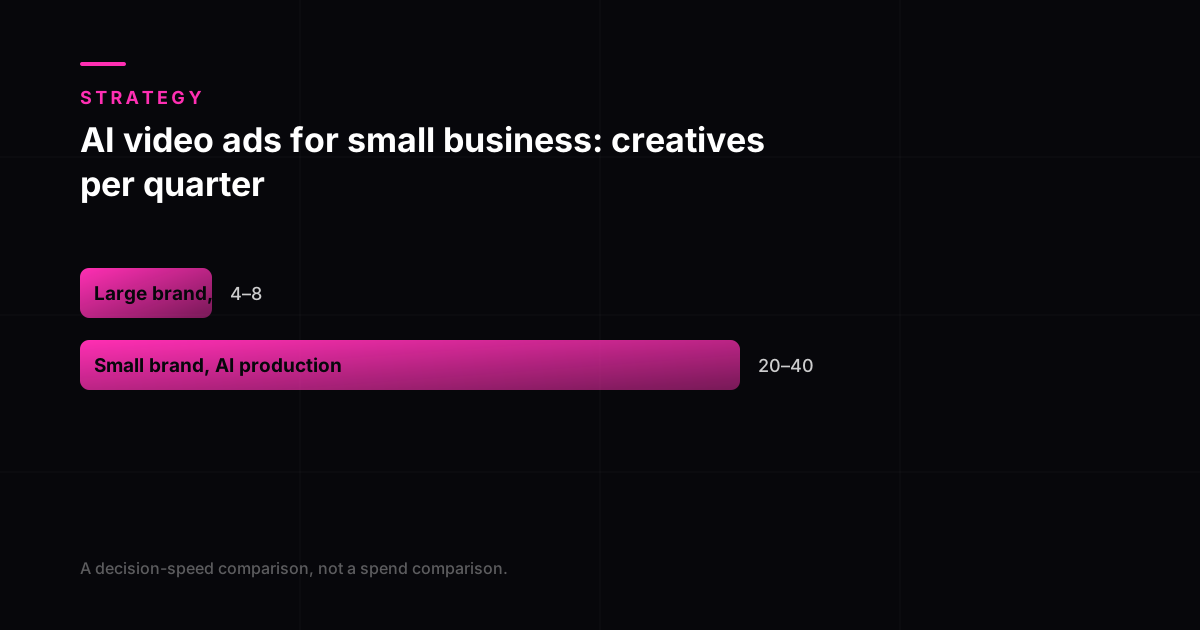
- Large brand, agency approval cycle
- 4 to 8
- Small brand, AI production
- 20 to 40
Not a spend comparison. It is a decision-speed comparison, and it is the one advantage that does not require a bigger budget to hold.
Month by month
- Month one: five to ten hooks against one buyer, one product. Small budget, tightly defined audience, judged on cost per acquisition.
- Month two: rebuild from the winning hook. Change one variable per variant. Kill anything that lost twice.
- Month three: extend the winning angle to the adjacent buyer, and only then consider a second product.
By the end of that quarter the asset you own is not the ads. It is a written record of which arguments your buyers respond to, which is the thing a competitor cannot copy from your ad library even though they can see every creative in it. Reading a competitor video ad strategy covers that from the other side, how to structure a creative test covers the mechanics, and our published pricing is there so the production half of the budget can be planned rather than quoted.
Why creative is the lever a small budget actually has
Every advantage in this article reduces to one thing: a small brand can change its creative faster than a large one can approve a change. That matters because creative is where advertising outcomes are decided. Nielsen found creative outweighed reach as a driver of advertising-driven sales, and reach is the one lever that only scales with budget. Media weight is the one lever you cannot pull; the largest lever is the one you can. Read that alongside Gartner's 2026 CMO Spend Survey, which puts marketing budgets at 7.8 percent of company revenue across mostly larger organisations: the gap in absolute spend is real, and it sits almost entirely on the half of the equation that matters least.
The number that makes volume worth it
Testing volume only pays because winners are rare. Motion's analysis of 578,750 Meta creatives across 6,015 advertiser accounts and $1.29 billion in spend puts the winner rate near 5 percent. A large brand shipping four creatives a quarter is buying roughly one winner a year; a small brand shipping ten a month is buying several, plus a written record of which arguments work. That is the entire mechanism behind every advantage listed above, and it is available at any budget that can fund the production.
Frequently asked questions
Can a small business compete with big brands on video ads?
On creative and iteration, yes. On reach bought with media budget, no, and pretending otherwise wastes money. The advantage available to a small brand is speed: testing, learning and changing creative within days while a larger competitor is still routing approvals through several layers. That advantage is real and it is not purchasable.
How much should a small business spend on video ads?
Published Indian benchmarks put total small-business digital marketing at 5 to 12 percent of revenue, with roughly ₹15,000 a month as a practical single-channel floor and ₹40,000 to ₹60,000 for multi-channel. Within that, budget for several creative variants rather than one polished asset: a single ad running blind is a guess regardless of what it cost, and you need enough variants to produce a readable result.
Do we need a big brand look to be taken seriously?
Less than most founders assume, particularly in feed environments where overly polished work reads as advertising and gets scrolled past. Specificity and credibility matter more than production values. A small brand that speaks precisely to a narrow buyer outperforms a generic ad with a bigger budget behind it.
Where can a small brand not compete?
Raw reach, which is bought with media spend, and brand recognition, which is accumulated over years. Neither can be shortcut with better creative. The correct response is to compete where recognition is not the deciding factor: specific problems, specific audiences, and channels where relevance beats familiarity.
What should a small brand do first?
Confirm the offer converts before scaling creative production. Video advertising amplifies whatever is already there, so a weak offer or a leaky landing page just reaches a negative conclusion faster and more expensively. Once the offer works, the speed advantage starts compounding.