How to Make a UGC Ad With AI (Without It Looking Fake)
An AI UGC ad feels real when it opens on a relatable problem rather than a product pitch, matches the platform’s native style, uses conversational scripting, avoids over-polished visuals, and ends on the outcome rather than a hard sell. Almost every AI UGC ad that reads as fake is too polished, not too artificial.
UGC ads work because they feel real. The problem with most AI-generated UGC is that it does not. It looks stiff, over-produced, or obviously synthetic, which defeats the entire point.
Here is what actually makes an AI UGC ad feel authentic.
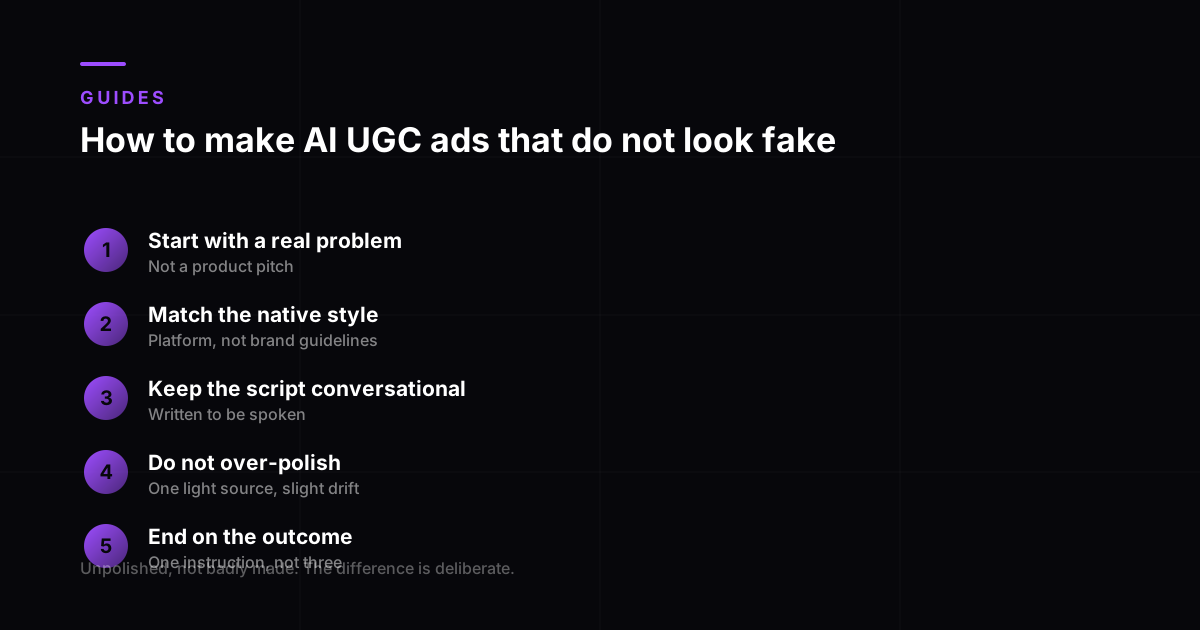
1. Start with a real problem, not a product pitch
The best UGC does not open with "check out this product". It opens with a relatable moment: a frustration, a before-state, something the viewer recognises in themselves. The product shows up as the solution, not the subject.
2. Match the platform’s native style
UGC on TikTok looks different from UGC on Instagram Reels. Pacing, framing, even the way someone talks to camera shifts slightly by platform. AI video that ignores this looks like it was made for nowhere in particular, which is exactly how it performs.
3. Keep the script conversational, not scripted-sounding
Real people do not talk in perfect marketing sentences. A few pauses, casual phrasing, and imperfect delivery go a long way toward believability, even when the presenter is AI-generated. Read the script out loud. If you would not say it to a friend, rewrite it.
4. Do not over-polish the visuals
Slightly imperfect lighting, natural backgrounds and handheld-style framing all read as real faster than a perfectly lit studio shot. Save the polish for commercials. UGC should feel found, not filmed.
5. End on the outcome, not the ask
The strongest UGC ads end by showing the result the product delivered, letting the viewer draw their own conclusion, rather than a hard "buy now" close that breaks the authenticity the whole format depends on.
The polish problem, in detail
Of those five, the fourth is the one teams get wrong most often, and it is worth spending longer on because it is counter-intuitive. Every instinct built up from making brand video says to raise the quality. In this format, raising the quality lowers the performance.
Real customer video has specific imperfections, and they are load-bearing. The white balance is slightly off because the room has a lamp and a window fighting each other. The framing drifts because someone is holding the phone. The subject moves out of focus for a moment. None of that is charming, and all of it is evidence that a person rather than a production made this.
- Let the light be uneven. A single practical source with real falloff reads as a room; even coverage reads as a set.
- Keep the framing slightly wrong. Head room a little too much or too little is what a phone held at arm length actually produces.
- Allow some motion. A completely static frame implies a tripod, and customers do not use tripods.
- Leave the background lived in. A clear surface behind the subject looks staged, because in real homes surfaces are not clear.
- Do not grade it to look cinematic. This is the single fastest way to make a UGC ad look like an ad.
Writing dialogue people believe
The script is where the second most common failure lives. Scripts written for UGC tend to come out as marketing copy with contractions added, which is not the same thing as speech.
What separates spoken language from written language is mostly structure rather than vocabulary. People start a sentence, abandon it, and restart. They put the emphasis in an odd place. They repeat themselves for emphasis rather than for information. Writing that in deliberately feels wrong on the page and sounds right on camera.
- Put the reaction before the explanation. Real speech leads with the feeling and justifies it afterwards.
- Include one specific and slightly irrelevant detail. Specificity that serves no selling purpose is what makes an account sound lived rather than written.
- Avoid stacking benefits. Nobody lists three advantages of something in conversation; they mention one and move on.
- Read it aloud and keep the bits you stumble on, if the stumble is natural. Fluency is not the goal.
How to make AI UGC ads without the tells
Every row below is the same decision made twice. The left column is what the instinct built on brand video produces; the right column is what real customer footage actually looks like.
| Element | Reads as an ad | Reads as real |
|---|---|---|
| Lighting | Even, flattering coverage | One practical source, visible falloff |
| Framing | Centred and deliberate | Head room slightly wrong, drifts |
| Camera motion | Locked off, implies a tripod | Handheld, never completely still |
| Background | Cleared and styled | Lived in, surfaces not tidied |
| Colour | Graded to look cinematic | Untouched, white balance slightly off |
| Delivery | Fluent, several benefits stacked | One idea, a natural stumble kept |
Disclosure, without killing the ad
The worry teams raise is that labelling an ad as AI-generated undermines the authenticity the format depends on. In practice the label sits in the platform interface rather than inside the creative, so it does not interrupt the video itself, and the honest framing is simpler than the alternative: an undisclosed synthetic endorsement is a policy and consumer-protection problem, not a growth tactic.
What genuinely does damage trust is a generated presenter making a claim only a real customer could make. A generated person can demonstrate a product and explain what it does. They cannot say this changed my life, because there is no they to have had the experience. That line is the one to hold, and are AI UGC ads legal covers the rules underneath it in full.
Both halves of that are written down rather than inferred. Meta publishes its AI content labelling policy, and the FTC's final rule banning fake reviews and testimonials prohibits a testimonial from someone who does not exist, whoever or whatever produced it. Label the ad, and keep the presenter demonstrating rather than testifying.
A five-minute check before you publish
- Does the presenter claim to have bought, owned or used the product? If yes, rewrite the line.
- Is the platform's own AI toggle switched on, rather than a disclosure buried in the caption?
- Does every product claim survive being read on its own, without the person saying it?
- Does the face resemble anyone identifiable? Generated composites are fine; a recognisable likeness is a separate and more serious problem.
- Have you kept a record of what was generated and how it was disclosed, per deliverable?
If you want the format produced to that standard rather than checked after the fact, that is what our AI UGC video ads service delivers, and the seven script formats are the structures it works from.
Done properly, an AI UGC ad should just feel like someone telling you about something that worked for them.
Disclosure in the Indian market
For brands advertising in India, the platform toggles are only half the picture. The Advertising Standards Council of India has published final guidelines for labelling AI-generated advertising content, effective December 2026, on a risk-based test: label it where the synthetic element could materially affect a purchase decision. A UGC-style ad with a generated presenter sits squarely inside that, which is another reason to write the format as demonstration rather than testimony from the outset.
Frequently asked questions
Why does my AI UGC ad look fake?
Almost always because it is too polished rather than too artificial. Check the lighting first: if it is even and flattering, it reads as a studio and therefore as an advertisement. Then check the pacing and the framing. Real customer video is slightly badly lit, slightly badly framed, and slightly unevenly paced, and removing all three is what makes generated footage feel synthetic.
Do I have to disclose that a UGC ad was made with AI?
Yes. Meta and TikTok both require AI-generated content to be labelled, and advertising rules in most markets prohibit presenting a synthetic endorser as a genuine customer experience. Labelling happens at the platform level rather than inside the video, so it does not disrupt the creative. The full breakdown is in are AI UGC ads legal.
How many variants should I make?
At least three openings against the same body, and realistically more. Motion's analysis of 578,750 Meta creatives across 6,015 accounts and $1.29 billion in spend puts the share that become genuine winners at roughly 5 percent, which implies four to six real attempts per winner. One carefully made AI UGC ad has little advantage over one carefully made real one; the advantage appears at the fourth and tenth variant, which is exactly where traditional production time becomes the constraint.
Is AI UGC better than hiring a real creator?
No, and framing it that way leads to bad decisions. A genuinely good creator with a real relationship to your product will usually outperform generated footage, because the enthusiasm is real and viewers detect that. What AI changes is supply: it produces variants in days rather than weeks, at a cost that does not scale linearly. Use creators for the flagship, generation for the volume.
What products does AI UGC not work for?
Anything where the value depends on a sensory judgement the viewer expects a real person to have made, and anything requiring a genuine before-and-after on a real body. Food taste reactions, skincare results and fitness transformations are the obvious cases. A generated presenter cannot credibly report an experience, and attempting it is both unconvincing and a compliance risk.
Do AI UGC ads need to look low quality to feel real?
No, and this is the most common overcorrection. The goal is unpolished, not badly made. Real phone footage has a single light source, slightly wrong headroom and a bit of handheld drift, but it is still in focus, correctly exposed and audible. Adding grain, shake or blur to fake authenticity reads as an effect and breaks the illusion faster than polish does. Aim for what a competent person films on a good phone, not for what a broken camera produces.