Where AI Video Still Fails: The Shots You Should Still Shoot
AI video is strong on short, informational, direct-response work and weak on anything that depends on sustained emotional performance, exact continuity or precise real-world detail. The recurring failures are hands and small text at close range, exact product geometry, named real locations, and any shot where one performance has to run longer than a few seconds without a cut. A separate class of limit is legal rather than technical: a synthetic presenter cannot be a real customer, and resembling a real identifiable person triggers disclosure obligations in both India and the EU.
Why publish this at all
Because you will find the gap yourself, and it is better that you find it in a planning conversation than in a delivered cut. Scoping around a limitation is cheap. Discovering it after approval is not.
Where the gap actually sits
Short informational clips need clarity, and generation delivers that. Brand films need a performance to hold across a shot, and holding is the hard part. That is not a rendering problem, which is why a better model does not close it.
You will find precise percentages quoted for this comparison. We do not quote them here, because the figures in circulation trace back to marketing blogs that state no original study, and an invented precision is worse than an honest description. What follows is what we consistently hit in production.
| Shot type | Verdict | Why |
|---|---|---|
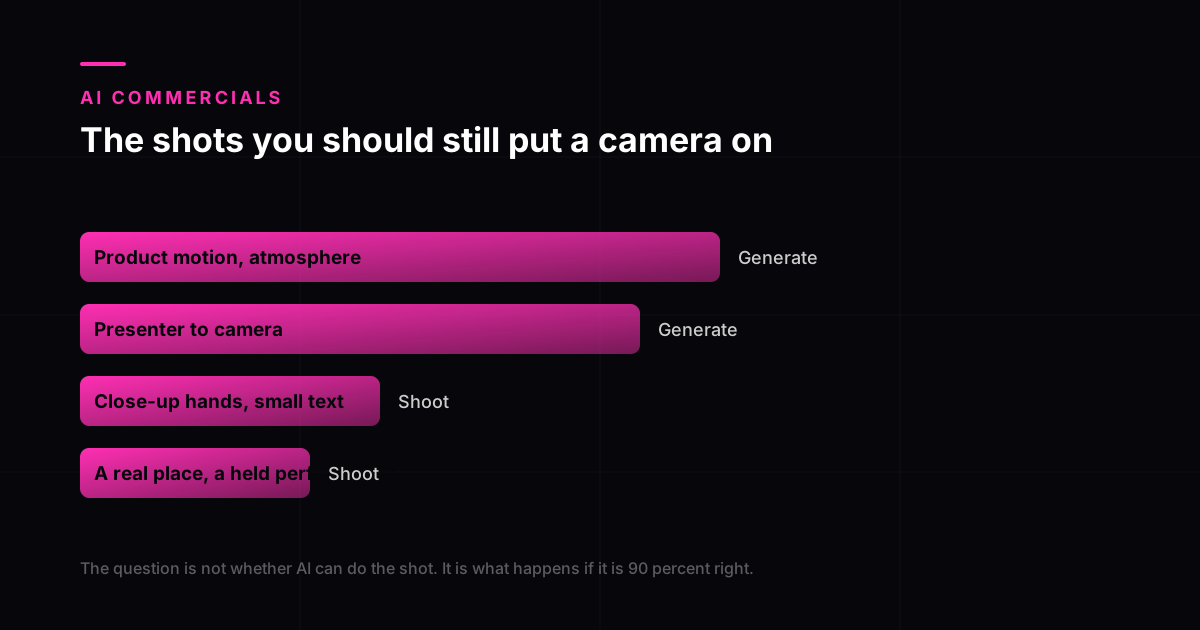
| Product on a surface, lit and moving | Generate it | Controlled, short, no performance to sustain |
| Presenter delivering information to camera | Generate it | Direct response tolerates near-perfect |
| Atmosphere, texture, abstract motion | Generate it | No continuity anchor to break |
| Close-up hands using the product | Shoot it | Fingers and grip remain the most reliable tell |
| Readable text, packaging copy, screens | Shoot or composite | Small type still degrades under generation |
| A specific real place your customer knows | Shoot it | Plausible is not the same as correct |
| One emotional performance across eight seconds | Shoot it | The gap widens with every second held |
| Exact product geometry for a hero shot | Shoot or model it | Approximate silhouettes fail on a known product |
The four failures worth planning around
Sustained performance
A face can be convincing for two seconds and drift by six. Micro-expression, blink rhythm and the small settling movements between beats are where it goes. The practical workaround is editorial: cut more often, and never write a shot that asks one generated performance to carry a long emotional beat on its own.
Continuity across shots
Generation is per shot. Nothing guarantees that the same jacket, the same label, or the same room returns identically in the next one. Anything that must match across a sequence has to be locked deliberately, which is a large part of what separates a premium AI commercial from a cheap one.
Precise real-world detail
Hands are the famous one and they have improved, but the underlying issue has not gone away: the model produces what is plausible, not what is correct. That is fine for a stretch of road. It is not fine for your packaging, your product silhouette or your app screen, all of which your customer already knows by sight.
Anything a person must be accountable for
A synthetic presenter cannot be a real customer, cannot be a real doctor, and cannot be your founder. That is now a compliance line as well as a craft one. EU AI Act Article 50 has applied since 2 August 2026 to content meeting its deepfake definition, and Google Ads has required AI disclosure since 9 July 2026. The rights and labelling rules around AI presenters set out where the line sits.
What a mixed approach looks like
- Identify the two or three shots the film actually rests on. Those are the candidates for conventional capture.
- Shoot those on a half day rather than a full crewed schedule. You are buying specific shots, not a production.
- Generate the connective tissue, the atmosphere and the coverage, which is most of the runtime and most of the cost.
- Grade the whole thing together at the end so the two sources sit in one look.
- Keep the pack shot real wherever the product is the hero. It is the shot people compare against the thing in their hand.
That approach also changes how you brief. Deciding between a brand film and a product ad is partly a decision about how much sustained performance the piece needs, and that is precisely the axis along which this technology is strong or weak. If the film has to hold a real emotional beat, budget for the camera on those shots and let generation carry the rest. What separates a premium AI commercial from a cheap one covers the finishing that makes a mixed cut read as one film.
Frequently asked questions
What can AI video not do well in 2026?
Sustained emotional performance across a long take, exact continuity between shots, precise real-world detail such as hands, small text and known product geometry, and any specific real location your audience would recognise. It handles short informational clips, controlled product motion and atmosphere well.
Why does AI video work for ads but not brand films?
Because the two ask for different things. A direct-response clip needs clarity over a few seconds, which the technology delivers. A brand film needs a performance to hold and an emotional beat to land, and the quality gap widens the longer a single shot has to sustain.
Are hands still a problem in AI video?
Less than they were, but they remain the most reliable tell at close range, along with small readable text. The underlying reason has not changed: generation produces what is plausible rather than what is correct, and a close-up of someone using your product is a shot where correct matters.
Should I shoot anything conventionally at all?
Usually two or three shots. The ones the film rests on: the hero pack shot, a specific real place, or a performance that has to carry a feeling. Buying a half day for those specific shots and generating the rest is cheaper than a full crewed schedule and better than an entirely synthetic film.
How do I know if my project is a bad fit for AI video?
Ask what happens if a shot comes back 90 percent right. If the answer is nothing, generate it. If the answer is that your product looks subtly wrong, or a real location looks nearly right, or a face nearly lands, then that shot needs a camera.