Do AI UGC Ads Actually Convert? The Honest Numbers
There is less trustworthy data on this than the confident numbers circulating suggest, and that is the honest starting point. Meta publishes its own automation figures, such as Advantage+ campaign budget decreasing cost per acquisition by an average of 4.6 percent, but those measure automated delivery rather than AI-generated creative. No independent, audited study compares AI UGC against creator UGC on conversion. What can be said with confidence is narrower and more useful: AI UGC wins on volume and iteration speed rather than on performance per creative, and it is unsuitable wherever a real experience has to be claimed.
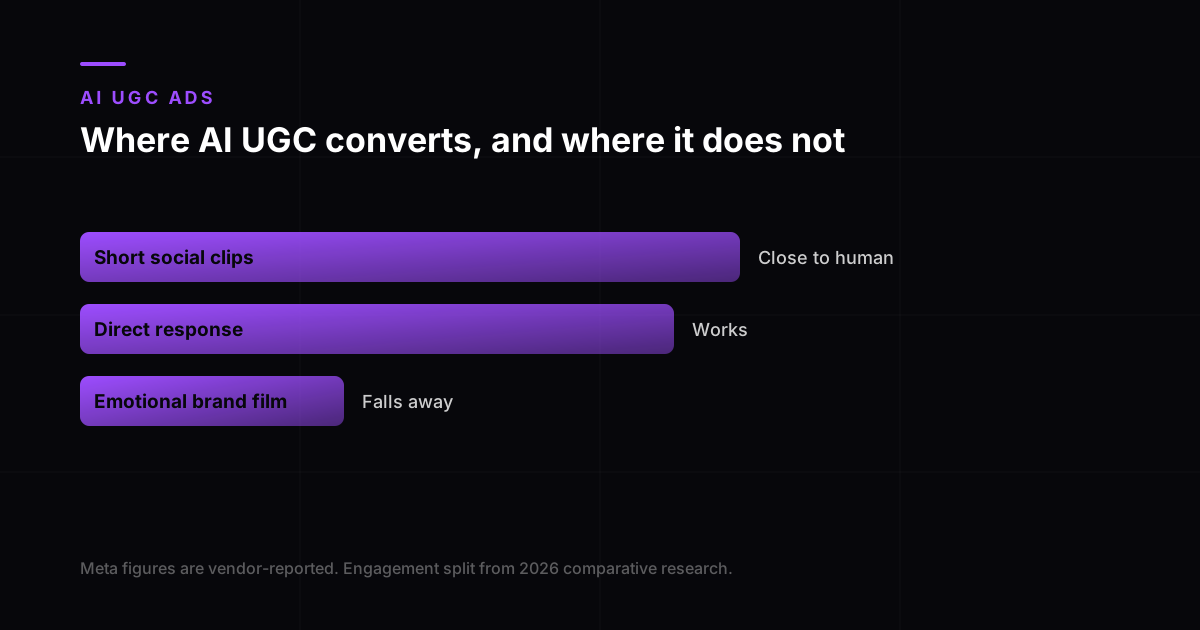
Do AI UGC ads convert? The short answer
On direct response, yes. On brand building, not reliably. That single split explains almost every contradictory claim you have read about this, because people quote whichever half suits the pitch they are making.
Start with the case against
Most marketers still lead with human-made UGC, and very few run AI-only. That is not conservatism for its own sake. It reflects something real about what the format is currently good at, and it is worth understanding before you commit a budget.
The clearest version of the limitation is the objective split. A face that is 90 percent convincing is fine for a fifteen-second demonstration. It is not fine for the shot that is supposed to make somebody feel something, because the gap widens with every second a single performance has to hold. You will find percentages quoted for this online. Treat them carefully: the ones in circulation trace back to marketing blogs that state no original study, which is why none are quoted here.
Now the case for
Meta publishes performance figures for its own automation. Advantage+ campaign budget is stated to decrease cost per acquisition by an average of 4.6 percent, and Advantage+ placements by an average of 11.7 percent. Read those for what they are: vendor-reported, undated, and measuring automated delivery rather than AI-generated creative. They tell you the platform is built around automation now. They do not tell you a generated presenter outperforms a real one.
- Advantage+ placements, CPA improvement
- 11.7%
- Advantage+ campaign budget, CPA decrease
- 4.6%
Published by Meta on its own Advantage+ pages. Vendor-reported, undated, and measuring automated delivery rather than AI-generated creative. Directional only.
The useful part is not the percentage. It is that the platform now rewards creative volume, and volume is the one thing an AI pipeline is unambiguously better at. Note also that running the format at all now carries an obligation: Google Ads has required AI disclosure since 9 July 2026, and the disclosure rules in full covers the Indian and EU positions.
The number that actually matters is cost per test
A creator UGC video is not expensive because of the video. It is expensive because of sourcing, sample shipping, scheduling, revisions and licensing, and because that whole chain has to run again for the next idea. So the real cost is not per asset. It is per attempt.
| What you are buying | Creator UGC | AI UGC |
|---|---|---|
| Attempts per month | One or two | Ten or more |
| Time to first cut | Two to three weeks | Three to five days |
| Cost of being wrong | A full production cycle | A re-render |
| Rights position | Per creator, often time-limited | Owned outright on delivery |
| Believability ceiling | A real person | Close, and not identical |
That is the argument in one line: you are not buying a better ad, you are buying more chances to find one. Running ten creatives to find a winner is only a strategy if producing ten creatives is affordable, and the creator route is priced per deliverable in a way that makes it one.
Where AI UGC is the wrong call
- Anything that depends on a visible real-world result. Before and after skin, hair, weight or repair work needs a real person, and in India it needs claim substantiation as well.
- Anything where a named individual is the brand. A founder-led ad works because the founder is in it.
- Anything presented as a genuine customer testimonial. Presenting a synthetic presenter as a real customer is a disclosure problem, not a creative one. See what the 2026 rules require you to label.
- Anything where texture is the product. Fabric drape, food steam and cosmetic finish are the shots that still give the format away.
- Your first ever ad, if you have no baseline. Test volume is worth nothing without something to compare against.
How to judge it on your own account
Ignore aggregate benchmarks, including the ones above. Run the format against your own control for one full learning cycle, hold the offer and the audience steady, and change only the creative source. Then read cost per acquisition and hold rate at three seconds, not view count.
One caution on the read. If AI creative loses on cost per acquisition but wins on cost per test, it can still be the better system, because it gets more shots at the one creative that changes your quarter. Judge the pipeline over a quarter and the individual ad over a week.
Frequently asked questions
Do AI UGC ads convert as well as real creator videos?
On direct-response objectives they come close, and on emotional brand storytelling they do not, because the quality gap widens the longer one performance has to hold. The practical advantage is not performance per creative, it is how many creatives you can afford to test. Be sceptical of precise percentages quoted for this comparison: the figures in circulation trace to marketing blogs that name no original study.
Why do most marketers still prefer human UGC?
Because believability still peaks with a real person, and because a large share of UGC work involves demonstrating a genuine result. That is a defensible position for categories where the product has to be seen working on someone, and it is why the format is best treated as a volume and iteration tool rather than a replacement for a real endorsement.
What performance figures has Meta published for AI creative?
Meta publishes figures for its own automation, such as Advantage+ campaign budget decreasing cost per acquisition by an average of 4.6 percent and Advantage+ placements by 11.7 percent. Both are vendor-reported and undated, and both measure automated delivery rather than AI-generated creative. No independent audited study currently compares AI UGC against creator UGC on conversion, so treat any precise percentage you see quoted for that with suspicion.
Which product categories should avoid AI UGC?
Anything where a visible real-world result is the proof, such as skincare before-and-afters, hair, fitness or repair work. Also founder-led advertising, anything presented as a genuine customer testimonial, and categories where texture is the selling point, such as fabric, food and cosmetic finish.
How should I test whether AI UGC works for my brand?
Hold the offer and the audience constant, change only the creative source, and run it for one full learning cycle against your existing control. Read cost per acquisition and three-second hold rate rather than views. Judge the individual ad over a week and the pipeline over a quarter.