Are 3D Websites Good for SEO? The Honest Answer
A 3D website is neutral for SEO when it is built HTML-first, and damaging when it is not. A canvas element paints pixels and holds no headings, sentences or links, so nothing inside a 3D scene can be crawled, indexed or cited. Every word you want ranked has to exist in the page HTML as well. Build it that way and the only remaining SEO question is weight, which is a Core Web Vitals problem rather than a content one.
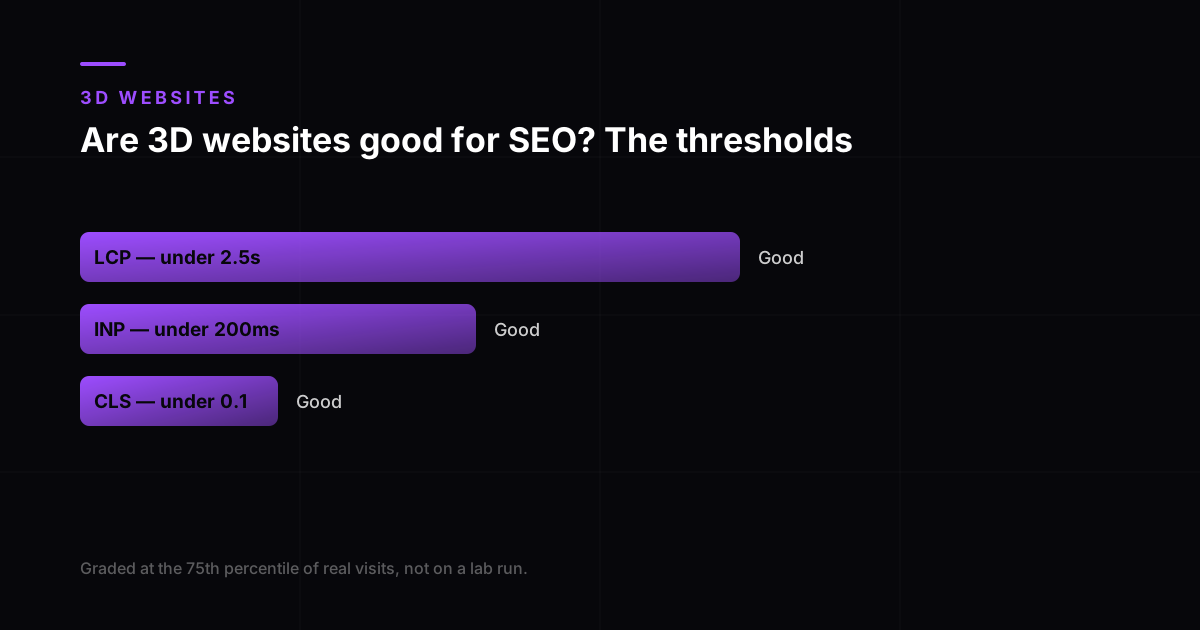
Are 3D websites good for SEO? The short answer
The 3D layer is neither good nor bad for SEO. It is invisible to it. What decides the outcome is what you did with the rest of the page, and whether anything important got moved inside the scene.
Why a canvas is invisible
A 3D website draws into a canvas element. A canvas is a surface of pixels. It has no headings, no paragraphs, no anchor tags and no alt text. A crawler reading your page sees an empty box where your beautiful scene is, in the same way it would see a photograph with no alt attribute.
That is fine, right up until someone puts the value proposition in there. A scroll-driven story that reveals your three service pillars as text inside the scene has just made three of your most important claims unreadable to every search engine and every AI answer engine at once.
The ten-second test
- Open the page and disable JavaScript in your browser settings.
- Reload. Whatever text remains is approximately what a crawler starts with.
- Check the H1, the body copy, the internal links, the FAQ answers and the contact route.
- If the page is now blank, or a headline over an empty box, you do not have an SEO problem later. You have one now.
Google does render JavaScript, so a JS-dependent page is not automatically invisible. But rendering is a second pass and a queue, and it never recovers content that only ever exists as pixels. Static or server-rendered HTML removes the question entirely.
What has to be in the HTML
| Element | Where it must live | Why |
|---|---|---|
| H1 and heading hierarchy | HTML | Defines what the page is about, and never skips a level |
| Body copy and claims | HTML | The only text an engine can read, rank or quote |
| Internal links | HTML anchors | A link drawn inside a canvas passes nothing anywhere |
| Image alt text | HTML | Applies to real images. A canvas needs a text equivalent nearby |
| Metadata and canonical | Document head | Title, description and canonical must not depend on hydration |
| Schema JSON-LD | Document head or body | Entity markup engines parse without rendering anything |
| Contact and forms | HTML | A form that only exists after hydration is a conversion risk, not just an SEO one |
The second SEO question is weight
Core Web Vitals are assessed on real visits, at the 75th percentile of your traffic over a rolling 28-day window. That is the important detail. You are not graded on your laptop. You are graded on the slower quarter of your actual audience, which on a mobile-first market is a mid-range phone on a busy network.
| Metric | Good | What it means |
|---|---|---|
| LCP | Under 2.5 seconds | How long until the main content appears |
| INP | Under 200 milliseconds | How fast the page responds when someone interacts |
| CLS | Under 0.1 | How much the layout jumps while loading |
INP is where 3D sites most often fail, because a render loop competing for the main thread makes taps feel sticky even when the page looks fine. The fixes are architectural rather than cosmetic, and they are covered in the performance guide.
AI answer engines raise the stakes
A traditional search result rewards a page. An AI answer rewards a passage. Engines lift a sentence or two, attribute it, and move on. A page whose distinctive content is inside a rendered scene offers nothing to lift, so it never appears in the answer, no matter how good the scene is.
- LCP: largest contentful paint
- Good: under 2.5s
- INP: interaction to next paint
- Good: under 200ms
- CLS: cumulative layout shift
- Good: under 0.1
Thresholds per Google's Core Web Vitals guidance. Scales differ per metric, so read each row against its own label rather than against the others.
Those are the numbers a 3D build is actually measured on, and they are published: Google documents the Core Web Vitals thresholds and grades at the 75th percentile of real visits, not on a lab run. A scene that is comfortable on a development machine and marginal on a mid-range phone will be scored on the phone. what makes a 3D site heavy covers the weight budget that keeps all three inside the bands.
Making the page quotable as well as crawlable
Crawlable and quotable are not the same bar. A page can pass every technical check and still give an engine nothing worth lifting, because the text exists but says nothing specific. The fix is editorial rather than technical: state the actual answer in a sentence, in the HTML, near the top.
- Answer the page's own question in one plain sentence before elaborating on it.
- Put numbers, prices and specifications in text, not baked into the scene or an image.
- Use real headings for real sections, so a passage has a boundary an engine can recognise.
- Keep the distinctive claim outside the canvas. If your best sentence only exists as rendered geometry, it does not exist.
This is the same discipline that makes the page work with the scene disabled, which is why a well-built 3D site treats the canvas as an additional layer rather than the content itself. If your current build fails the ten-second test above, rebuilding it HTML-first is usually cheaper than retrofitting text around a scene that was designed to carry it.
- Answer the question in the first paragraph, in plain text, before any scene loads.
- Keep claims discrete and self-contained, so one sentence survives being quoted alone.
- Use real headings that name the question, not a headline that only makes sense in context.
- Keep AI crawlers allowed in robots.txt if being cited is part of the plan.
The audit checklist
- JavaScript off: H1, body copy, links and forms all still present.
- No sentence, claim or navigation item exists only inside the canvas.
- Every scene has a static fallback for reduced motion and low-capability devices.
- Heading hierarchy runs H1 to H2 to H3 without skipping.
- Title, meta description, canonical, Open Graph and schema render without hydration.
- Mobile LCP under 2.5 seconds on a mid-range device, measured on field data rather than a lab score.
- Redirect map in place if the rebuild changed any URL that previously ranked.
Frequently asked questions
Are 3D websites bad for SEO?
Not inherently. They are bad for SEO when content lives inside the 3D scene, because a canvas element paints pixels and contains no text, headings or links for a crawler to read. When the 3D is additive and every word exists in the HTML underneath, the scene is simply invisible to search, and the only remaining question is page weight.
Can Google read text inside a WebGL scene?
No. Text rendered into a canvas is pixels, not markup, so there is nothing in the DOM to extract, index or quote. Google does execute JavaScript and can index content that JavaScript writes into the DOM, but that is a different thing entirely from content painted onto a canvas surface.
How do I check if my 3D site is crawlable?
Disable JavaScript in your browser and reload the page. Whatever text remains is roughly what a crawler starts with. Check that your H1, body copy, internal links, FAQ answers and contact route all survive. If the page renders as a headline over an empty box, the content is trapped in the scene.
Do 3D websites hurt Core Web Vitals?
They can, and INP is usually the first to suffer, because a render loop competing for the main thread makes interactions feel sticky. Core Web Vitals are measured on real visits at the 75th percentile over 28 days, so a scene that runs beautifully on your laptop can still fail on the slower quarter of your audience.
Will a 3D website get cited by ChatGPT or Perplexity?
Only on the strength of its HTML. AI answer engines lift and attribute passages of text, and a rendered scene offers nothing to lift. Put the answer in the first paragraph as plain text, keep claims self-contained enough to survive being quoted alone, and keep AI crawlers allowed in robots.txt.
Is server-side rendering necessary for a 3D website?
Static or server-rendered HTML is the safest route, because it removes any dependence on rendering for your content to exist. The 3D scene itself always initialises on the client, which is fine. What matters is that the headings, copy, links and schema arrive in the initial HTML response rather than after hydration.