How Long Does a 3D Website Take to Build?
A custom 3D motion website is typically a six to ten week build for a small site, measured from a signed brief to a live handover. The 3D itself is rarely the long pole. Copywriting, content gathering and approval cycles are, and they are the stages that depend on the client rather than the studio. A build that slips usually slipped because nobody had written the words yet.
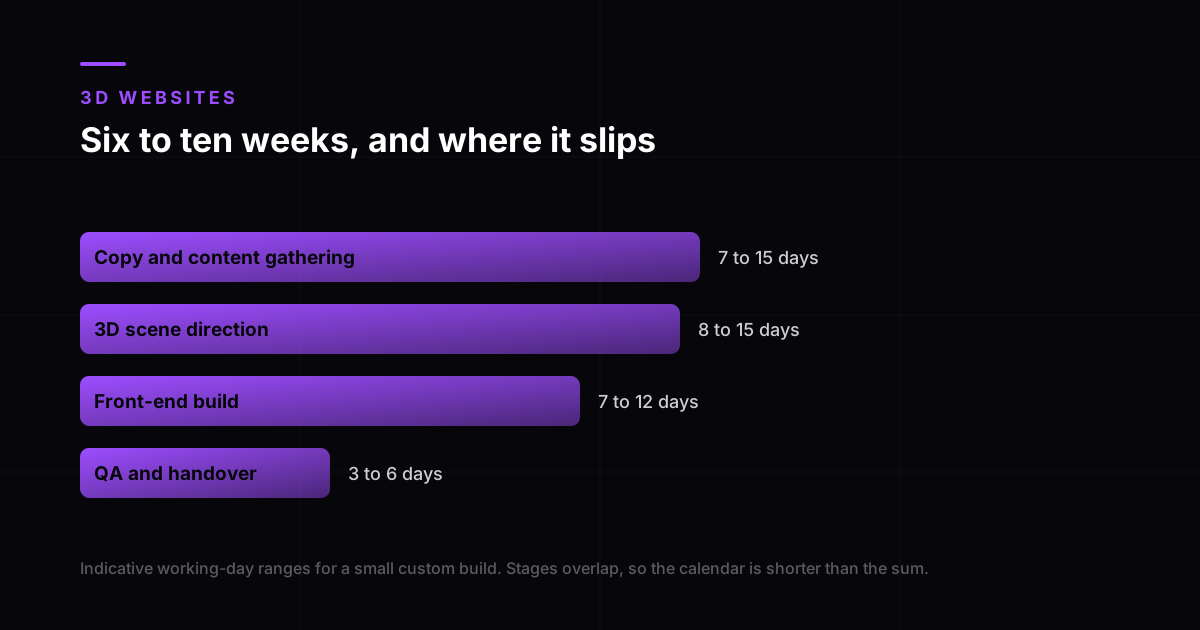
The honest range
Six to ten weeks for a small custom site with two or three directed 3D scenes. Faster is possible when the content already exists and one person can approve. Slower is normal when the copy has to be written from scratch and three people have opinions. These are our own ranges rather than an industry benchmark, because no published benchmark for custom 3D build time exists that is worth quoting.
- Brief and discovery
- 3 to 5
- Copywriting and content gathering
- 7 to 15
- Design direction
- 5 to 10
- 3D scene direction and build
- 8 to 15
- Front-end build and integration
- 7 to 12
- QA, performance and handover
- 3 to 6
Our own working-day ranges for a small custom build, drawn from how we scope projects rather than from published industry research. Not a quoted schedule. Stages overlap in practice, so the total is shorter than the sum. Your own scope decides the real figure.
Note that the stages overlap. Front-end build starts before every scene is final, and QA runs continuously rather than as a block at the end. The sum of the rows is longer than the calendar because of that.
What actually drives the number
| Driver | Effect on schedule | Why |
|---|---|---|
| Number of directed 3D scenes | High | Each scene is directed individually, so scenes scale time, not pages |
| Whether the copy exists | High | Design cannot finish around text nobody has written |
| Number of approvers | High | Every extra decision-maker adds a round, not just an opinion |
| Page count | Moderate | Additional pages reuse an established system |
| Custom interaction and scroll logic | Moderate | Bespoke behaviour needs its own QA pass |
| Integrations and forms | Low to moderate | Predictable unless a third party is slow |
| Hosting and domain setup | Low | Routine, but leave a day for propagation |
Where builds slip
- Copy arriving in pieces, so design keeps reflowing around it.
- Approval by committee, where each round surfaces a new stakeholder rather than closing the previous comments.
- Assets that do not exist yet, particularly photography and product files needed for the scenes.
- Scope added mid-build. A new page is small. A new scene is not.
- Performance work discovered late, which is why the weight budget is agreed before the scene is designed rather than after. The targets are not negotiable, and Google grades them on real visits at the 75th percentile rather than on a lab run.
What you should be seeing, and when
- End of week one: a written brief you recognise, and a sitemap.
- Around week three: copy in draft and a design direction you can react to.
- Around week five: the first scene moving, in the browser, on your phone.
- Around week seven: a full staging link with real content in it.
- Before handover: a performance pass on a mid-range phone, and the domain in your name. StatCounter has India running mobile-first by a wide margin, so that device is the test, not your laptop.
If you reach week five without seeing anything move in a browser, ask why. Static mockups of a motion site are a warning sign, because motion decisions cannot be judged as pictures. The QA stage should also include a reduced-motion pass, since browsers expose the preference through prefers-reduced-motion and a motion-heavy site that ignores it is unusable for some visitors.
How timeline relates to cost
They move together, because both are driven by scene count rather than page count. 3D website pricing in India is set per scene for that reason, and the same logic answers the timeline question: adding a page adds days, adding a scene adds a fortnight.
It is also the honest reason a custom build takes longer than the alternative. A template with bundled animation ships in days because the decisions were made before anyone knew what your business was. That is precisely the trade you are making.
Frequently asked questions
How long does a 3D website take to build?
Six to ten weeks is realistic for a small custom site with two or three directed scenes, measured from signed brief to live handover. The range depends far more on whether the copy exists and how many people approve than on the 3D work itself.
Why does it take longer than a normal website?
Because each 3D scene is directed individually rather than dropped in from a library, and because motion has to be judged in a browser rather than in a static mockup. Scene count, not page count, is what drives the schedule.
What makes a 3D website build run late?
Copy arriving in pieces, approval by committee where each round surfaces a new stakeholder, missing photography or product files, and scope added mid-build. Performance problems found late also cost time, which is why a weight budget should be agreed before the scene is designed.
Can a 3D website be built in two weeks?
Not as a custom build. A two-week quote is a template with bundled motion, which is a legitimate product but a different one. Bundled animation was designed before anyone knew what your business does, and it costs load time to decorate rather than to explain.
What should I have ready before the build starts?
One named decision-maker, your copy or at least the source material for it, brand assets, any product files needed for the scenes, and access to your domain and analytics. Those five things remove most of the usual delay.