How Much Does a 3D Website Cost in India? (2026)
No studio in India publishes a rate for custom 3D motion websites, which is why every quote you get will look arbitrary. The template market does publish: Halones Technologies in Kochi lists ₹4,999 for a three-page static site and ₹17,999 for an eight-page CMS build. A custom 3D site is not those plus a bit, because it is not priced per page. It is priced by scene count, model complexity, how much is written from scratch, and whether an existing site has to be migrated without losing its rankings.
3D website design cost in India: the short answer
There is no published rate for a custom 3D website in India. I looked, because I wanted to link one. Agencies publish blog posts about what websites cost in general, and studios that actually build 3D work quote privately. So the honest answer is not a number pulled from the air. It is the list of things that decide the number.
What is published is the template end of the market, and those figures are real and checkable. Here is what one Kochi studio lists openly on its own price page.
- Basic static site, up to 3 pages
- ₹4,999
- Business CMS site, up to 8 pages
- ₹17,999
- E-commerce site, up to 100 products
- ₹24,999
One-time prices published on the company’s own price list, GST included, as listed in August 2026. Template-tier builds with first-year hosting bundled. Shown to anchor the bottom of the market, not as a comparison to custom work.
Why 3D is not priced per page
Template pricing is per page because every page costs about the same to produce. Drop the content into the layout, adjust, publish. Twenty pages costs roughly twenty times one page.
Custom 3D breaks that arithmetic completely. A single scroll-driven scene can take longer than an entire twenty-page brochure site, because the work is not laying out content. It is modelling, lighting, directing a camera, building the interaction, then doing it again for mobile, again for reduced motion, and again for the devices that cannot run it at all. That third version is not optional politeness: browsers expose the preference through the prefers-reduced-motion media query, and a scene that ignores it is unusable for a real share of visitors.
So when a quote arrives priced by page count, that tells you something. It usually means the 3D is a bought asset dropped onto a template, which is a legitimate cheaper product and not the same thing you were asking about.
The seven things that actually move the price
| Driver | Cheap end | Expensive end |
|---|---|---|
| Scene count | One hero scene | A scene per section, each individually directed |
| Model source | Simple geometry, or a licensed stock model | Your actual product, modelled and textured from scratch |
| Interaction | Ambient motion, no input | Configurators, drag, state the visitor controls |
| Page count | A long single page | A structured site with real information architecture |
| Copy | You supply the words | Every page researched and written for search intent |
| Migration | New domain, nothing to preserve | Existing rankings, URL mapping, redirects, no traffic lost |
| Setup scope | You already own domain and hosting | Domain research and purchase, DNS, SSL, analytics, forms tested |
Model source is the one people underestimate. Rotating a generic shape is cheap. Modelling your product accurately enough that a buyer trusts what they are seeing is a different job, and it is the version that actually removes a doubt and earns its weight.
What one scene involves
- Deciding what the scene explains, and cutting it at the sketch if the answer is nothing.
- Modelling and texturing, to a polygon and texture budget set before anything is built.
- Lighting and materials, which is where most of the perceived quality actually comes from.
- Camera direction and the scroll or cursor mapping that drives it.
- A mobile version with fewer objects, smaller textures and a shorter camera path.
- A reduced-motion version that is a composed still, not the scene with the movement switched off.
- A static fallback for devices that should not be asked to run it.
- Performance testing on a real mid-range phone, not a throttled desktop.
That is one scene. Read that list again and the pricing stops looking arbitrary. It also explains why a studio that quotes 3D casually is usually quoting items one through four and discovering five through eight later, at your expense or theirs.
The running costs nobody puts in the quote
The build is a one-time cost. Keeping the site alive is not, and this is the part most quotes go quiet about. The good news is that these figures are published, small, and easy to check yourself, whether that is the wholesale .com registry fee, Cloudflare’s at-cost registrar, or the published plans at Netlify and Vercel.
| Item | Published price | Notes |
|---|---|---|
| .com domain, wholesale | $10.26 a year | Rising to $10.97 on 1 November 2026, a 7 percent increase under Verisign’s ICANN cap |
| Domain at an at-cost registrar | Registry fee only | Cloudflare Registrar states it applies no markup, and includes free WHOIS redaction |
| SSL certificate | Free | Included by every host worth using. Nobody should be billing you for this |
| Static hosting, Netlify | Free tier, then $9 a month | Free tier includes custom domains with SSL and a 300 credit allowance |
| Static hosting, Vercel | Free tier, then $20 a month per user | The free Hobby tier is for personal, non-commercial use. A business site belongs on Pro |
| Analytics and Search Console | Free | A setup cost in time, not a licence fee |
Add it up and the real annual running cost of a static 3D site is a domain and a hosting plan. Anyone quoting a large monthly maintenance fee on top of that should be able to say precisely what the money buys, in hours.
Why two quotes for the same site differ by five times
Because they are not for the same site. The brief said 3D website and both parties heard something different. These are the questions that collapse the gap.
- Who writes the copy? If the answer is vague, it means generated text, and it is the single largest hidden difference between two quotes.
- How many scenes, and are the models custom or licensed?
- What happens on mobile, and is that a separate build or the desktop one scaled down?
- Is there a reduced-motion version of every animation, or does motion simply stop?
- Who owns the domain, the hosting account and the code at the end?
- How many revision rounds, and what counts as a round?
- If I already have pages that rank, who maps the redirects?
The last one is worth a specific answer in writing. Rebuilding a site that ranks without a redirect map is the fastest known way to lose traffic you have already paid for, and it is not a line item most quotes think to include.
The cheapest quote and the cheapest outcome
These are different things, and the gap between them is measurable. Google and Deloitte found that a 0.1 second improvement in mobile site speed was associated with an 8.4 percent lift in retail conversions. A cheap build that is two seconds slower is not saving you money quietly. It is spending it, on every visit, forever.
The same applies to the words. A site that loads instantly and says nothing convincing is a fast way to lose someone. Budget is finite, so if something has to give, give up a scene before you give up the copy.
What to ask before you accept a 3D quote
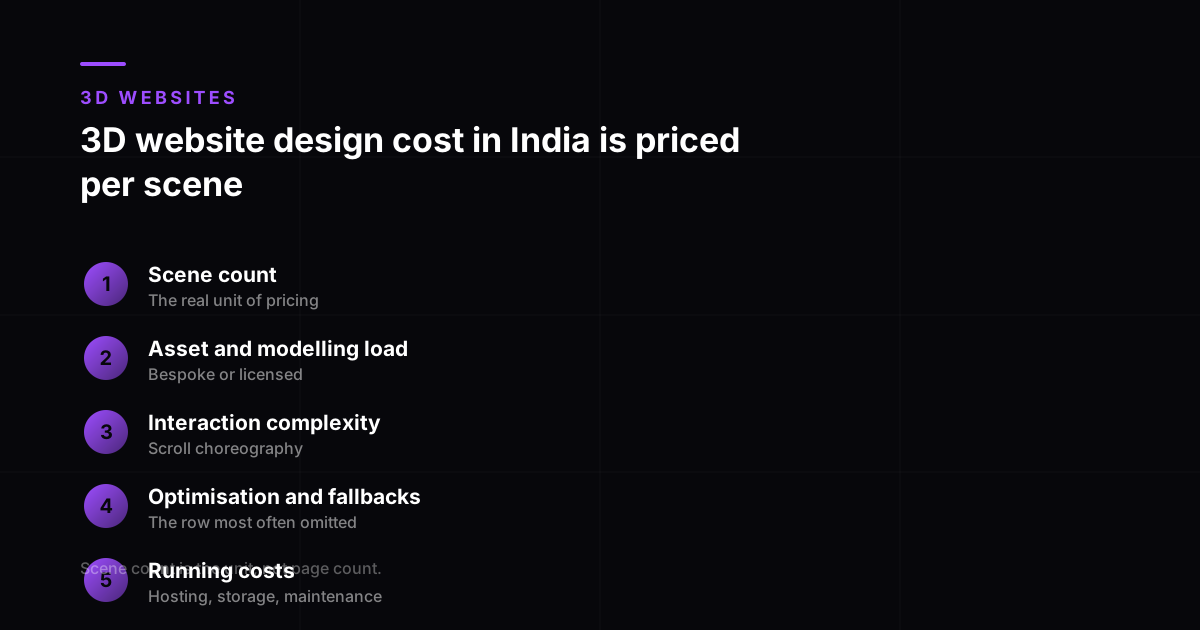
- How many scenes, and is each priced separately? Scene count is the real unit, not page count.
- What is the weight budget for the scene on a mid-range Android phone, stated as a number?
- Does the page work with the canvas disabled, for crawlers and for reduced-motion users?
- Who owns the source files, meaning the models, the scene graph and the shaders, and can another studio pick them up?
- What are the running costs after launch: hosting, asset storage, and who maintains it when a browser updates?
If a quote cannot answer the second and third, it is pricing a look rather than a build. Do 3D websites slow down your site covers the weight question, are 3D websites good for SEO covers the crawler one, and 3D website versus template covers whether you need the scene at all. Our own scope and pricing for this sits on the 3D motion website design page.
Frequently asked questions
How much does a 3D website cost in India?
No Indian studio publishes a rate for custom 3D websites, so any single figure you are quoted online is invented. What is published is the template tier: Halones Technologies in Kochi lists ₹4,999 for a three-page static site and ₹17,999 for an eight-page CMS build. Custom 3D is priced by scene count, model complexity, how much is written from scratch and whether an existing site needs migrating, not by page count.
Why is a 3D website more expensive than a normal website?
Because a scene is not a page. Each one needs modelling, texturing, lighting, camera direction and interaction, then a separate mobile version, a reduced-motion version and a static fallback, then performance testing on a real mid-range phone. A single scene can take longer than a twenty-page brochure site, which is why page count tells you almost nothing about the price.
What are the ongoing costs of running a 3D website?
A domain and a hosting plan, and both are published prices you can verify. The .com wholesale registry fee is $10.26 a year, rising to $10.97 on 1 November 2026, and an at-cost registrar like Cloudflare passes that through with no markup. SSL is free everywhere worth hosting. Netlify starts at $9 a month above its free tier and Vercel at $20.
Can I use free hosting for my business website?
Check the terms before you rely on it. Vercel’s free Hobby plan is explicitly for personal, non-commercial use, so a business site belongs on Pro. Netlify’s free tier does allow custom domains with SSL within a credit allowance. Either way, the account should be in your name rather than your developer’s, so you keep control of the site you paid for.
What should I ask before accepting a 3D website quote?
Ask what is excluded rather than what is included. Specifically: who writes the copy, how many scenes and whether models are custom or licensed, what happens on mobile, whether every animation has a reduced-motion version, who owns the domain and hosting at the end, how many revision rounds, and who maps the redirects if you already have pages that rank.
Is a cheap website actually cheaper?
Not usually, because a slow or unconvincing site keeps costing you after the invoice is paid. Google and Deloitte found a 0.1 second mobile speed improvement associated with an 8.4 percent lift in retail conversions, so a build that is seconds slower is spending money on every visit. Work out what one customer is worth over a year and the difference between two quotes usually stops looking large.
Do I need to pay for the domain separately?
You should pay for it, and it should be registered in your name. Some studios bundle the first year, which is convenient and fine, but the account and the ownership record need to end up as yours. A domain registered in a developer’s account is the most common way businesses lose control of their own web address.