How to Update Training Video Without a Reshoot
With AI training video, a changed policy is a re-script and re-render of one section, not a reshoot. The rest of the library stays exactly as it was, which is why it ages well. The saving is not mainly money, it is that the update actually happens instead of being postponed until the module is quietly wrong.
Here is the cost nobody quotes for: keeping training current. With filmed video, one policy change means rebooking the presenter and matching the old lighting. Most teams just do not, and the library goes stale.
Why you can update AI training video without a reshoot
- Change one section: re-script and re-render only the part that changed.
- Everything else stays identical, so nothing else has to be redone.
- No studio, no presenter to rebook, no lighting to match.
- A library that stays current is worth more in year three than in year one.
The reshoot problem is fixed cost, not variable cost
This is the part that makes filmed training libraries decay. Changing one sentence and changing ten minutes cost roughly the same, because the expense is in reassembling the conditions rather than in the recording itself.
To reshoot thirty seconds you need a great deal to line up. The presenter available. The same location, or one close enough to pass. Matched lighting, wardrobe and audio. Then an editor to cut it in so the join is invisible. Miss any one of those and the correction is visible as a correction, which is worse than leaving it alone. So a small fix carries a large minimum cost, and small fixes are exactly what a maturing policy generates.
| One policy line changes | Filmed module | AI-produced module |
|---|---|---|
| Presenter needed again | Yes, and must match | No |
| Location and lighting | Must be recreated | Unchanged by definition |
| Wardrobe continuity | A real constraint | Not applicable |
| What gets remade | The scene, often the module | The affected section |
| Typical turnaround | Weeks, subject to availability | Days |
| Realistic outcome | Deferred until the next big refresh | Done when the policy changes |
That last row is the honest one. The difference in practice is not that the update is cheaper. It is that the update happens at all.
What a stale library actually costs
A training module teaching last year process is not neutral. It actively teaches the wrong thing, and it does so with the authority of an official company resource.
- New staff learn the superseded process and have to be corrected informally, which undoes the point of standardised training.
- Experienced staff learn to disregard the library, and then miss the parts that are current and important.
- In a regulated environment, evidence that you trained people on a superseded procedure is worse than having no recording of it.
- Every module people know is out of date lowers the credibility of every module that is not.
Build it so it can be updated
The production method helps, but it does not save a library that was structured badly. These decisions matter more than the tool, and they apply whether the video is generated or filmed.
One idea per chapter
If a chapter covers three topics, a change to one of them forces a rewrite of all three. Discrete chapters mean a discrete change, and they make the module easier to navigate as a side effect.
Keep the script as the source of truth
The maintainable asset is the script, not the video file. If the current script lives in a document that anybody can find and diff, updating is a small edit and a re-render. If the only record of what the video says is the video, every update starts with somebody transcribing it.
Do not bake in what will change
Dates, version numbers, named individuals, org chart references and specific tool interfaces all expire. Where a module has to include them, isolate them into their own short section rather than threading them through the narration, so expiry is contained.
The number that makes the case
Two figures worth holding together. Around 38 percent of employees leave within their first year, and structured onboarding is reported to cut time-to-full-productivity from roughly eight months to three to five. Both of those depend on training content being accurate at the moment somebody watches it.
A library that has drifted out of date does not merely fail to deliver that benefit. It works against it, because a new hire who follows a superseded process and gets corrected learns that the official material cannot be trusted, and from then on asks a colleague instead. That is the cost the reshoot economics were quietly creating.
When a reshoot is still the right answer
Being fair about the limits: if the underlying process has genuinely changed rather than been amended, patching sections produces a module that is internally inconsistent, and rebuilding is the correct call. The same applies when the module is old enough that its whole framing is wrong.
Section-level updating is for keeping a fundamentally sound module accurate. It is not a way to avoid ever rebuilding something that has quietly become obsolete. On the surrounding questions, see why nobody finishes your training videos and training video production cost.
What a maintainable library looks like
Updatability is decided when the library is built, not when the policy changes. The modules that can be revised in an afternoon share the same handful of properties.
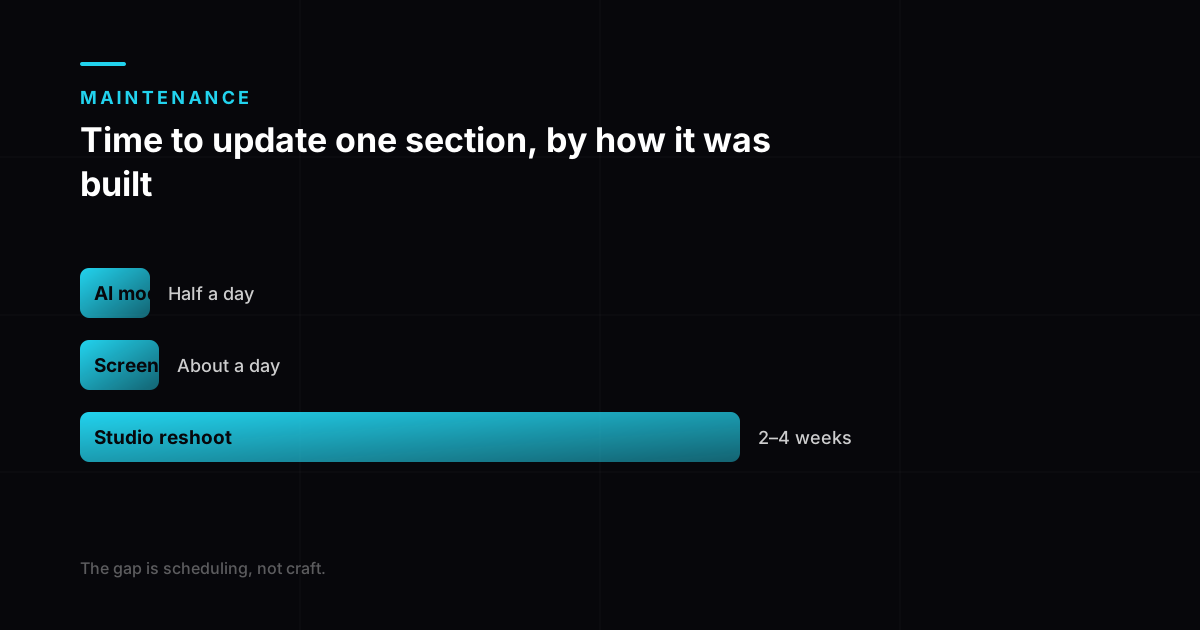
- AI module, section re-rendered
- Half a day
- Screen recording, section re-captured
- About a day
- Filmed module, studio reshoot
- 2 to 4 weeks
Elapsed time to change one factual section, not total production time. The filmed row is dominated by scheduling rather than by shooting.
The gap in that chart is scheduling, not craft. Re-rendering a section needs a corrected script. Re-shooting one needs a studio, a presenter, and a date on which all three are free. That is why the filmed version usually does not get updated at all. It quietly goes stale instead.
Five properties that make a module updatable
- One task per module, so a process change touches one file rather than six.
- Facts and figures spoken in isolated sections, never woven through a continuous narration.
- No on-screen dates, version numbers or prices baked into the footage. Put them in text overlays you can replace.
- Captions held as a separate file rather than burned in, so a wording change does not mean a re-render. WCAG requires captions at Level A regardless, so you will have them either way.
- Source scripts and project files retained and owned by you, which is a contract question rather than a technical one.
Building to those five costs nothing extra at production time and is most of what determines whether the library survives its second year. New hire onboarding video covers which modules to build first, and our training video production scopes libraries this way by default.
The accessibility work that has to survive an update
One thing must not get lost when a section is swapped: captions. WCAG requires captions on pre-recorded video with audio at Level A, so an updated module that ships without them has quietly regressed from compliant to non-compliant. Keeping captions as a separate file rather than burned into the footage is what makes this automatic: change the script, regenerate the caption file, done. The same structure is what makes a second language possible without a reshoot. How long a training video should be covers why short modules make that cheap.
What a stale module actually costs
The case for cheap updates is not the production saving, it is what an out-of-date library does to the people using it. SHRM puts the cost of replacing an employee at 50 to 200 percent of annual salary, and training that contradicts current process is a direct contributor to a poor start. Measured against a single avoided replacement, the difference between a module you can revise in an afternoon and one you will quietly leave wrong is not a line item worth optimising. It is the whole argument.
Frequently asked questions
Will the updated section look different from the rest of the module?
It should not, and that is the main technical advantage. Because the presenter, setting and lighting are specified rather than physically staged, regenerating a section reproduces the same conditions exactly. The usual causes of a visible join in filmed video, a different haircut, different daylight, a slightly different microphone, do not arise.
How quickly can a module be updated when policy changes?
Usually days rather than weeks, and most of that is the approval cycle rather than the production. The rendering is quick. What takes the time is agreeing the new wording and getting it signed off, which is the same in any format. That is worth planning for, because it is the part that will actually set your timeline.
Can we update video that was originally filmed conventionally?
Only by reshooting the affected part, which brings back the matching problem. What some teams do instead is replace filmed modules with rebuilt ones gradually, starting with whichever modules change most often. Trying to mix a generated section into a filmed module is rarely convincing, and the mismatch draws attention to exactly the part you were trying to quietly fix.
Does frequent updating create version control problems?
It can, and it is worth deciding the answer before you need it. Keep the script under version control with a dated change note, record which version each learner completed, and make sure the learning management system serves the current one rather than caching an old file. None of that is difficult, but it is much easier to set up at the start than to reconstruct later.
How often should a training library be reviewed?
Every six months as a standing review, plus immediately whenever the underlying process changes. The six-month pass is not about re-recording, it is about checking that what the modules describe is still what people actually do. Most libraries do not go stale in one dramatic moment; they drift, one small process change at a time, until the gap between the video and reality is large enough that people stop trusting any of it.
Who should own keeping the library current?
One named person, and preferably the person who owns the process rather than the person who owns the video. Ownership sitting with L&D or marketing is why libraries go stale: they do not find out a process changed. Ownership sitting with the team that runs the process means the trigger for an update is the change itself rather than a calendar reminder six months later.