How Long Should a Training Video Be? Completion Over Coverage
Split training into modules of 3 to 7 minutes, each covering one task a learner can complete. Long single-file modules get abandoned partway and are almost never revisited, while short task-based ones get finished and, more importantly, get returned to when someone needs the answer months later.
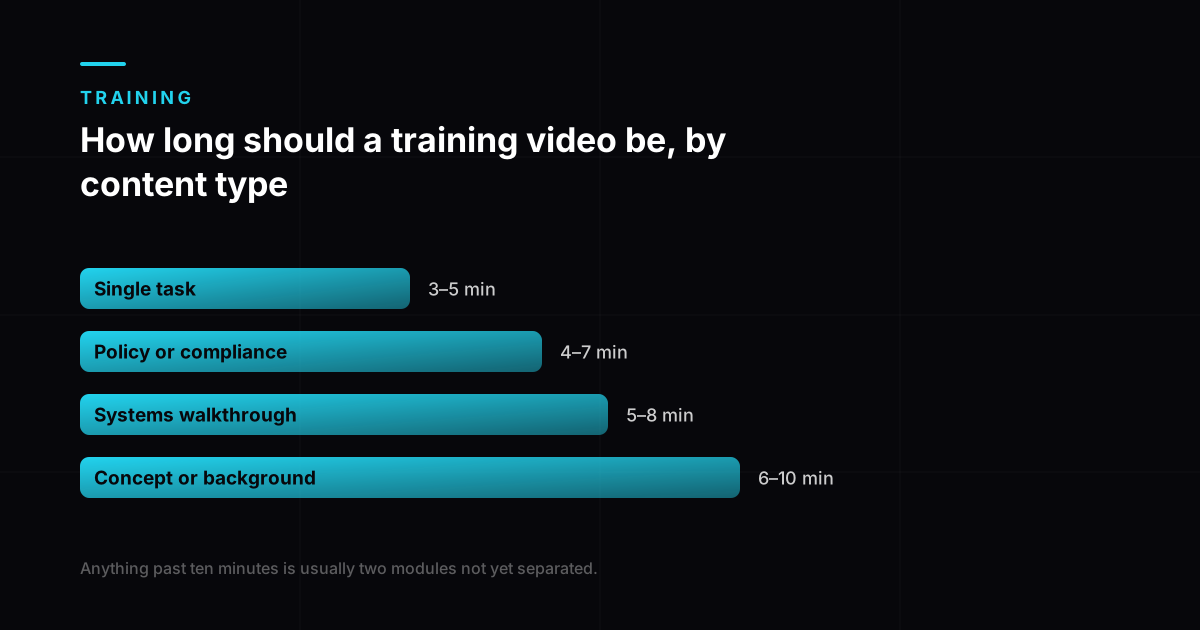
How long a training video should be: coverage is not the goal
Most corporate training is built to cover material, and length is set by how much there is to say. That produces modules nobody finishes, which means the material was not actually covered at all.
Build for completion instead. The measure that matters is whether someone can do the task afterwards, not whether the file contained the information.
One module, one task
| Content type | Target length | Split by |
|---|---|---|
| Software walkthrough | 3 to 5 min | One workflow per module |
| Policy or compliance | 4 to 7 min | One policy per module |
| Practical skill | 5 to 8 min | One technique per module |
| Onboarding overview | 5 to 10 min | One department or theme |
| Full course | Never one file | Modules of the above |
The test for a good split: can you name the module after a thing the learner will be able to do? "Processing a refund" is a module. "Customer service part two" is a file.
- Single task or procedure
- 3 to 5 min
- Systems walkthrough
- 5 to 8 min
- Policy or compliance
- 4 to 7 min
- Concept or background
- 6 to 10 min
Lengths follow the task, not the subject. Anything running past ten minutes is usually two modules that have not been separated yet.
Why the ceiling is about ten minutes
The limit is not attention span, which is the usual explanation and the wrong one. It is the size of the gap the viewer has to find. A ten-minute module fits into the space between two meetings; a forty-minute one requires somebody to schedule it, and scheduled training is training that gets postponed. Past ten minutes you are no longer competing with boredom, you are competing with a calendar.
That is also why splitting works better than shortening. Cutting a forty-minute module to thirty changes nothing about whether it fits in a gap. Splitting it into eight five-minute modules changes it completely, and the total runtime can stay the same. Why nobody finishes your training videos covers the abandonment side, and new hire onboarding video covers what to build first.
What chaptering solves, and what it does not
Chapters make a long video navigable, which matters enormously in month four when someone needs one specific answer. They do not fix abandonment on first viewing, because a 40-minute file still looks like 40 minutes.
- Chapter everything, regardless of length. It costs nothing and it is what makes a library usable.
- Name chapters after tasks, not topics.
- Still split into short modules. Chaptering is not a substitute for that.
- Add captions and a transcript, which makes the content searchable in a way video otherwise is not.
Structure inside a module
- Open by naming what they will be able to do at the end. Ten seconds.
- Teach the task in sequence, without digressions into related topics.
- Show it happening, rather than describing it happening.
- Close with the single most common mistake and how to avoid it.
The maintenance argument for short modules
When a process changes, a short module can be re-recorded or re-rendered on its own. A 40-minute file means re-doing the whole thing, which is why most training libraries go stale and people quietly stop trusting them. Updating a training video without a reshoot covers the mechanics, and training video production cost covers why per-minute pricing makes short modules cheaper to maintain as well as to finish.
What to do with the length you have already made
Most teams reading this already own a library of long modules, and rebuilding it wholesale is not realistic. The salvage order that works:
- Chapter what exists, starting with the modules people actually search for. Costs nothing and makes a long file usable as a reference.
- Caption everything. WCAG requires captions on pre-recorded video at Level A, so this is an obligation you may already be missing rather than an improvement.
- Split only the modules that are both long and frequently referenced. Length alone is not a reason; length plus repeat traffic is.
- Re-record the first minute of the worst performer. The opening is where abandonment concentrates and it is the cheapest minute to replace.
- Leave the rest alone until the process it documents changes, then rebuild that one properly at the new length.
That sequence spends the budget where completion actually moves. If you would rather have the library rebuilt as task-named modules in one pass, our corporate training video service is built for exactly that shape of job.
Length is a symptom, not the disease
It is worth stating the limit of everything above. Cutting modules to five minutes will not rescue training that nobody had a reason to watch. Length decides whether people can finish; relevance decides whether they start.
The scale of that problem is larger than most teams assume: Gallup finds only 12 percent of employees strongly agree their organisation does a great job of onboarding. That is not a runtime failure. It is content built around what the company wanted to say rather than what the new hire needed to do on Tuesday. Fix the module titles first. If none of them name a task, the length was never the problem.
Frequently asked questions
How long should a training video be?
Three to seven minutes per module, split so each covers a single task. Reported completion for modules in the three to five minute band runs two to three times that of thirty-minute courses, which is a larger effect than almost anything you can change about the content itself. Set length by the task rather than a target duration, but treat anything past about ten minutes as a signal the module should be split.
Is it better to have one long video or several short ones?
Several short ones, for two separate reasons. Learners finish short modules and abandon long ones, and short modules can be found and reused later when somebody needs one specific answer. The second reason matters more over time, because most of a training library’s value comes from being used as reference long after the initial completion.
Does chaptering a long video solve the problem?
Partly. Chapters make a long video navigable, which is genuinely valuable in month four when someone needs one answer. They do not fix first-viewing abandonment, because the learner still sees a forty minute runtime and decides they do not have forty minutes. Chapter everything regardless, and still split into short modules.
How do I know where to split a long module?
Split by task, not by time. The test is whether you can name each resulting piece after something the learner will be able to do afterwards. If a proposed split produces a section you can only describe as part two, the split is arbitrary and the module will not work as reference material later.
What completion rate should we expect?
There is no credible universal benchmark, because completion depends heavily on whether training is mandatory, how it is assigned and whether the system enforces sequential viewing. Compare your own modules against each other instead: the ones people finish and the ones they abandon will tell you far more than an industry average would.
Should a training video have a presenter, and does that change the length?
It changes the length more than people expect. A presenter adds pacing overhead, greetings, transitions and sign-offs, which can add a minute or two to a module without adding anything a learner needs. For a systems walkthrough, a screen recording with a voiceover is usually shorter and clearer than the same content with a face in the corner. Keep the presenter for material where tone matters, such as culture or a welcome, and drop it for anything procedural. The exception is compliance, which often reads as more serious delivered straight to camera.