Why Nobody Finishes Your Training Videos (And How to Fix It)
People abandon training video when it is long, faceless and unchaptered. Completion goes up when it is broken into short chapters, scripted like speech, and captioned so it works on mute. The usual cause is not weak content but a format that asks for forty uninterrupted minutes from someone who has nine.
A finished training video that nobody finishes is a deck with a play button. The problem is rarely the content. It is the format.
What pushes training video completion rates back up
- Chapters: short, findable sections beat one 40-minute block nobody commits to.
- Scripting: write it like someone talking, not like a policy document read aloud.
- Captions: many people watch training on mute at their desk.
- A reason to care in the first minute, the same as any other video.
What the completion data looks like
Industry figures for corporate training completion are worse than most teams assume, and the gap between formats is larger than the gap between good and bad content within a format.
| Reported figure | |
|---|---|
| Average corporate training completion | Around 45% |
| Learners fully engaging with content | Around 25% |
| Microlearning module completion | Around 80% |
| 3 to 5 minute modules vs 30 minute courses | 2 to 3 times higher completion |
| Employees who pause a training video mid-way | Around 60% |
| Of those, who never resume | Around 35% |
The last two rows are the ones worth sitting with. If most people pause and a third of those never come back, then the design assumption behind a forty-minute module, that somebody will watch it start to finish in one sitting, is wrong for the majority of your audience. You are not building for an attentive viewer with a clear diary. You are building for someone who will be interrupted.
Why length is the wrong thing to argue about
Teams usually respond to poor completion by trying to make the video shorter, and then discover they cannot cut much without losing content they are required to cover. The argument stalls there. It stalls because length is not really the problem.
The problem is the size of the commitment being asked for in one sitting. A forty minute video demands a forty minute gap in someone diary, and most people do not have one. The same forty minutes split into seven chapters demands nothing bigger than six minutes at a time, and six minute gaps are everywhere.
Chaptering also changes what happens after an interruption. A viewer pulled away from a single long video loses their place and rarely returns. A viewer who has finished chapter three knows exactly where to restart, and restarting feels like progress rather than repetition.
The script is written to be read, not heard
This is the most common and least noticed cause. Somebody adapts the policy document into a script, which means the sentences carry the structure of written prose: subordinate clauses, formal connectives, and a density that works on a page you can re-read and fails completely in audio you cannot.
Spoken language is different in specific ways, and adapting for them costs nothing but attention.
- One idea per sentence. A listener cannot go back a line, so a sentence carrying three ideas loses two of them.
- Say the point before the qualification. Written prose builds to the point; speech should lead with it.
- Use the second person. Policy documents say employees must, which is nobody in particular. A training video should say you.
- Read every draft out loud. Anything you stumble over is a sentence the viewer will stumble over too.
Design for mute and for interruption
A lot of workplace training gets watched at a desk in an open office, which means the sound is off. If the video does not work silently, a large share of the audience is not watching it, they are having it play near them.
- Caption everything, and burn the captions in rather than relying on a player setting. This is not only an engagement question: WCAG requires captions on pre-recorded video at Level A, so for internal training it is usually a compliance obligation as well.
- Put key terms and numbers on screen as text rather than only speaking them.
- Make each chapter title descriptive enough to be findable later. People come back to look one thing up far more often than they rewatch.
- Assume any given viewer will be interrupted at least once, and design so that being interrupted is survivable.
Give them a reason in the first minute
Mandatory training has an unusual property: the audience is captive but not willing. Because attendance is compulsory, nobody feels obliged to earn attention, and the opening minute is usually spent on a title card, a compliance notice and an agenda.
That minute is the only chance to convert a compelled viewer into an interested one. The question it needs to answer is what goes wrong for you personally if you do not know this. That is a different question from what this module covers, and it is the one people actually care about.
Measure whether it worked, not whether it played
Completion rate is easy to collect and easy to game. A video can be left playing in a background tab, and the learning management system records a pass. It tells you the file finished, not that anybody learned anything.
Better signals are available and mostly ignored: which chapters get rewatched, where the drop-off consistently happens, whether people search the library for a topic that a module supposedly covered, and whether the mistakes the training exists to prevent actually decline. That last one is slow, and it is the only one that matters.
On the related questions of how long each module should run and what all this costs, see how long a training video should be and training video production cost. If the library needs rebuilding as chaptered modules rather than patched, that is what our corporate training video service does.
Where people actually stop
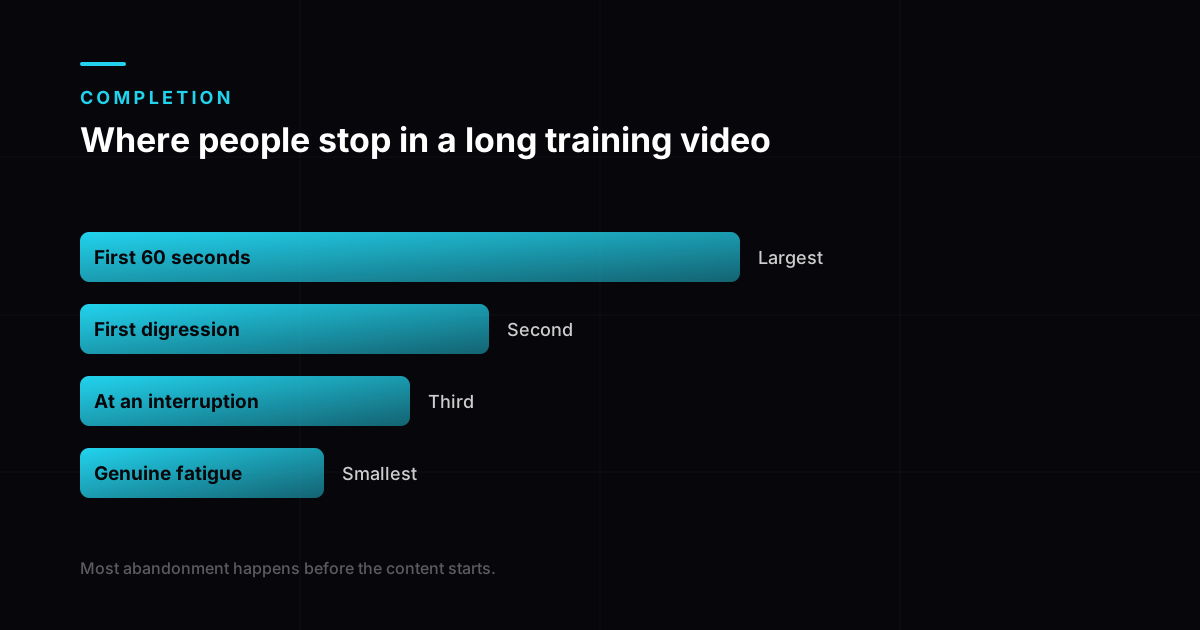
Abandonment is not evenly spread across a module, which is why an average completion figure hides the fix. It concentrates in three places, and each has a different cause.
- First 60 seconds: no reason to care yet
- Largest share
- Around the first digression
- Second largest
- At the first interruption, never resumed
- Third
- Genuine fatigue near the end
- Smallest
Indicative shape rather than measured percentages. The point is the ordering. Most abandonment happens before the content has started, not because the content was too long.
That ordering redirects the fix. Rewriting the opening minute costs almost nothing and addresses the largest share; shortening the whole module is expensive and addresses the smallest. Captions help with the third case, and they are an obligation anyway: WCAG requires captions on pre-recorded video with audio at Level A. How long a training video should be covers splitting, and our training video service builds libraries to be resumable rather than sat through.
The two obligations hiding in this
Two of the fixes above are not optional preferences. Captions are required rather than recommended: WCAG requires captions on pre-recorded video with audio at Level A, so a library without them is non-compliant regardless of what it does to completion. And the underlying problem is larger than any single module. Gallup finds only 12 percent of employees strongly agree their organisation does a great job of onboarding. If your completion figures are poor across the whole library rather than on one module, the issue is what the training is for rather than how long it runs.
Frequently asked questions
What is a good completion rate for internal training video?
Commonly cited industry figures put average corporate training completion near 45 percent, with microlearning-style short modules reporting around 80 percent. Treat those as rough aggregates rather than benchmarks, because completion varies enormously with whether training is mandatory, how it is assigned and whether the system enforces sequential viewing. The more useful comparison is your own library against itself: which modules hold people, which lose them, and what the first group does differently.
How short should each chapter be?
Short enough that finishing one feels like a small task rather than a commitment, which usually lands somewhere between three and eight minutes. The more useful rule is one idea per chapter. If a chapter covers two things, viewers cannot find either of them later, and findability is what makes a library worth keeping.
Do talking-head presenters help or hurt completion?
A present, competent presenter generally helps, because a human face carries attention better than slides with narration. What hurts is a presenter reading visibly from a script in a flat register, which is worse than no presenter at all. If you cannot get a comfortable delivery, clear graphics with good narration is the safer choice.
Should training video be updated or replaced when policy changes?
Updated, if the format allows it. Replacing a whole module because one section changed is what causes libraries to go stale, since the cost is high enough that teams postpone it indefinitely. Building modules as discrete chapters is what makes a targeted update possible. Updating training video without a reshoot covers how that works in practice.