How Often Should a Brand Post Reels? A Realistic Cadence
Three to five reels a week is a strong cadence for most brands, but the number matters far less than holding it without gaps. A consistent two a week sustained for a year outperforms five a week abandoned after a month, because the compounding comes from the streak rather than the volume.
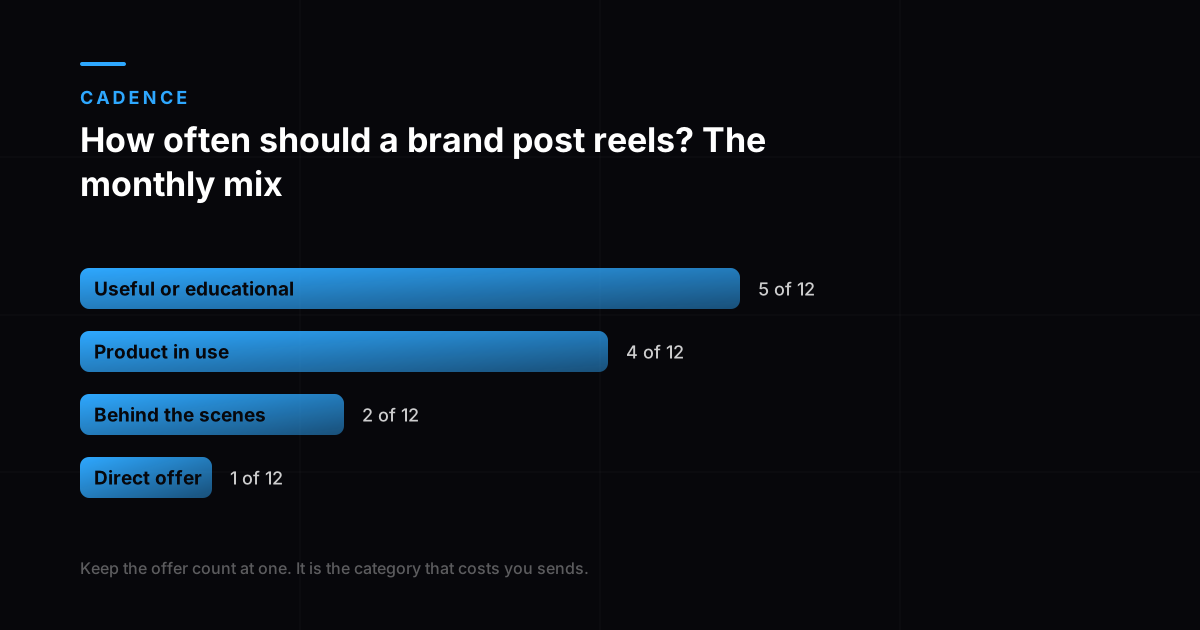
How often a brand should post reels: pick a cadence you can hold
Not your best month. Your worst one. Cadence plans built around an enthusiastic January collapse in March, and the collapse costs more than the lower number would have.
| Cadence | Suits | Realistic if |
|---|---|---|
| 2 per week | Small teams, one owner | You have a content plan and no dedicated person |
| 3 to 4 per week | Most e-commerce brands | Production is outsourced or batched |
| 5 to 7 per week | Growth-stage, social-led brands | Someone owns this as their actual job |
| Daily | Creators and personality-led brands | The founder is the content |
Why gaps cost more than a lower number
- Distribution favours accounts with recent, regular activity. A month of silence resets momentum you paid to build.
- Your audience forgets. Attention is a habit, and habits break faster than they form.
- You lose the learning loop. Every gap is a gap in data about what your audience responds to.
- Restarting is harder than continuing. The first post after a break consistently underperforms.
Batch, do not improvise
The reason most cadences fail is that each reel is treated as a separate project. Plan a month at once and the cost per reel collapses. It is the same economics as paid creative: the first video carries the concept and the rest reuse it, so twelve planned together cost far less than twelve decided one at a time.
- One planning session per month. Decide every topic and hook for the next four weeks.
- Group by format, not by date. Produce all the demos together, all the talking-head pieces together.
- Keep a running list of hooks that worked. Rebuild proven structures with new ideas rather than starting fresh.
- Hold back two finished reels as a buffer. That buffer is what survives a bad week.
Make the mix serve the ranking signals
Instagram’s own ranking explainer confirms its main reel signals as watch time, sends per reach, and likes per reach, with sends carrying roughly three to five times the weight of a like for reaching people who do not follow you.
That is worth holding next to your content mix, because the categories are not equally good at producing sends. Useful and educational content gets forwarded to a specific person, which is the behaviour that opens the account to strangers. Direct offers almost never get forwarded. A feed weighted toward offers does not just annoy people, it starves the one signal that drives new reach.
What to post, at that frequency
| Share | Type | Purpose |
|---|---|---|
| 40% | Useful or educational | Saves and shares, reaches new people |
| 30% | Product in use | Converts the audience you already have |
| 20% | Behind the scenes or founder | Builds trust and familiarity |
| 10% | Direct offer | Sells, without becoming the whole feed |
A feed that is 100 percent product stops getting distributed, because nobody shares an advert. A feed that is 100 percent entertaining builds an audience that never buys. The mix is the point.
- Useful or educational
- 5 of 12
- Product in use
- 4 of 12
- Behind the scenes or founder
- 2 of 12
- Direct offer
- 1 of 12
Twelve reels a month against the 40/30/20/10 split. Rounding matters less than keeping the offer count at one. It is the category that costs you sends.
Batching a month in one session
Twelve reels is a planning problem, not a filming problem. Written as twelve separate tasks it never happens; written as four groups of three it takes an afternoon. Pick four topics, script three angles on each, and shoot or generate them in one run. The mix above then falls out of the plan rather than being reconstructed weekly under pressure.
This is also the argument for producing them rather than improvising them. A month batched in advance survives a bad week; a feed dependent on weekly inspiration does not, and gaps cost more than a lower cadence. Why consistency beats one viral reel covers why, and our monthly reels service exists because holding cadence is the part most brands cannot sustain alone.
What to do when you miss a week
Missing a week is not a catastrophe and should not be treated as one. The damaging pattern is not the gap itself, it is the response to it: a fortnight of silence followed by five reels in two days to catch up, which produces weaker work and teaches the system nothing consistent.
Return to the normal cadence at the normal quality and let the streak rebuild. Instagram's ranking explainer describes distribution as predicted per reel from signals like completed watches and reshares, so a rushed batch of weak reels does more damage than the silence did. Each one is measured, and each one lowers what the next is expected to achieve. Hold two finished reels in reserve and the situation stops arising. Consistent reels versus viral covers why the streak is doing the work.
Frequently asked questions
How often should a brand post reels?
Three to five a week works well for most brands, and two a week is genuinely fine if that is what you can sustain. The number is less important than the absence of gaps, because the compounding comes from the streak. Pick the figure you could still hit during your busiest trading period, then treat it as a floor rather than a target.
Is posting once a day too much?
Not inherently, and it is only sustainable when someone owns social as their actual job or the founder is comfortable being the content. The failure mode is not frequency, it is quality collapsing to fill a schedule. A run of rushed posts teaches your audience to scroll past you, which is more damaging than posting less often.
What happens if I miss a week?
One missed week is recoverable and not worth panicking about. What does real damage is the pattern that usually follows: a missed week becomes a missed month because restarting feels harder than continuing. Publish something modest rather than nothing, and protect the streak even when the quality bar slips slightly.
Should I post at specific times of day?
It matters far less than it used to, because short-form distribution is driven mostly by how a video performs rather than by who happens to be online when it lands. Your own analytics will show when your audience is active, which is worth a glance, but posting time is a small optimisation and consistency is a large one. Do not let timing debates delay publishing.
How many reels do I need before I see results?
Expect a quarter of consistent posting before the data is worth acting on, which at three a week is roughly forty videos. The first several weeks mostly teach you about your own production process rather than about your audience. Anyone promising meaningful results from a handful of posts is describing luck.
Does posting more often reduce reach per reel?
Not in the way people fear. Instagram ranks each reel largely on its own predicted performance rather than rationing distribution per account, so a second reel in a day is not competing against your first for a fixed allowance. What does cause a drop is quality falling as volume rises: if hitting a number means shipping reels with weaker hooks, the average performance falls and the weaker ones drag the account signal down with them. The honest test is whether your fifth reel of the week is as good as your first. If it is not, the cadence is too high for your current process, not for the algorithm.