Why Your Reels Stopped Getting Views (And How to Fix It)
Reach usually collapses for one of seven reasons: a watermarked or recycled file, content that reads as unoriginal under the 2026 originality weighting, a weak first two seconds, posting inconsistently, format fatigue, chasing trends that do not fit your audience, or content that gets views but not saves and shares. Your own retention graph tells you which one applies. Two 2026 changes matter for diagnosis: account-level consistency now carries more weight than any single post, and viewers can tune their own Reels feed by topic.
Know which signals actually rank you
Instagram has been unusually direct about this. In its own ranking explainer, the platform names the predictions that matter most for reels: how likely you are to reshare it, to watch it all the way through, and to like it. Adam Mosseri has put the same three in that order of importance: watch time, sends per reach, then likes per reach.
| Signal | What it is | Weight |
|---|---|---|
| Watch time | Whether people keep watching, especially past 3 seconds | Highest |
| Sends per reach | How often people share it in a DM | Roughly 3 to 5 times a like |
| Likes per reach | The obvious one | Weakest of the three |
The middle row is the one most brands are not managing. A DM share is the strongest signal available for reaching people who do not already follow you, and it is worth several times what a like is worth. Likes skew toward distribution among your existing followers; sends are what open the account to strangers.
That changes what you should be making. Content optimised for likes is content people approve of. Content optimised for sends is content somebody wants a specific person to see, which is a much higher bar and a different creative brief: useful enough to forward, funny enough to forward, or so precisely aimed at a situation that it names someone in the viewer’s head.
Three 2026 changes that affect the diagnosis
The signals above have been stable for a while. What moved in 2026 is the frame around them, and each change alters which explanation for a reach drop is the likely one.
First, originality became an explicit input. Reposted, watermarked and recycled-without-addition content is down-ranked, and that now catches clean uploads republished unchanged, not just watermarked ones.
Second, and more consequential for diagnosis, weight shifted toward the account rather than the individual post. Fanpage Karma’s 2026 analysis of the algorithm describes distribution leaning on consistent patterns over time instead of judging each upload cold. That is why a single good reel no longer rescues a bad month, and why the recovery timeline below lags the way it does.
Third, viewers gained direct control over their own Reels feed, naming topics they want more and less of. This one is worth knowing precisely so you do not over-diagnose: some of your reach variance is now audience preference being expressed deliberately, and no hook rewrite addresses that. It is also why Reels deserve a proportionate share of the effort, with Reels reported at 46 percent of US time spent on Instagram and more than half of its ad inventory.
Diagnose before you change anything
Open the analytics on your last ten reels and note two numbers for each: the percentage still watching at 3 seconds, and the number of sends and saves. Those two columns identify the problem faster than any general advice.
| Symptom | Likely cause | Fix first |
|---|---|---|
| Low 3-second retention | The hook | Rewrite the first two seconds |
| Good start, steep drop at 5 to 8s | The setup is too slow | Cut the introduction entirely |
| Watched to the end, few shares | Not useful or surprising enough | Change the idea, not the edit |
| Reach fell suddenly across everything | Watermarked or recycled files | Export from your own edit |
| Reach declined slowly over weeks | Format fatigue | Change format, not frequency |
| Spiky, unpredictable reach | Inconsistent posting | Fix cadence before anything else |
Why your reels are not getting views: the seven causes
- Recycled files. Uploading a video downloaded from another app, watermark included. Fix by exporting from your edit every time.
- Unoriginal uploads. New in 2026: a clean file republished unchanged across platforms, or an old post reposted without meaningful addition, is down-ranked on originality alone. Fix by re-cutting the opening per platform. Note that this targets recycling rather than AI production, and whether Instagram penalises AI-generated Reels answers that separately.
- A weak hook. The first two seconds decide it. Logos, title cards and greetings all lose.
- Inconsistency. Four posts in a good week then nothing for a month teaches the algorithm nothing and teaches your audience to forget you.
- Format fatigue. The same structure repeated until your own audience stops registering it as new.
- Trend mismatch. Using a trending sound that has nothing to do with your product attracts viewers who will never buy.
- No reason to share. Views without saves or shares signals content that was watched but not valued.
Consistency beats brilliance, measurably
One excellent reel a quarter loses to four decent ones a month. Short-form is a volume game with a learning loop attached, and you cannot learn from a sample size of one per quarter.
The realistic constraint is production capacity, not ideas. Most brands know what to post and cannot produce it, because filming, editing, captioning and scheduling each reel is a job somebody already does not have time for. That is the gap our monthly reels service exists to close, and how often a brand should post reels covers picking a cadence you can actually hold.
What recovery actually looks like
The expectation people bring to this is a single fix followed by a rebound. That is not the shape recovery takes, and expecting it is why brands abandon the correction two weeks in.
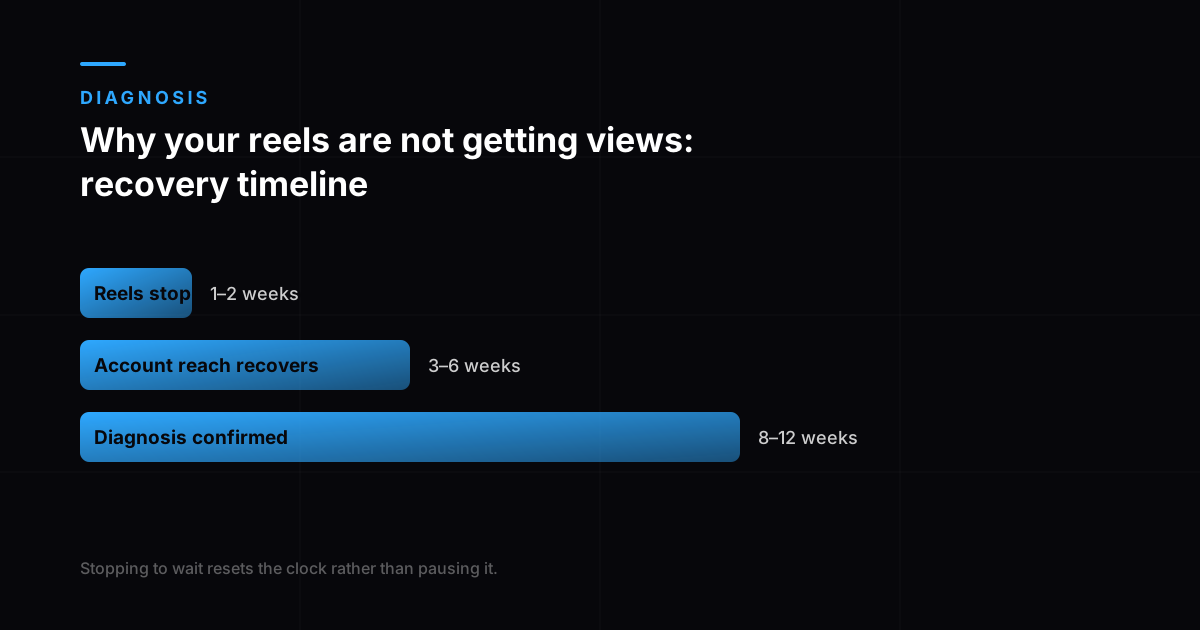
- Individual reels stop underperforming
- 1 to 2 weeks
- Account-level reach begins recovering
- 3 to 6 weeks
- Enough data to confirm the diagnosis
- 8 to 12 weeks
Assumes the underlying cause was correctly identified and posting continued throughout. Stopping to wait resets the clock rather than pausing it.
Why it lags
Distribution is decided per reel on predicted performance, and those predictions are informed by your recent output. A run of weak reels lowers the starting expectation for the next one, so the first few corrected reels are being judged against the account's recent history rather than on their own merits. The improvement has to accumulate before it compounds, which is precisely why the gap-plus-panic cycle is so destructive: each pause hands the system more evidence that the account is inactive.
The practical instruction is to change one thing, hold the cadence for a full quarter, and judge on the trend rather than the next post. Consistent reels versus viral covers why the streak itself is doing the work, and writing a reel hook that holds is where the per-reel improvement usually comes from.
What to do this week
- Take your best-performing reel from the last six months and rebuild its structure with a new idea.
- Rewrite the first two seconds of your next five reels before producing anything else.
- Set a posting schedule you can hold for twelve weeks. Two a week held beats five a week abandoned.
- Stop measuring views. Measure saves, shares and profile visits, which correlate with commercial outcomes.
What not to do while you are diagnosing
The instinct when reach collapses is to change everything at once, which guarantees you learn nothing. Four reactions make the situation measurably worse.
- Deleting underperforming reels. It does not remove them from your account history and it destroys the comparison you need.
- Posting more to compensate. Volume with a weaker hit rate lowers the average further.
- Changing format, cadence and topic in the same week. Whatever happens next, you will not know why.
- Pausing entirely to "reset". There is no reset. A gap is the one thing that reliably makes recovery slower.
Change one variable, hold everything else, and give it a fortnight. Instagram's ranking explainer is clear that distribution is predicted per reel from signals like completed watches and reshares, so the fastest lever is almost always the opening rather than the posting schedule. how to write the opening is where to start.
Frequently asked questions
Why did my reels suddenly stop getting views?
A sudden collapse across all your content, rather than a gradual decline, most often points to the files themselves: videos downloaded from another app and re-uploaded with a visible watermark. Since 2026 the same applies to clean files republished unchanged, because originality is now weighted directly. The next most common cause is a break in posting, which matters more than it used to now that distribution leans on account-level consistency. A gradual decline over weeks is a different problem and usually means the format has fatigued.
Has my account been shadowbanned?
Almost always no. Shadowbanning is the first explanation people reach for and rarely the real one, because the observable symptoms, falling reach and fewer non-follower views, are produced far more often by a weak hook, a recycled file or an inconsistent schedule. Work through those before concluding the platform has acted against you, and check whether the drop is uniform or concentrated in particular posts.
Should I delete reels that performed badly?
There is no reliable evidence that deleting weak posts improves the performance of later ones, and you lose the data about what did not work. Leave them up. The exception is content that is genuinely off-brand or misleading, which is worth removing for reasons that have nothing to do with reach.
What metric should I actually watch on Instagram?
Watch time first, then sends per reach. Instagram has confirmed those as its top two ranking signals, with likes a distant third. Sends carry roughly three to five times the weight of a like and are the strongest driver of reach beyond your existing followers, so a reel with modest likes and strong sends is performing better than the reverse even though it looks worse on the surface.
How long does it take to recover reach?
If the cause is a fixable file or hook problem, individual posts can recover immediately, since each video is largely evaluated on its own performance. Recovering an account-level pattern after a long gap takes longer, usually several weeks of consistent posting, because you are rebuilding a signal rather than fixing a single asset.
Does posting more often fix falling reach?
Only when the cause is inconsistency. If the format has fatigued, posting more of the same thing makes the decline steeper, because you are increasing the supply of something your audience has already learned to scroll past. Diagnose first: change what the reels are before you change how many there are.