How Long Should a Reel Be? Instagram, TikTok and Shorts
For most brand content, 15 to 30 seconds performs best across Instagram Reels, TikTok and YouTube Shorts. The maximum each platform allows is far longer, but distribution is driven by completion rate, and a shorter video is finished by more people. Length should be set by how long the idea takes, not by the upload limit.
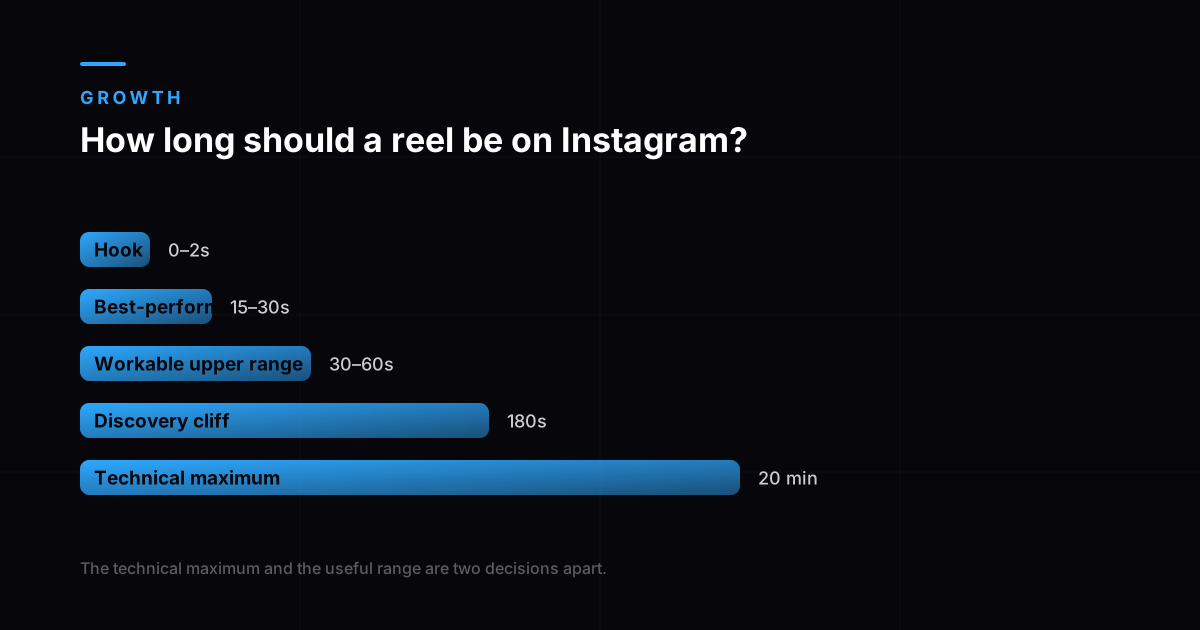
Maximum allowed is not the target
Instagram now permits Reels of up to 20 minutes, raised during 2026 from the previous three-minute cap. That number is close to useless as a guide. Every platform permits significantly longer short-form video than performs well, and treating the limit as a target is one of the most common reasons brand reels underperform.
Upload limits move, so re-check the current figure in the app before planning a format around it. The recommendation below does not depend on the limit, because the limit was never the constraint.
The three-minute discovery cliff
This is the single most useful thing to know about Reels length, and it is not a completion-rate argument. Reels running longer than about three minutes are largely not surfaced to people who do not already follow you. It follows from how the system ranks: Instagram's own ranking explainer describes reels distribution as driven by predicted reshares and completed watches, and a long reel is worse at both.
That changes what the decision is. Under three minutes, a reel can reach strangers through Explore and the Reels tab. Over it, the reel stays mostly inside your existing follower graph and behaves like a post to your own audience rather than a piece of reach. Both are legitimate, but they are different jobs, and it is worth choosing deliberately rather than discovering it afterwards.
- Hook, decides the view
- 0 to 2s
- Best-performing range
- 15 to 30s
- Workable upper range
- 30 to 60s
- Non-follower discovery cliff
- 180s
- Technical maximum
- 1,200s (20 min)
The technical maximum and the useful range are two decisions apart. The cliff at three minutes is the one that changes who sees it.
Choosing length before you write, not after
Length is a brief decision, not an edit decision. Deciding afterwards is how a 20-second idea becomes a 90-second reel: the material expands to fill whatever runtime nobody set. Pick the job first, reach or depth, and the ceiling follows from it. A reach reel gets one idea and a hard stop. A reel for existing followers can take the time the idea genuinely needs, because the discovery cliff no longer applies to it.
Whatever length you choose, the frame is fixed: Instagram publishes reel size and aspect ratio guidance at 1080 by 1920, 9:16. Shooting or generating to that from the start avoids the crop that quietly removes the bottom of your own captions.
When a longer reel is the right call
Length is not a virtue in either direction. A reel aimed at people who already follow you, answering a question they actually asked, can run past a minute without penalty. The discovery cliff only matters when reach is the job. Tutorials, process walkthroughs and founder explanations are the usual cases, and cutting them to thirty seconds to satisfy a rule of thumb makes them useless rather than punchy.
The test is which audience the reel is for. Reach reels get a hard ceiling; depth reels get the time the idea needs. Publishing both is normal, and the mistake is applying one set of rules to both. Consistent reels versus viral covers how the two fit in a monthly plan.
The related decisions are cadence and consistency rather than duration: how often a brand should post reels and why consistency beats one viral reel both matter more than any single runtime. If reach has fallen off a cliff recently, why your reels stopped getting views diagnoses that separately. We produce these as monthly sets through our social media reels service.
| Placement | Recommended length | Why |
|---|---|---|
| Reaching cold audiences | 7 to 15s | Easy to finish, easy to replay |
| Instagram Reels, brand content | 15 to 30s | Completion rate drives distribution |
| TikTok, brand content | 15 to 34s | Long enough for a hook and payoff |
| YouTube Shorts | 20 to 40s | Slightly more patient, often search-led |
| Paid social ad | 15 to 30s | Cost per result rises with length |
| Tutorial or demo | 30 to 60s | Only if the steps genuinely need it |
| Anything over 3 minutes | Followers only | Falls out of non-follower discovery |
Why completion rate is the real metric
Short-form algorithms reward videos people finish, and reward loops and rewatches more still. A 20-second video finished by half your viewers outperforms a 60-second video finished by a tenth of them, even if the longer one had more total watch time.
This is why cutting a reel down often increases its reach. You are not removing content, you are raising the percentage of people who reach the end.
The two-second rule
A reel does not fail at the end. It fails at second two. By then the viewer has decided, usually without noticing. Everything after that is delivery on a promise the hook already made. Writing that opener is its own craft: see writing a reel hook that holds.
- No logo, no title card, no "hi guys". Three seconds gone before anything happened.
- Open mid-action or mid-sentence. The context can arrive at second four.
- Put the most visually surprising frame first, not in the middle.
- Assume no sound. Captions must carry the hook alone.
How to cut a long reel down
- Delete the introduction entirely. Start at what used to be second four.
- Remove every pause between sentences. Silence in short-form reads as dead air.
- Cut any shot that repeats information another shot already gave.
- Move the payoff earlier and let the explanation follow it.
- End on the last useful frame. No outro, no subscribe card, no fade.
In our own edit suite a first cut usually gives up about a third of its runtime to those five passes without losing a single idea.
The same runtime means different things per platform
A single length does not travel cleanly across the three. YouTube classifies square or vertical video up to three minutes as a Short, so a 150-second cut is short-form there while sitting past Instagram's non-follower discovery cliff. The practical consequence is that the ceiling should be set by the platform you are optimising for, and a cut built for Reels reach will always be safe on Shorts. The reverse is not true.
Frequently asked questions
How long should a reel be on Instagram?
Fifteen to thirty seconds for most brand content, and seven to fifteen if the goal is reaching people who do not follow you yet. Instagram allows up to 20 minutes as of 2026, but that is a technical ceiling rather than a recommendation. If your idea genuinely needs forty seconds, use forty. What does not work is padding a fifteen second idea to fill the available time.
What is the maximum length of an Instagram Reel?
Twenty minutes as of 2026, raised from the earlier three-minute cap, for both in-app recording and uploads from your camera roll. The more useful number is three minutes, because past roughly that point reels largely stop being shown to non-followers, which means the practical ceiling for anything intended to grow an account is far below the technical one.
Do longer reels get less reach?
Yes, through two separate mechanisms worth keeping apart. Longer videos are finished by fewer people, and completion is one of the strongest distribution signals in short-form. Separately, past around three minutes a reel drops out of non-follower discovery altogether. The first is a gradual effect; the second is closer to a cliff.
Should a reel be a different length on TikTok and Shorts?
Slightly. TikTok audiences tolerate a little more length than Instagram, and YouTube Shorts viewers are the most patient of the three, partly because many arrive through search with an intent rather than through a passive feed. The practical approach is one master edit and a marginally longer cut for Shorts, rather than three separately conceived videos.
Is there a minimum length for a reel?
Nothing meaningful from a distribution point of view, and very short videos can perform strongly because they loop, and loops count as rewatches. A seven second reel that gets watched three times is a strong signal. The risk with very short videos is not the length, it is that there is often not enough substance to justify a share or a save.
Does a reel need to fill the whole time to get watched?
No, and trying to is a common cause of weak performance. End on the last useful frame. Outros, subscribe cards and slow fades all extend the runtime without adding value, which lowers completion rate on every single view. Stopping abruptly at the payoff is better than trailing off politely.