The First Two Seconds: Writing a Reel Hook That Holds
A reel is decided in the first two seconds. A hook holds attention when it opens on tension, a bold claim or a pattern break, not on a logo or a "hi guys" intro. The hook is both what is said and what is seen: a strong line over a static opening frame still loses.
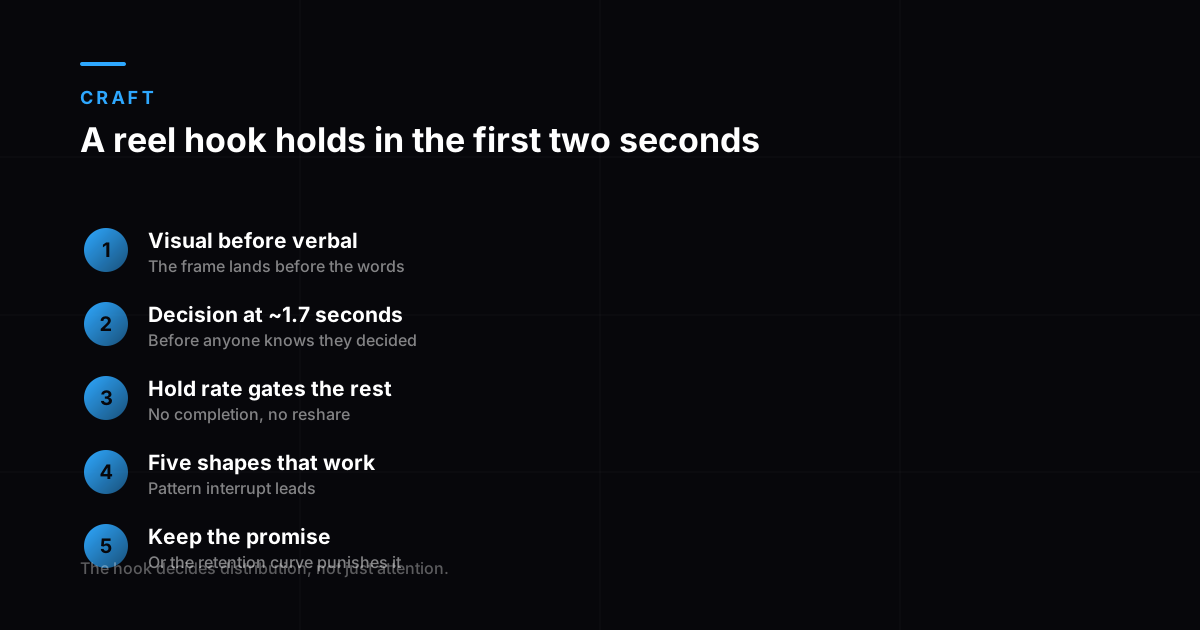
A reel does not fail at the end. It fails at second two, before the viewer has consciously decided anything. So the whole job is the opener, and how long the reel runs barely matters if that opener misses.
What makes a reel hook hold in the first two seconds
- Hold: open on tension, a bold claim, a question, or a visual pattern break.
- Lose: a logo, a title card, or "hi guys, welcome back". Three seconds gone.
- Say the most interesting thing first, not last.
- If the first line would not stop your own thumb, rewrite it.
The hook is visual before it is verbal
Most advice about hooks is about the words. The words are half of it. A viewer scrolling a feed sees your first frame before they process a single syllable, and if that frame looks like nothing is happening, the thumb keeps moving while your excellent opening line plays to no one.
A strong opening frame has motion already underway, a face mid-expression, or something visually unusual enough to interrupt the pattern of the feed. A weak one is a person sitting still about to start talking, which reads as a video that has not begun yet.
- Start mid-action rather than before it. The hand is already reaching, the pour is already happening.
- Put your on-screen text up on frame one, not after a beat. Many viewers read before they listen.
- Avoid opening on a wide establishing shot. There is no room in two seconds to establish anything.
- Check the first frame as a still. If it would not stop you as a thumbnail, it will not stop anyone as a hook.
How fast the decision actually happens
Reported figures put the average continue-or-scroll decision at around 1.7 seconds. Not two seconds as a rule of thumb: less than two, before most viewers could tell you they had decided anything.
What follows from that is the number worth managing. Three-second retention, sometimes called hold rate or the inverse of skip rate, is the share of viewers still watching at the three second mark. Typical skip rates sit around 20 to 35 percent, and anything above 40 percent means the opening is not doing its job.
Why that particular number carries so much weight is visible in how the platform ranks: Instagram's ranking explainer describes reels distribution as driven largely by predicted completed watches and reshares. A viewer lost at second two contributes to neither, so hold rate is not one metric among several. It is the gate the others sit behind.
Five hook shapes that work
Published three-second retention benchmarks by hook type point in a consistent direction, and it is worth noticing which end of the table the familiar marketing openings sit at.
- Pattern interrupt
- 72% to 84%
- Curiosity gap
- 65% to 78%
- Direct question
- 58% to 72%
- Bold claim
- 55% to 70%
- Problem
- 50% to 65%
- Social proof
- 45% to 60%
Published 2026 benchmarks. Note how narrow the spread is between the best and worst opening: roughly 25 points separates the strongest hook type from the weakest, which is a large enough gap to decide a reel and small enough that execution within a type matters as much as the choice of type.
Social proof sitting last is the useful surprise. Opening on a testimonial or a rating feels persuasive and performs worst of the six, most likely because it reads as advertising immediately. The visual pattern interrupt performs best, which is also the only one on the list that survives being watched on mute with no captions.
The contradiction
State something that runs against what the viewer expects to hear. It works because a contradiction creates an open loop, and open loops are uncomfortable enough to hold attention until they close.
The specific claim
A precise, concrete statement about a result or a method. Specificity signals that there is real information coming, whereas a general claim signals an advertisement. Numbers help here, provided they are true.
The named audience
Address exactly who the reel is for in the first line. You lose everyone else instantly, which sounds bad and is usually good: a smaller, correctly-targeted audience watching to the end beats a large one leaving at second three.
The mistake
Open on the error the viewer is probably making. This works because it is about them rather than about you, and because the implied promise, that you will explain the fix, is one people want kept.
The visual pattern break
Something unexpected happens on screen with no verbal setup at all. Useful when the product itself does something visually interesting, and the only shape on this list that survives being watched on mute with no captions.
| Hook shape | Example opening | Best for |
|---|---|---|
| The contradiction | "Posting more is why your reels stopped working." | Categories where the usual advice is wrong |
| The specific claim | "We cut three seconds off every reel and reach doubled." | When you have a real number to stand behind |
| The named audience | "If you sell skincare on Meta, this one is for you." | Narrow niches worth more than broad reach |
| The mistake | "You are lighting this the wrong way round." | Teaching and how-to content |
| The visual pattern break | No line at all. Something unexpected happens on frame one. | Mute-first feeds and visually interesting products |
The promise problem
There is a way to write hooks that holds attention at second two and destroys the reel at second six. It is the hook that promises more than the video delivers. Retention graphs show it clearly: a strong start followed by a cliff.
This matters beyond a single reel. An audience that learns your openings oversell stops trusting them, and the hooks get progressively less effective on the same people. Whatever the hook implies has to arrive, and ideally arrive quickly.
How to actually write them
- Write the hook last, once you know what the reel genuinely delivers. Writing it first tends to produce a promise the video then has to chase.
- Write ten and throw away eight. The first three are almost always the obvious ones.
- Read them aloud. A line that reads well and sounds stiff is a line nobody will believe on camera.
- Cut every word before the interesting one. Most hooks improve by deleting their first four words.
- Test hooks against each other rather than debating them. Same reel, two openings, let the retention decide.
That last one is the only reliable method, and it is why volume matters so much in short-form. Opinions about hooks are cheap. Retention data is not, and you only get it by publishing. More on that in why consistency beats one viral reel.
Why the hook decides distribution, not just attention
The first two seconds are usually discussed as an attention problem. They are really a distribution problem, which is why the stakes are higher than they look.
Instagram's own ranking explainer describes reels distribution as driven largely by how likely a viewer is to watch through and to reshare. Both of those are decided at the opening: a reel abandoned in the first two seconds cannot be completed and will not be sent to anyone. The hook does not merely win the view in front of it, it determines whether the platform offers the reel to the next thousand people.
That is the mechanism behind the gap in performance between a strong and a weak opening. It is not that a good hook is somewhat better; it is that a weak one removes the reel from circulation before the rest of the video is ever assessed. How long a reel should be covers the completion side of the same signal, and why your reels stopped getting views covers what it looks like when this goes wrong at account level.
Testing hooks without remaking the reel
The practical advantage of treating the hook as a separate component is that it can be tested on its own. Keep the body identical, change only the first two seconds, and publish three versions across three weeks. Any difference in performance is attributable to the opening, because nothing else moved. That is a real experiment, and it costs one edit rather than three productions.
Doing that monthly builds a list of openings that work for your specific audience, which is worth more than any general advice about hooks including this article. If the constraint is producing the variants rather than writing them, that is what our social media reels service handles.
Frequently asked questions
How long is a hook, exactly?
Reported averages put the continue-or-scroll decision at roughly 1.7 seconds, so functionally you have under two. Treat second one as the visual hook and second two as the verbal one. The metric to manage is three-second retention: typical skip rates run 20 to 35 percent, and anything above 40 percent means the opening is not working.
What is a good retention rate for a reel?
At the three-second mark, above 60 percent is strong and below 40 percent is a problem. The gap matters more than the number: reels holding above 60 percent have been reported reaching 5 to 10 times further than those below 40, from the same account. If your analytics show a steep fall in the first three seconds, fix the opening before changing anything else.
Should the hook include the product?
Only if the product is the interesting part. Opening on a product shot when the product is unremarkable to a stranger is effectively opening on an advertisement, and people are practised at scrolling past those. Opening on the problem, the result or the surprising claim and bringing the product in a few seconds later usually holds better.
Do hooks work the same on Reels, TikTok and Shorts?
The principle is identical because the scroll behaviour is identical. The tone differs: TikTok audiences tolerate rougher, more direct openings, while Reels skews slightly more produced. Write one hook, then adjust the delivery per platform rather than rewriting from scratch. Reels vs TikTok vs Shorts covers the wider differences.
Can I reuse a hook that worked?
Yes, and you should. A hook shape that performs is a template, not a one-off, and repeating a proven structure with new specifics is one of the fastest ways to raise your average. What fatigues is the exact wording, not the underlying shape, so vary the words and keep the structure.
How many hooks should I test before deciding one works?
At least three against the same body, and more if the results are close. One reel outperforming another tells you very little, because reel-to-reel variance is large even with identical content. What you are looking for is a hook shape that performs repeatedly across different subjects, not a single high number. Three variants over three weeks is the smallest test worth drawing a conclusion from, and the conclusion should be about the shape rather than the exact words.