Why Posting Consistently Beats One Viral Reel
One viral reel a quarter loses to four decent reels a month. Short-form rewards supply and consistency: the algorithm keeps surfacing brands that keep showing up, and volume is what lets you find the hook that works instead of guessing at it.
Everyone wants the viral one. Almost nobody plans for the boring truth: consistency wins short-form, not luck. The uncomfortable part is that this is not really a claim about algorithms. It is a claim about learning.
Consistent reels vs viral: why supply wins
- The algorithm favours accounts that post regularly, not accounts that post once and vanish.
- More reels means more chances to find the hook that lands. Volume is the test.
- A quiet month resets the momentum you built. The feed forgets fast.
- Four decent reels teach you more about your audience than one lucky hit.
Virality is an outcome, not a plan
The reason chasing virality fails is structural. You cannot execute it. There is no brief you can write that reliably produces a hit, which means a strategy built on getting one is really a strategy built on waiting.
What that looks like in practice is a team that spends three weeks on one ambitious reel, publishes it, watches it do ordinary numbers, and then spends two weeks demoralised before starting the next one. Five weeks, one data point. Meanwhile the account posting twice a week has ten data points and a much better idea of what its audience responds to.
The viral reel you want is probably not the one you get
This is the part that surprises people who finally get a hit. A reel that travels a long way usually travels because it was broadly entertaining, and broad entertainment reaches an audience with no particular interest in what you sell.
The follower spike looks good and behaves badly. Those followers did not come for your product, so your engagement rate drops as they sit inert in your audience, and your next few reels reach a diluted pool. It is common to have a worse month immediately after a hit than before it.
What consistency actually buys you
Evidence
Every reel is a test of a hook, a format and a subject. Post four a month and after a quarter you have twelve results and can see genuine patterns: which openings hold, which topics get saved, which formats get shared. That is not algorithmic favour. That is a research programme. Paid creative behaves the same way and the numbers are documented: Motion's analysis of 578,750 Meta creatives puts the winner rate near 5 percent, which is why volume beats deliberation almost everywhere in short-form. How to A/B test video ads applies the same logic to paid.
Speed
The tenth reel takes a fraction of the time the first one did. Not because anyone is working faster, but because the decisions that took a week of debate the first time have become defaults. Consistency is how a team gets fast, and getting fast is what makes consistency sustainable.
Presence
Short-form audiences do not remember brands they see once. They remember brands they keep seeing. Being reliably present is a different asset from being briefly enormous, and it is the one that supports a business.
Why the viral reel flatters you
There is a mechanical reason a big reach number can coincide with a bad month, and it is visible in what Instagram actually ranks on. In its own ranking explainer the platform names its top three signals as watch time, sends per reach, and likes per reach.
Note that two of the three are ratios against reach. A reel that travels a long way to a broad, uninterested audience pushes the denominator up while the numerator stays flat, so your sends per reach and likes per reach both fall. The account looks, to the ranking system, like it just published something people did not engage with, because proportionally that is what happened.
Steady posting to a well-matched audience produces the opposite shape: smaller reach, healthier ratios. That is the version the platform rewards, and it is why the boring answer keeps winning.
The two strategies over one quarter
| Over three months | One viral reel a quarter | Four decent reels a month |
|---|---|---|
| Results to learn from | One, and only if it lands | Twelve |
| Reach | Large, broad, mostly outside your category | Smaller, matched to your category |
| Sends and likes per reach | Fall, because reach is the denominator | Hold or improve |
| Followers added | Many, largely inert | Fewer, plausible buyers |
| Production speed | Resets with every attempt | Compounds; the tenth is the fastest |
| The following month | Often worse than the month before | Steady |
Pick a cadence you can actually hold
The most common failure is not laziness. It is ambition. A team commits to daily posting, sustains it for three weeks, misses a day, misses a week, and stops entirely. The account then looks worse than if they had never started, because an abandoned feed signals something to a visitor that an inactive one does not.
- Choose the number you could still hit in your busiest month, not your calmest one.
- Two a week held for a year beats daily held for five weeks.
- Batch production so a bad week does not break the schedule. Filming four at once is barely harder than filming one.
- Keep a small buffer of finished reels. The buffer is what turns a cadence from a weekly panic into a routine.
On the specific question of what that number should be, how often a brand should post reels goes into it properly. If your existing reels have stopped performing, why your reels stopped getting views covers the usual causes, and writing a reel hook that holds is where the per-reel work starts.
- One viral attempt a quarter
- 1 result
- Two reels a week
- 24 results
- Four reels a month
- 12 results
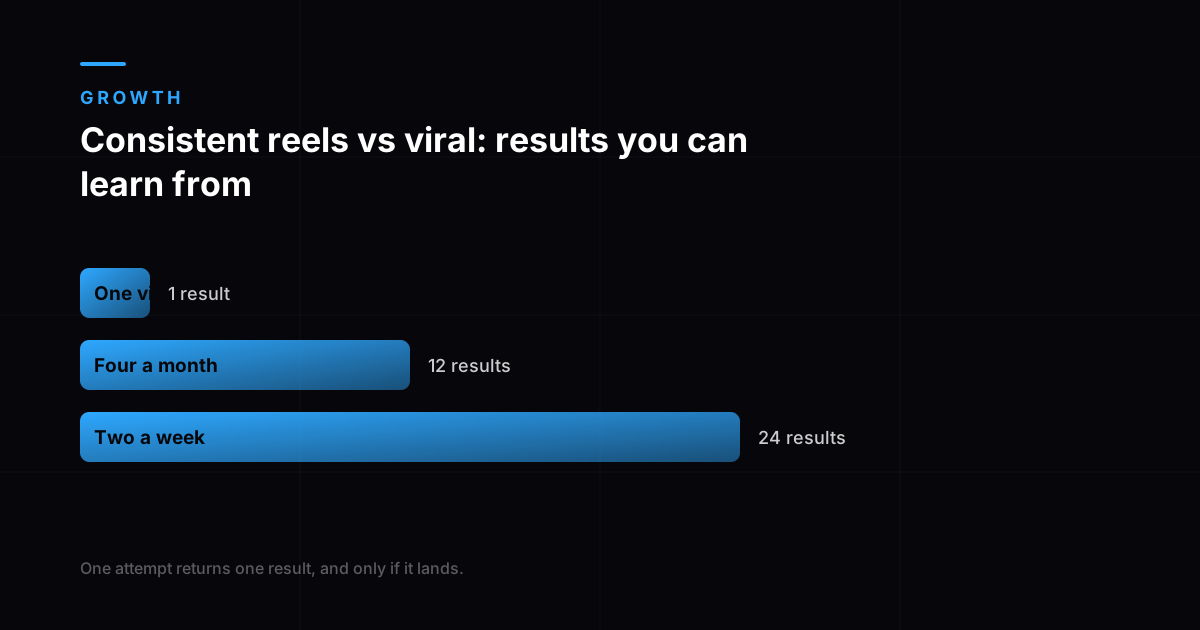
Each published reel is one test of a hook, a format and a subject. The ambitious single attempt produces one data point, and only if it lands.
That is the case in one picture. The viral strategy is not merely riskier, it is uninformative: one attempt returns one result, and a miss returns none. Twelve returns a pattern you can act on: which hooks hold, which subjects travel, which formats your audience ignores. Supply is not just more chances at a hit. It is the only way to learn anything reliable about your own audience. If holding that cadence is the constraint rather than the ideas, our monthly reels service produces the month in one batch.
Frequently asked questions
How many reels a month is enough to see results?
Enough to produce evidence, which realistically means at least four and comfortably eight. Below four a month you are learning too slowly to correct course within a quarter. The right number is the highest one you can sustain for a full year without the quality dropping, because a cadence you abandon costs more than a slower one you keep.
Is it bad to post too often?
It is bad to post more than you can make well. There is no meaningful penalty for frequency itself, but quality falls off a cliff when a team is scrambling to fill a schedule, and a run of weak reels teaches your audience to scroll past you. If the choice is four good ones or twelve rushed ones, take the four.
What if a reel goes viral? Should we chase that format?
Look at who it reached before you chase it. If the reach came from your actual category, repeat the format deliberately and see whether it holds. If it came from a general audience with no connection to what you sell, treat it as a pleasant anomaly rather than a signal, because building a content plan around it will pull you steadily further from the people who buy.
How long before consistency starts working?
Expect a quarter before the data is worth much and two before the compounding is visible. The first month mostly teaches you about your own production process rather than about your audience. Anyone promising a transformation in three weeks is describing a lucky hit, which is exactly the thing you cannot plan for.
Is it better to post a mediocre reel or skip the day?
Skip it, but fix the reason you had nothing ready. A weak reel does more than underperform on its own: it is measured against your own audience, so a poor hold rate and low sends tell the ranking system your recent output is worth showing less. One gap does not do that. The real answer is neither, though. A cadence that depends on having an idea that morning is the problem, and two finished reels held in reserve removes the choice entirely.
Does consistency mean posting at the same time every day?
No. Posting time is one of the most over-discussed variables in short-form and one of the least consequential, because reels are distributed by predicted interest over days rather than served chronologically to followers. Consistency here means a reliable number of reels per week, not a fixed slot in the calendar. Optimising the hour while missing two weeks is exactly backwards.